Showing posts with label Tonic Water. Show all posts

Monday, 31 December 2012

Fentimans & Bloom Pre-mixed Gin & Tonic


Fans of the site will know that I have a penchant fro premixes and it has been a puzzlement to me that no-one had made a very decent pre-mixed gin and tonic so imagine my intrigue when I saw that Fentimans had teamed up with Bloom Gin to make a high-end gin and tonic.

This is bottled in Fentimans standard 250ml bottle and comes with a high-end price tag of £3.99 a bottle (I got mine for a discount to £3.50).

It is bottled at 6.5%ABV which as Bloom is bottled at 40% means the drink is one part gin to six parts tonic.

THE TASTE

CHILLED: OK but too bitter at the end and only a little zestiness. The gin is there but it is rather lost. Part of this is due to the alcoholic weakness of the gin.

WITH ICE: much better with ice but still decidedly mediocre. Not even a patch on a fresh made Bloom Gin and tonic; which can be superb!
Fentimans-wise I'd rather have a chilled bottle of their (non-alcoholic) ginger beer on it's own.

This combination does neither the gin the tonic or the attractive bottle justice.

In Conclusion
To my mind this disappointing product is a waste of time. The gin is not nearly strong enough and it represents poor value for money.

Thursday, 9 August 2012

Tonic Ice and the Gin that's only sold in one shop in THE WORLD!


Today I'm going to write about a special gin, one that is only available from one shop in the whole world, Taurus Gin. The shop itself is located just south of Guildford in the village of Bramley and it has its own gin to compete with the likes of the big boys to make a thrifty but tasty G&T.

To test it out I am actually going to try another experiment at the same time—to use a G'Vine iceball made of tonic water (I got the idea from YetAnotherGin). I may kill two birds with one stone!

Taurus Gin is a simple, clean gin with a good dose of slightly bitter juniper. It is a classic gin and it's perfect partner would have to be tonic.

The nice thing about the tonic ice is that the bitter aspects of the tonic come out first and the flavour profile of the drink changes as the ice melts; it starts off rather herbal and a bit floral.

What is really interesting is that the ice ball is hollow! (I discovered this when I hit it with a small Hendrick's croquet mallet/stirrer.) This gave me the idea of having the gin contained within the ice ball: I did try this but the ice ball had two holes so the gin just came out of the bottom. The idea's got potential, though.

Here are some more tasting notes for Taurus Gin:

On it's Own
nose: juniper and grainy nose with a hint of floral vanilla
taste: a very fresh and juicy gin, luscious with succulent juniper and zesty citrus and a slightly sweet finish

Gin & Tonic
I used Fentiman's Tonic for this drink. Taurus makes a really sound gin and tonic and the extra citrus from the Fentimans makes it even more refreshing. Quite excellent.

Martini
A crisp Martini, citrus with a touch of bitter spice. Decent strength, good flavour.

In Conclusion
I think Taurus is a good gin at a very reasonable price point (£12.99 a bottle)—overall very good value for money. Every drink I tried it in was of solid quality and should satisfy even the most ardent gin fan.

Wednesday, 31 August 2011

Tonic Water Update


Out second batch of tonics for tasting

Perhaps it was inevitable that the surge of interest in gin would be accompanied by a rash of new tonic waters. Further to our blind tasting on which I have posted before, we have had the chance to sample a few more.

DBS returned from a trip to Calais armed with a bunch of new tonic waters, some of them only available on the other side of La Manche, and we had a quick analysis of a dozen that had escaped us before, including some artisanal syrups/concentrates:
Look Tonic An exclusively French offering, I think. A sharp vervey tonic, light and sharp, and quite nice, though perhaps with some gins it slightly leaves a hole in the middle.
Tesco Finest Indian Tonic Water Very soft, with a sophisticated feel to it. With gin it is subtle and reveals SW4 quite well, though perhaps is a touch sweet for me. Mind you, on its own this is probably my favourite of the lot—so when my liver finally packs up and I’m forced to exist on soft drinks alone, this is what I’ll be sipping on in the corner.
Hartridge’s Very fizzy and limey. As a mixer it’s too soft and sweet, and actually a bit stomach-turning.
Heritage Indian Tonic Has an odd taste of carrots. Rather teeth-coating feel to it.
Waitrose Essential Tonic Water Fizzy and lemony, but a bit synthetic-tasting.
Fevertree Mediterranean An unexpected floral nose, like rose, perhaps. As a mixer I feel it has a bit too much going on in the middle, just as I sometimes feel about standard Fevertree.
Tonic by Carrefour Pretty neutral. OK with gin, though a bit sweet.
Hartridge’s Low Calorie Tooth-coating nastiness.
Schweppes Our control, and still a good benchmark.
Esprit de Schweppes Another French exclusive, it seems. The label says “moins amer” and “plus léger”, but to me it actually seems as if they’ve stripped out much of the sugar, leaving quinine and a bit of citrus, making it actually more bitter than most. I find this rather appealing—as if it really is stripping things back to the essence of what tonic water should be about.
Tom’s Tonic Syrup Weird, savoury, rooty smell, with citrus and dusty, earthy spice. With gin it comes across as strongly gingery with a strong bitter aftertaste. Not unpleasant, exactly, but rather too busy to be of much use in my mind.
John’s Tonic Syrup Very bitter, plus citrus peel and what tastes like quite a bit of cinnamon.

Out of all of these, the most interesting was the Esprit de Schweppes, though Tesco’s Finest probably scores as the nicest to drink on its own. But of course the real point of tonic water is as a mixer, and I find I veer away from very complex examples—God knows, many contemporary gins are complex enough, and I seek a tonic water that acts primarily as a platform for the gin to show what it’s got. The more busy tonics, such as both types of Fevertree and especially Fentiman’s, might work well with a very simple, juniper-dominated gin, but all the mid-range spice tends to quarrel with a lot of gins.

1724 tonic water
Since that tasting I have come across two more, very promising tonics. One was given to me by Chris Goulbourne of 10 Degrees C: it’s called 1724, and is named after the height above sea level where the quinine is harvested. It’s made in Argentina and I do not think it is distributed in the UK yet, but pray that it will be, as it’s the best tonic I’ve tasted to date.

South America is, of course, where quinine comes from, but Chris tells me that moreover the continent has a long-standing tonic water style that is different from that typically enjoyed in the UK. He explains that the ingredients are carefully selected, the water for its purity, the plants are organic, etc. I can’t find much of this on the website (which, oddly, has Spanish headings on the English language version and vice versa), only lifestyle marketing guff. But the tonic itself does somehow taste fresh and real, leaving others seeming rather synthetic. It has something in common with Esprit de Schweppes, in that it is light, sharp and clean, leaving a blank canvas for the gin to express itself. But I’d say it had a defter, more sophisticated palate, almost an extra subtle dimension to it.

One final tonic water is Thomas Henry, a sample of which DBS gave me recently. Despite its English-sounding name it actually hails from Germany. To me it has a lot in common with 1724, with a sharp, clean taste that frames gin well. In the fact the marketing makes it clear that all Thomas Henry products are strikingly bitter, which they see as an “intense and mature” flavour profile.

Admittedly I have whatever you would call the opposite of a sweet tooth, so these tonics may not be to all tastes. But I do think that they would partner well with the current generation of gins that are rich, spicy and perfumed, and particularly those that have more of a sweetish profile, such as G’Vine  or Adnam’s Copper House Distilled Gin (not that I’ve tried these combinations yet—if I can get my hands on a supply of 1724 I certainly will).

1724 tonic water is rigorously tested against Schweppes with a range of gins


Saturday, 23 July 2011

A new Perfect Partner for SW4 - The Gin of Champions?

This lazy weekend, I have experimenting with Thomas Henry drinks, a range of German mixer. Starting with their tonic, I tried it in a variety of guises, but the most enjoyable was clearly in a Gin & Tonic. My gin of choice was SW4, the gin of Champions. It's getting to the stage where I have tried nearly 50 different varieties of tonic water and I must say that, along with 1724, Thomas Henry is one of the "new kids on the block" that makes superb drinks.


I used the standard 40% ABV SW4 in a 2:1 (Tonic:Gin) ratio with Thomas Henry's Tonic Water. Here are my tasting notes:

There's an initial burst of freshness; the tonic brings out a lot of the citrus notes from the gin, but the juniper is still rather prevalent. This is a drink that is exceptionally refreshing, rather delicious and a great way to cool down on a hot evening. Unlike many tonics, Thomas Henry's does not overwhelm the drink, nor does it bring any unwelcome flavours or cloying textures. A great complement that enhances the gin, rather than covering it up.

For more information on Thomas Henry Mixers: http://www.thomas-henry.de/
For more information on SW4 Gin, check out their brand new website: http://sw4gin.com/

Friday, 17 June 2011

Tonic Water Review: 1870 mixers

I've been waiting to try Silver Spring 1870 tonic for a little while now, but it has been difficult to come by. So, as you can imagine, I was quite pleased when I saw today that my local Waitrose had started to stock both the Regular and Light (diet) varieties. At £0.69 a bottle (1ltr), I thought it was worth a try.

1870 Tonic is produced by Silver Spring of Kent, a company that was founded in 1888 as a mineral water company. They produce the rather tasty Perfectly Clear (a range of flavoured water) and make a variety of own-brand soft drinks for British supermarkets (Morrisons, Asda & Tesco).

According to their website, the 1870s mixer range started to be developed during the 19th century (hence 1870?). The tonic waters are the result of Brazilian Essential Oils being expertly blended with pure sparkling spring water.

The Rather Pleasantly Packaged 1870 Tonic Waters


The Taste


Regular
This had a medium fizz, but was rather artificial in its sweetness and cloying. There was also a harsh, soil-like bitterness. Of the 30+ tonic waters I have tried, this is below average. It improved when gin was added, but still had a cloying aftertaste and lacked any depth of flavour.

Light
There was obvious artificial sweetness form the outset; the kind that sticks to your teeth. This tonic water left a really nasty taste in my mouth. Once again, the taste slightly improved when gin was added (frankly what doesn't?), but this didn't hide the fact that the drink was off-balance and unpleasant. If it hadn't been for the use of Plymouth Gin (a waste on reflection), this would have been one of the worst Gin & Tonics I have ever had.

Upon looking at the ingredients list, it appears that both the Regular and the Light versions of the tonic water contain the artifical sweetener Aspartame. Whilst I can accept its use in a low calorie version, its inclusion in the regular version seems hard to defend. Even if costs were an issue, it should be noted that Waitrose's Regular own-brand tonic water contains no artificial sweeteners and is actually sold for only £0.47 per litre.

In Conclusion
It is unusual that I am overtly negative about a product, but in this case I'd avoid these two products and if you are in Waitrose, buy their brand instead.

Waitrose Tonic is available at around £0.47 for 1 litre (diet and twist of lime and twist of lemon varieties are also available).

Tuesday, 1 February 2011

Budget Gin & Tonic

THE BUDGET GIN AND TONIC


In the world of drinks there is decadence aplenty; maybe you fancy a £500 dram of whisky or a goblet of wine with the world's largest black pearl dissolved in it? But what about the other end of the spectrum? Can you get a quality drinks for pennies in the pound?

A staple favourite of our readers is the Gin & Tonic and, with £45-a-bottle gins and small bottles of tonic costing upto £2.50, the cost of a single double-measure serving of this beverage could quickly creep to over £4.55—and that's from the comfort of your own home, acting as your own bartender!

So I wondered, was it possible to find a very respectable (and tasty) gin and tonic for less than £1 (that's one hundred new pence). Saving the theatrics, the answer was "Yes".

Here is the solution:


The Gin
Oliver Cromwell London Dry Gin (Original)—£10.99 for one litre from Aldi. (100ml = £1.09)
Bottled at 37.5%, it's a good gin and great value for money. On its own it's OK but when mixed with tonic it's a gin that competes with the best of them.

The Tonic
Waitrose Regular—£0.49 per litre (or £2.09 for a six-pack of 250ml cans). (Sometimes this is available in a 3 for 2 deal, giving you even more savings.)
This has a good balance of sweetness and bitterness, and no overbearing artificial taste like many.

So the combination: a good example of a gin and tonic, you have juniper, you have a citrus you have a bitter edge and it is very refreshing. For 60p it is a bargain and you wouldn't feel like you were one step away from the bath-tub gin or cutting your Gordon's Gin by adding more water to make it go further.


Monday, 8 November 2010

Update from the lab.

Here in the Institute's south coast branch, with a plentiful supply of lightning storms to power my Vermouth Interocitor and my Quinine extractor, I have been busy with a few home-made projects.

Update from the Lab: 8th Nov 2010

#1 Mincemeat Vodka & Mincemeat Liqueur
I was inspired to make this by an end-of-the-aisle display in my local hypermarket. I added mincemeat to vodka (no sugar was required, as mincemeat
has sugar enough already) and left for a week, shaking at intervals.

Vodka: I was surprised at how much flavour has been infused into the vodka; the smell of the fruits and spices is there and that is represented in the taste. On the downside, the finish is a little harsh, but I think that this may be better for mixing in cocktails, whilst the liqueur may be better for sipping.

Liqueur: This is essentially the former spirit, diluted with extra water and sugar. The flavours of the mincemeat are still very present and Mrs. B says it reminded her of Stollen and Christmas. She is very keen for me to try using it in a hot cocktail.

#2 Ginger Tonic Water Syrup
This was my first attempt at making Ginger Ale Syrup, but it really turned out more like Ginger Tonic Water.

On it's own: This is an odd one; it definitely isn't ginger ale, but it has a savoury-ness and an understated sweetness that is hard to place. The ginger comes through, as does the bitterness from the Cinchona bark, but it is not as tart or tangy as tonic water syrup.

With Gin: Initially, this tasted just like a gin and tonic, but towards the end the bitterness is replaced by a gingery warmth; rather odd, but Mrs. B liked it.

#3 Ginger Ale Syrup
This was created in a similar way to the Ginger Tonic syrup, apart from the additional of lemon zest, the exclusion of Citric Acid and Cinchona Bark, and, before any water was added, the sugar, ginger and lemon were caramelised together. OK, it was the same as the Tonic syrup in that it contained ginger, water and sugar!

On it's own: As with all syrups, the trick is getting the right dilution. After a little experimentation, we were left with a sweet ginger ale, with a bit of citrus and a little fire towards the end; spicy, but not blazing. Quite nice for a first go.

With Gin (Gin Buck): The gin is more dominant and, in order to get the ginger through, I had to add more syrup, making it sweeter. For the next batch, I think I need a bit more ginger and a less sugar. A work in progress.


What I'm drinking:
It seems to be the latest trend in London Bars, a Gin & Tonic in the "Evans" style: garnished with both Lemon and Lime, citrus bliss! (I used Oliver Cromwell Gin & Waitrose Tonic)

What's Next?
Can one man make his own Old Tom Gin?

Sunday, 7 November 2010

Tonic for the troops

The guinea pigs prepare for the blind tasting
Although I often find myself sampling gins neat, I seldom actually drink gin that way for pleasure. Part of gin’s recent surge in popularity is precisely its versatility as a cocktail ingredient, but let us not forget the humble gin and tonic, which is how I suspect a lot of people almost always drink their gin. (It was for just this “silent majority” that SW4 gin was created.)

Mr Bridgman-Smith tests gins exhaustively in about 16 different ways: I’m not sure my tastebuds or my liver have the stamina, but you certainly can’t get the measure of a gin without trying a G&T. Yet it has always niggled with me that if you’re really comparing different products this way then you surely can’t ignore what probably makes up at least two thirds of your drink—the tonic.

DBS explains his elaborate scoring system. He is roundly ignored
It’s not surprising that we’ve seen a rise in the range of tonics out there too, with recent arrivals Q and 6 O’Clock joining Fever Tree and Fentimans which have been around a few years, and venerable brands such as Schweppes and Britvic. A couple of months ago we had a spontaneous tasting at one of our regular ginthusiast nights at Graphic, but DBS was determined to formalise the process and so, last Monday, we returned to blind-taste eight tonic waters.

Just as gin started life as a way of both making crap spirit taste better with a juniper infusion and as a way of preserving the medicinal benefits of juniper, so tonic water began in the days of the Raj as a way of making the daily anti-malarial quinine dose more palatable by diluting it with water and adding sugar. Inevitably someone realised it was even more palatable with gin in it.

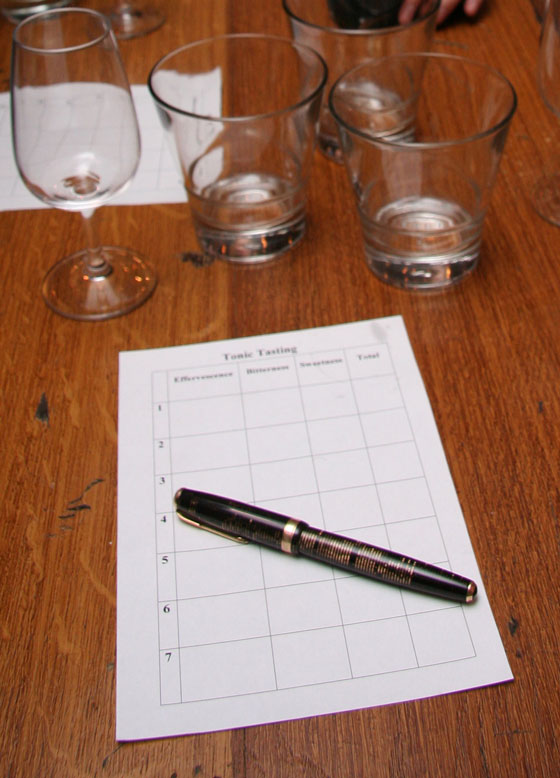
My scoring grid, before I cover it in tonic-spattered
tasting notes that ignore the categories of bitterness.
sweetness and effervescent DBS has carefully laid out
Quinine itself came originally from South America. In 1638 Countess Chinchona, wife of the Spanish Viceroy in Peru, was cured of a fever by a local healer using bark from the native quina tree; this popularised the substance across Europe, where it cured Charles II and Louis XIV, and the tree acquired the botanical name Cinchona Officinalis after the countess. However, the bark seems to have been in use in Rome (surrounded by malarial swamps in those days) at least as early as 1631, having been brought back by Jesuits (in fact it was known as “Jesuit’s bark”). The active ingredient quinine took its name from the native word for the tree, though “cinchona” turns up in the names of fortified wines like Kina Lillet and China Martini, which both contain extracts. Peru and the other countries where it grew outlawed the export of trees and seeds, and the bark became rare and precious, but eventually seeds were smuggled out to Indonesia and the tree became widely cultivated in Asia and the West Indies.

Mind you, modern tonic waters have much less quinine (but apparently still enough to make them fluoresce under UV lighting—there’s something you can try at home), although tonic is still recommended for treating nocturnal cramps. In fact anyone genuinely wanting to take therapeutic quinine might be interested in a concentrated tonic syrup that DBS and I were given to try by Louis Xavier Victor-Smith of Hendrick’s. It’s called Battersea Quinine Cordial though I don’t think it has actually had a commercial release yet. I thought it was yummy.

The quinine cordial they don't
want you to have
However, the Battersea Quinine Cordial was not among the tonics we tasted on Monday, although we had been sent a phial of John’s Tonic Syrup all the way from Arizona—it comes as a concentrate and you add soda water.

We initially tasted the tonics neat and DBS asked us to rank them in order of preference. Although the blindness of the tasting was laudable, owing to a shortage of glassware we had to taste the samples one at a time, which meant you somehow had to remember the flavours of all of them to make a comparison. DBS, ever the instinctive taxonomist, does like to know which of any group of samples is your “favourite”, but I often don’t have one—I’m just interested in the differences. Here are my tasting notes, in the order we tasted—bearing in mind that at the time I did not know what I was tasting in each case:

Tesco own brand Lime on the nose and palate. A bit one-dimensional. Quite sweet, lacking in bitterness. Not very effervescent.

Schweppes More fizz, more dominant bitterness, less citrus than the last one. Not much happening in the aroma department.

Britvic Very effervescent, giving an interesting mouthfeel. Balanced citrus notes. Nose is more complex than previous two.

John's Tonic Syrup, handmade at the Tuck Shop
restaurant in Phoenix, Arizona
John’s Tonic Syrup This one is frankly brown, which is a bit of a giveaway (although, as we didn’t even know which tonics were on test, I guessed it was David’s own homemade tonic syrup, which is pretty terrifying). This one was unexpectedly savoury and vegetal, with an extraordinary spicy, herbal nose and earthy root flavours. Plenty of bitterness—perhaps too much for drinking on its own. Leaves a disturbing tide mark of interesting scum around the glass. Overall, quite intriguing, but a bit outside the comfort zone if tonic water is what you're after.

Fever Tree Good mouthfeel from the balanced effervescence. Plenty of citrus on the nose, although unfortunately it reminds me of some cleaning product. Good level of bitterness, though a shade too much for drinking on its own. Good balance of lemon and lime, though the taste seems a bit crude.

Schweppes Slimline Big citrus nose—though not backed up on the palate, which is pretty empty. A slightly austere mouthfeel. Overall a bit watery, which at least makes it easy enough to drink on its own.

Fentimans Rather an overwhelming nose of citrus. Big exotic flavours, including lemongrass, are a giveaway: although we weren’t trying to identify the brands, Fentimans is pretty distinctive.

6 O’Clock Very bold! Nose does have a hint of varnish but on the palate it is rather tasty.

Obliged to rank them, I put Schweppes and Britvic joint first, 6 O’Clock third, Tesco fourth, Fever Tree fifth, Fentiman’s sixth, Schweppes Slimline seventh and poor John’s tonic last. In truth I was only certain about the last three, and even then I think Fentiman’s is actually quite nice but too overwhelming as a mixer. Likewise the brown syrup is fascinating but not what I look for in a tonic water. (Or perhaps it just takes a bit of getting used to?)

The winners, by popular vote
As a group, our overall rankings put Schweppes first, Britvic and Schweppes Slimline joint second, Fever Tree and Fentimans joint fourth, Tesco and 6 O’Clock joint sixth and John’s syrup limping in lasting place. Apparently these are pretty standard results for this sort of blind test, and in fact mirror a home tasting that DBS held, where Britvic came out a surprise winner.

I don’t drink tonic water on its own, so I had no real yardstick to compare against; but I do drink G&T, and we now had a chance to taste the top three (plus 6 O’Clock, for curiosity’s sake I guess) with gin (Bombay Sapphire in this case). I added Fever Tree too, because it is what I usually drink at home. The results were a bit different:

Britvic Dominated by citrus and sweetness—too sweet for my tastes.

Schweppes Less sweet than Britvic and more citric than Fever Tree. Has a sort of neutrality about it; arguably a benchmark taste for what a tonic “should” taste like.

Fever Tree Compared to the others this is all about mid-range notes for me, warm and almost spicy (Fever Tree don’t say what goes into it but do mention “botanical oils”), compared to the high citric notes that dominate some others. It’s probably worth experimenting with matching different gins and different tonic waters.

6 O’Clock Rather nice, though I kept getting an odd hint of mustard (I was alone in this observation). This tonic was actually created to match with 6 O’Clock gin, a combination I’d be keen to try.

Schweppes Slimline Doesn’t taste much of anything.

The lesson? Well, if you’ve always used the same tonic you might well be surprised by the differences if you shop around. Mind you, if your default tonic is Schweppes then this test at least shows that you can rest assured life is not passing you by.

Tuesday, 21 September 2010

Just the tonic!

Sarah from Graphic with the remains of our five-way tonic test
I've long been an advocate of Fever Tree tonic, a fact that annoys Mr Bridgman-Smith as he feels that much pro-Fever Tree opinion is just dogma. He likes Fentiman's and also—the result of a blind tasting of his own—Britvic. My experimentation with Britvic has suggested a rather artificial sweetness and citrus spike. So at the Fifty Pound tasting at Graphic last night we, and some other ginthusiasts, held an ad hoc five-way blind tonic test. In each case the tonic was mixed 2:1 with Fifty Pound gin.

I'm pleased to say that, after some head scratching, I did guess all five correctly. Q tonic (which, on its own, I've previously thought was distinguishable by not tasting of much at all—at great expense) emerged has actually having rather an odd taste; Sarah from Graphic put it well by saying it tasted like a mouthful of soil.

Fentiman's was the most striking: very bold flavours of lime and lemongrass. I can see why the staff think of it as a nice soft drink on its own, but too overbearing as a mixer.

Schweppes, oddly, was the one the identity of which I was most confident about—even though I would characterise it by its neutrality. Which is perhaps why it is the default tonic for many when it comes to G&T tastings.

And the two I had the most difficulty distinguishing? Fever Tree and Britvic! I can't really explain this, though in combination with gin the differences are obviously eroded. I would also expect that different gins would partner better or worse with different tonics. I would describe Fever Tree as having a mid-note complexity (where Britvic was more "scooped", emphasising high citrus notes and a bottom-end sweetness) and as I am a fan of gins like Miller's, which I think of as having a steely, high-note character, perhaps this explains my positive feelings towards it.

The results were interesting enough for us to decide to have a proper tonic test in the future. One candidate is something I wouldn't have thought to try but which Philip Wilson from Eaux de Vie recommended—Asda's own label. Watch this space.

Wednesday, 15 September 2010

I'll drink any Gin but that!

Or, Gordon’s Gin, An Apology

One of the best drinks in the world is the Gin & Tonic and in the last 75 years it has gained many fans. Back in 1930s America if you had asked for a Gin mixed with tonic you would have probably been asked to leave (the establishment’s Squire presuming that to order such a hideous mixture you must have had too much already).

Well gone are those days and today many bars and homes are full of discerning Gin & Tonic drinkers, each with their own pet recipe.

Two things I often hear when being told the perfect method for preparing this libation are:

#1 the tonic has to be Schweppes (maybe Fevertree depending on how well-heeled the drinker is)

#2 the Gin should NOT be Gordon’s. (Bombay Sapphire or some such luxury brand seems to be preferred). Indeed Gordon's Gin is often looked upon with disdain, but what many folks don't realise is that there is more to this Gin than that familiar resident of a public house’s optics.

Gone are the days of Gordon’s making Lemon, Orange, Grapefruit or even Mint flavoured Gin or using Jamaican Cane Sugar as the alcohol base but there are still some alternatives to the contents of that famous Green bottle.

Current varieties include:

#1 Gordon's Green (UK Domestic) 37.5%*
#2 Gordon's Export (International) 37.5%
#3 Gordon's Export (International) 40%
#4 Gordon's Export (International) 42%
#5 Gordon's Export (International) 47.3%
# Gordon's Distiller's Cut 40%


Having compared the export to the domestic Gin I was convinced that the recipe was different as they certainly don't taste the same. However I have been reliably informed that they are in fact made from the same recipe but as they are not all made in the same place, differences in the water used and the people making it may result in some flavour fluctuations.

From a blind taste test the Export Gin (37.5%) certainly goes better with tonic than it's domestic counterpart. The 40% version provides a little extra kick and makes for a more citrusy and refreshing drink. The 47.3% (a personal favourite) makes a good example of a Gin & Tonic although it is a bit on the strong side. This version of the Gin is also perfect for recreating a Classic Vesper.

Which leads us to the Distiller's Cut, the premium version of Gordon’s which comes in a clear, silver labelled bottle but is a little tricky to come by. The suggested garnish for a Gin & Tonic made with Distiller’s Cut was strawberry but I ignored that and garnished it only with ice. It makes a lovely Gin & Tonic; it's soft and smooth and has a delicious flavour of stem ginger. This is not a typical London Dry gin but it does make some ruddy good drinks!

So there is more to Gordon’s than Gordon’s Green but as for the domestic variety itself, there is a reason why it sells well and there is a reason why it came out as the "Perfect Pour" when mixed with Britvic Tonic at recent industry taste test; that is because it is not as bad as many make out and all it needs is another chance.

*Alcohol By Volume