Showing posts with label gorse. Show all posts

Monday, 16 March 2020

Cornish gin update 2.0


Back in Cornwall last summer I popped once again into John’s Liquor Cellar in St Ives to see if they had any new local gins in. What they suggested this time was Caspyn Midsummer Dry Gin, made by Pocketful of Stones who have a distillery just outside Penzance in Long Rock. In fact the man behind the distillery is a displaced South African, Shaun Bebington, but the lure of the coastal life he grew up with drew him from London where he’d been running a pub. The name Caspyn came from a Neolithic stone circle near the distillery: it’s actually called the Merry Maidens—apparently Bebington misread a sign that was actually an acronym: CASPN, “Cornish Ancient Sites Protection Network”, but by the time he realised his mistake the gin was named.

I was immediately taken by it: the nose is a perfumed tapestry of citrus and other fruits—blueberries, pears, melons—with cucumber and dry spice like cumin. On the tongue it is fruity and spicy, with a curious salty finish (what could be more Cornish than that?). The cucumber is not a coincidence: the very pale green colour of the gin is because fresh cucumbers are infused in it. In a Martini it intrigues with a combination of floral perfume on the nose and a relatively savoury, vegetal palate, again with that very subtle briny finish.

In fact the Midsummer gin is a relatively recent addition, a development from the original Caspyn Cornish Dry Gin (the suggestion is that the Midsummer is nothing more than the original Dry Gin with those cucumbers infused in it). This brings us back to the old question of what makes, or might make, a gin intrinsically Cornish—last time I idly suggested gorse and brine, and Caspyn does indeed have gorse in it, which they say combines with orris to give a sherbet finish. (There is no suggestion of brine, but, as I say, I do get a hint of salt on the finish.)

Mind you, the other botanicals don’t seem particularly Cornish: floral hibiscus, citrus from lemon and orange peel, lemongrass and lemon verbena, Japanese tea. And it’s lemon that really hits you on the nose when you sniff the Cornish Dry, plus something vividly herbaceous; there is also a floral note, something like berries, and an earthy echo at the end, but overall the nose is bright and zingy. By comparison the nose of the Midsummer version is mellower, slightly waxy, with a definite cucumber note but also savoury hints like agave or dill pickle.


On the palate the Cornish Dry is sharp, dominated by that lemon zestiness, with a peppery finish. They do say the aim is to make it taste like a crisp Cornish spring morning, bright but cool. Again the Midsummer version is mellower, with the citric spike softened and more of a fleshy vegetal warmth. Maintaining the climatic analogies, the distillers say that the Midsummer gin is intended to evoke a hazy summer afternoon. Both gins are absorbing, with vivid flavours that reveal themselves in layers, inviting close contemplation, but if the Midsummer really has just had cucumbers bunged into to it for a while, it’s interesting how much of an effect they have had.

Of course putting cucumber into gin is not new—Hendrick’s famously do it and so do Martin Miller’s. But Hendrick’s don’t use fresh cucumber: they use a commercial essence sourced from the Netherlands (I’ve tasted it neat, and found it rather delicious). In each case it seems well established that trying to macerate cucumber prior to redistillation, as you do with normal botanicals, doesn’t work, so it has to be added after distillation. Why do Hendrick’s use an essence rather than the real thing? I guess with their multi-shot technique (essentially producing a botanical concentrate, which is then diluted with alcohol and water to boost the volume for bottling) it is perhaps too difficult to get a strong enough flavour this way. The Caspyn Midsummer certainly achieves a distinct cucumber flavour, which balances deftly with the other flavours.

I like both these Caspyn gins. After I first tasted the Midsummer I decided I wanted to post about it but, tellingly, I got through it so quickly I had to order another bottle, along with a bottle of the original Cornish Dry for comparison. As I write this both bottles are nearly empty. This tells you all need to know. They are vivid and inviting, with a smooth spirit base that makes them all too easy to drink neat.

But of course most of us don’t drink gin neat most of the time. I was afraid that the Cornish Dry’s pronounced fresh lemon effect of the lemon peel, lemongrass and lemon verbena, when combined with the citrus thrust of most tonic waters, might be too much, but in fact it works well. What seems to come out in this combination is a midrange herbal spiciness and a gentle earthy note. The Midsummer mixes with tonic to bring out the cucumber character, mellow and relaxed, again with an earthiness. It is savoury almost to the point of being like food.

In an Aviation cocktail the Cornish Dry slots effortlessly into the drink with poise and balance, though the Midsummer is perhaps a bit too bohemian and savoury for the floral/tart structure of this cocktail. In a Negroni the Cornish Dry again shows its classic credentials and works well, but again the Midsummer is a bit odd. In a straightforward Dry Martini the Cornish Dry is crisp and sharp, with a warm and slinky midrange perfume—very inviting. By direct comparison, the Midsummer again seems strikingly savoury; it’s nice but certainly not a classic Martini. I’m beginning to think the Midsummer gin’s natural place is in a G&T, which is probably how it was intended.


The Caspyn gins come in chunky, round-shouldered bottles with wood-capped corks for a high-end feel. The labels have hand-written batch numbers. The Cornish Dry features a picture of a basking shark, rather a local emblem in Cornwall, also featuring on Tarquin’s label, though I’ve never actually managed to see one in the flesh. The Midsummer Gin, somewhat bizarrely, features a picture of a hoopoe—an odd choice for a gin that is meant to evoke an English summer. Is this a reference to Bebington’s South African roots?

“I first started thinking about using the hoopoe whilst I was is Croatia doing some juniper research and one happened to cross my path,” Shaun tells me. “The hoopoe does reside in South Africa during the Southern Hemisphere summers but flies to Europe for the Northern Hemisphere summers, mostly to the countries around the Med. Occasionally they overshoot their migration route and end up in Cornwall. I’ve yet to see one but I’ve seen photos. I liked that it was symbolic of our occasional summers here in the UK and I liked the link between South Africa and Cornwall.”

The connection between South Africa and Cornwall has just got stronger, as Shaun tells me he is now making a version of Caspyn gin at West Coast Distillers in Langebaan, South Africa. “The South African version is made with South African botanicals,” Shaun explains. “They are very similar but whereas the Cornish version has Cornish lemon verbena and bergamot (Earl Grey tea) the SA version has rooibos, honeybush and citronella pelargonium, a lemon-scented geranium.” This recipe is intended only for the South African market, though Shaun tells me that he hopes to bring the Nightshade Gin and Mutiny Bitters made at Langebaan over to the UK.

My (virtually empty) miniature of Penzance Bathtub Gin
For reasons I forget, we stepped into a deli in Penzance, and I noticed they were selling a “Penzance Bathtub Gin”. OK, I thought, I’ll bite. But for how much? Even a tiny 50ml sample bottle was £8—the equivalent of £112 for a 70cl bottle. You’ll be pleased to hear that, if you like the stuff, you can get a better deal by buying a larger bottle now from their website, though it looks as if changes have been afoot. When I got my sample last summer it was (as you can see from the photo) sold as a bathtub gin—the joke being that Penzance’s famous Art Deco lido, the Jubilee Pool, made it a town with a vast bathtub. (And since Prohibition bathtub gin dated from the same era as the Pool, all the more reason for Penzance to have its own version.) But I see that they are now selling it simply as “Penzance Gin”—the label design has the same image of the lido, but the word “bathtub” has been removed. But I will assume for now that it is made in the same way.

I wondered which distillery had made the gin, but the label simply said it had been made in association with the Cornish Hen. Which turned out to be the deli where I’d bought it. So seemingly a very local, handmade thing. The website says it was dreamed up by three friends over a few drinks at a local pub quiz.

The current label, shown on the website
As you can tell from the colour, this is an infused gin. They have clearly bought neutral grain spirit (or perhaps just vodka from the supermarket), macerated it in their own botanical blend, and sold it on. Nothing wrong with that. Would you want to pay £8 for 50ml? Well, I wouldn’t. It is very strange stuff: on the nose there is a strong orange citrus note, but combined with something wheaty that reminds me overall of orange Club biscuits from my youth. In fact the citrus is so strongly combined with notes of wheat, and even butter, that it profoundly suggests lemon drizzle cake.

The makers do not say what goes into it, other than that it features gorse. The palate seems clumsy after the Caspyn, with the same orange peel and wheat flavours in a rather thin, astringent spirit base. And, if I’m honest, I don’t feel there is much about it that reminds me of gin. But the product seems to have taken off rapidly in a way that makes it possible the current product is not quite the same as the batch I tasted.

Caspyn Cornish Dry and Caspyn Midsummer can by bought widely online for about £39. Penzance Gin can by bought from penzancegin.co.uk for £38.

Wednesday, 28 February 2018

When is a gin Cornish?


I like Cornwall, England’s westernmost county, and regularly go on holiday there. It was on a previous jaunt, to the Roseland Peninsula, that I came across Tarquin’s Cornish Gin, which got me thinking about how one could meaningfully create a gin that seemed redolent of Cornwall itself. (Tarquin’s gin has mostly conventional botanicals from all over the world, with the only local one being violets from Tarquin’s garden.)

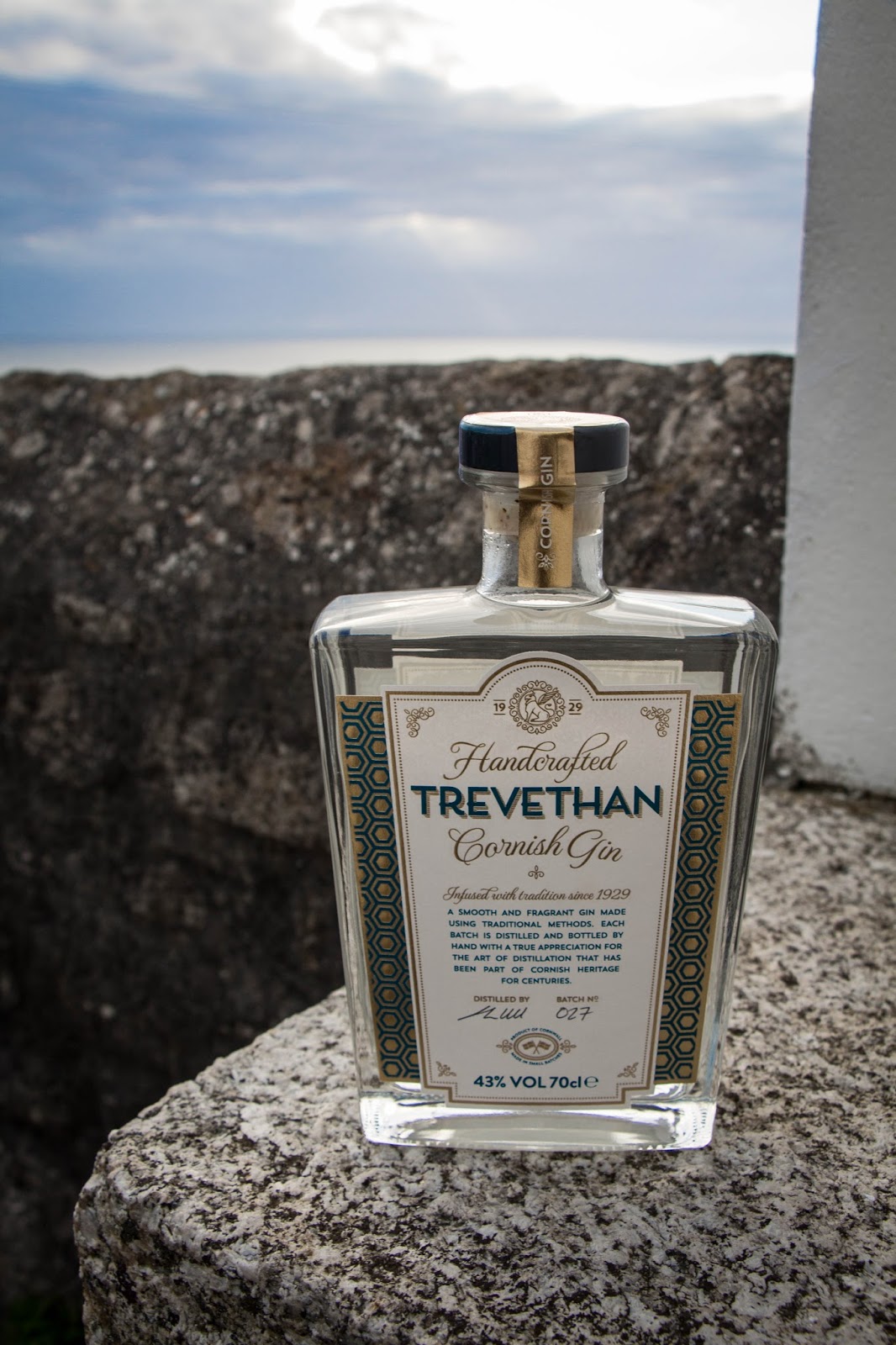
The last time I was in the area I popped into the Polgoon winery near where I was staying. I’d been before, sampled their wines and frankly found them pretty unpalatable, but I like the idea so I went back to give them another try. Their product was still unexciting (though they also make cider, which is better), so I poked around in the shop and found a whole wall of Cornish gins. More or less at random I picked three to try, Curio, Wrecking Coast and Trevethan. Each of these takes a different approach to what might make a gin distinctly “Cornish”.

Curio gin is made by the Curio Spirits Company in Mullion, west Cornwall, which is husband and wife team William and Rubina Tyler-Street. The Big Idea is that Curio uses rock samphire (Crithmum maritimum) as a botanical, which grows on cliffs in the area. It is not to be confused with the more commonly-encountered marsh samphire (Salicornia europaea), which I first came across in a fishmongers some years ago, sold as an accompaniment. I was told it grew on the coast and was only in season for about three weeks a year; later I foraged my own one summer on a flat, marshy beach in Norfolk. It has a pleasant crunchy texture and a light salty flavour. It is sometimes called sea asparagus, but it is not nearly as strongly flavoured as asparagus. Nowadays it is sufficiently fashionable (at least in London) that I see it in supermarkets all year round, imported from the Middle East and elsewhere.

Rock samphire, on the other hand, is still pretty obscure, probably because it has a strong, alarming flavour. While rambling on the coast we crossed a beach where, according to the guidebook, rock samphire grew on the cliffs; I did nibble some stalks of what I concluded must be the right plant (though Mrs H. was sceptical) and it was pretty fiery and pungent. Curio has a dominating flavour of mint, both on the nose and the palate, a sort of soggy mint with an undertone of fennel. I’m guessing this is your rock samphire, as it is also known as sea fennel. The illustration on the label shows the samphire, and also juniper and star anise (and what looks like coriander leaf but presumably isn’t). The company say that there are 15 botanicals but won’t give them away apart from samphire, juniper, star anise, cinnamon and seaweed. Mind you, there is a photo on their website which seems to show them all. How good are you at identifying them? I can also spot lemon peel, nutmeg, coriander seed, fennel sea, and what looks like ground almond and orris root powder, plus some sort of dried flower?

The botanicals that go into Curio

It's one of those occasions when I can’t really pick up on many of those, so dominating is that sweet mint/fennel thing. There is a waft of fresh lemon on the nose, and a bit of pepper and caramel on the finish. It goes well enough with tonic, but that mint flavour persists and, for me, becomes more cloying as you go on. The recommended serve is on the rocks with a pinch of sea salt. The spirit is certainly smooth neat (they say their spirits are “quadruple distilled”) and the salt adds the briny promise that is there on the label but not in the spirit itself (despite the presence of seaweed in the mix), but I can’t really warm to this gin. I am just haunted by those nagging pungent, aromatic oils.

Wrecking Coast is made at Tintagel, on an area indeed known as the Wrecking Coast because of the violent winter weather. The microdistillery uses a selection of 12 botanicals (apparently juniper, coriander, chamomile, vanilla, angelica, liquorice, orris, grains of paradise, cassia bark, cinnamon quills, lemon peel and aniseed), steeped in neutral grain spirit for 14 days, then redistilled through a computer-controlled iStill designed in the Netherlands, before being rested for a further seven days. But the Big Idea with Wrecking Coast, in fact the starting point for the whole project and the thing that makes it self-consciously Cornish, is clotted cream. In case you don’t know, clotted cream is a local delicacy, made by gently heating cream to produce a very thick, slightly caramelised end result with a fat content of at least 55%. The distillers seem to blend clotted cream with more grain spirit (I assume the fat dissolves in the alcohol) then use a separate, hand-blown glass vacuum still to redistill that mixture.* I guess they must have found that traditional heat distillation did something horrid to the taste. The two distillates are blended then diluted down to 44% ABV.

Making alcohol from dairy is nothing new—some vodkas are milk based and it was a common base for illicit Irish poitín (in fact I believe Knockeen Hills is made from milk) but I have not heard of someone mixing cream with neutral grain spirit then redistilling that.** Wrecking Coast say that the resulting drink retains the flavour of the cream while also gaining a “rich, velvety feeling in the mouth”. Certainly some spirits do have a creamy, unctuous mouthfeel, such as Sipsmith and Chase vodkas, though neither of those has any dairy in them.

The first thing that hits me on Wrecking Coast’s nose aside from mentholly jumiper, is citrus, plus lemony coriander and something herbaceous, like lemon balm. There is also a strong sweetly floral element, like violets. Particularly when sniffing the neck of the bottle I get toffee or caramel notes too. The palate is also citrus-forward plus juniper, coriander, perhaps berry fruit, and a perceived floral sweetness (orris?), which grows if you let ice melt in the gin. I also find a growing sense of that aniseed. I am much taken by this gin; I like its botanical intensity and the sweet/savoury balance. But I confess I don’t get cream. And a velvety feel in the mouth? Actually, out of the three gins on test here, this one actually has the fiercest mouthfeel, but then it is the strongest at 44% ABV.

Trevethan takes its Cornishness from its back story. In the 1920s local man Norman Trevethan was a chauffeur to Earl and Lady St Germans and would sometimes take them to events in Jazz Age London. Inspired by the cocktail culture he found there, he decided to join in by making his own gin. There was a long rural tradition of making alcohol from seasonal crops, though quite how easy it would have been for Norman to find conventional gin botanicals I do not know. Then in 2015 two industrial food and drink scientists got talking—one of them, Robert Cuffe, is Norman’s grandson and the other, chemist John Hall, heard about his friend’s grandfather and had a hankering to recreate the family recipe.

I’m not sure how much resemblance the modern version has to the original—the suggestion is that they merely “tweaked” it. I met John at the World Gin Awards judging and he told me that Rob’s mother can remember going out with Norman to gather botanicals for the gin, so I guess they must have some idea of the original recipe. The modern gin does contain elderflower and gorse flower foraged at Trewonnard Farm in Treneglos, and, like all the gins here, it is made with Cornish spring water.

Norman Trevethan
The distilling notes are enlightening. They know that Norman only made his gin in small batches, which is how they made their test recipes, but scaling that up to their 300-litre copper pot still (still “small batch” by commercial standards) meant making adjustments to keep the flavour the same. In tests they used the gorse to add a hint of sweetness but found they needed to add vanilla to maintain this at high volume, which also helps create a smooth, oily mouthfeel. They describe the profile as juniper-led, backed up by cassia and angelica, with citrus “hiding in there” and cardamom “lingering at the end of the mouthful”. Other botanicals mentioned are coriander, orange peel, lemon peel.

Compared to the other gins tasted here, Trevethan immediately emerges as more elegant and poised. I like Wrecking Coast but it is more boisterous and in-you-face, whereas Trevethan has a reserved complexity. At times I have decided it was all about coriander, then cardamom (and I think the cardamom does emerge more with dilution). Sniffing the bottle again now I get lemony citrus, balanced by warm, perfumed lower notes, definitely including cassia. Then you notice the resinous juniper. And now and then you’re hit by a sideways stab of very savoury curry notes. It is indeed smooth and oily on the tongue, though sipping it now I still feel that high, dry, aromatic coriander seed notes dominate, followed by fresh coriander or parsley leaves. On the finish I could certainly believe there is elderflower here.

Without doubt Trevethan is my favourite of these three. It’s a sort of “desert island gin” in the sense that it does the fundamental job required of a gin, without being gimmicky, but also has a complex balance that reveals different nuances at different times. Even after you’ve swallowed it the aftertastes continue to evolve. It rewards study if you want to ponder it, but it also delivers if you just want a drink without thinking about it.

Does any of these gins capture the essence of Cornwall? No, but then gin is not a quintessentially Cornish thing. Curio may well pack a big hit of rock samphire, but there is probably a reason why we don’t eat rock samphire very much. Wrecking Coast is a fun gin but does appear crude next to Trevethan, and I’m damned if I can detect clotted cream in it. Trevethan, on the other hand, make the point that theirs is traditional—because Norman was trying to create a normal gin, not trying to stand out in a crowded market by being Other.

In my rambles along Cornwall’s clifftop paths I have often reflected that, aside from brine, one powerful fragrance of the area is indeed gorse, which is everywhere and has a powerful smell, sweet and distinctly redolent of coconut. I’m not sure that, blind-tasting Trevethan, I would leap up and yell “Gorse!”, but it does have a sweet, warm, perfumed element to the nose in which I can definitely believe that gorse is playing a part.

* Conventional distilling raises the temperature of the liquid till the alcohol evaporates off and can be condensed in a second chamber. Vacuum distillation achieves evaporation by instead lowering the pressure inside the vessel. In fact lowering the pressure has the effect of causing the temperature inside the vessel to drop. Ian Hart from Sacred Gin does all his distilling this way and I believe that Oxley does as well. Clearly if you are not “cooking” the liquid the end flavours may well be different.

** Today I learned that in the early days of vodka-making it was common to distill the spirit a couple of times, then mix it with milk before distilling it again, which is much more like what Wrecking Coast are doing.