Showing posts with label bourbon. Show all posts

Monday, 7 March 2022

Instant Mint Julep

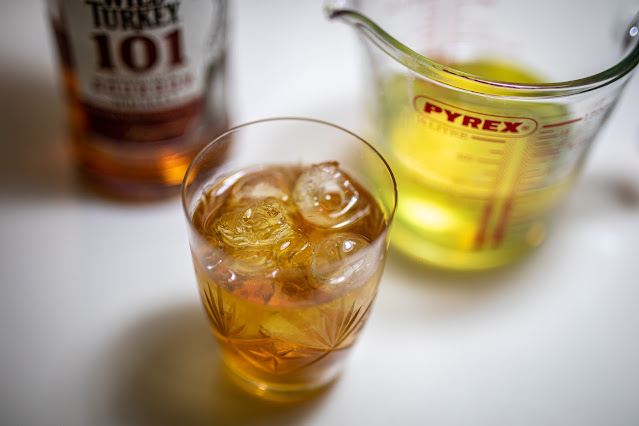
This is what the syrup looks like neat
I found myself with a glut of fresh mint after one of the Candlelight Club events. I don’t like to see food go to waste, so I’ll usually round up all the left-over ingredients and cart them home. (After Halloween, in addition to the flesh cut from the giant jack-o-lanterns, I also brought home half a dozen squashes of various kinds, which had been bought for decoration—and I’m pleased to say we made our way through all of them.)

Obviously fresh herbs won’t keep for that long, and there is only so much tabbouleh a man can eat, so I hit upon the idea of making a mint-flavoured syrup.

The Mint Julep is a classic—nay, the classic—drink of the American South, but I’ve always struggled to make satisfactory examples at home. The general idea is that you mash fresh mint at the bottom of a glass with sugar or sugar syrup before adding whiskey and lots of ice; but I always find the mint flavour elusive and the mangled shrubbery in the glass a bit unsightly.

So for this experiment I infused the mint into the syrup ahead of time, kept it in the fridge and just added it to bourbon on the rocks to make the drink. And it worked extremely well.

I did this a few months ago, so I’m a bit hazy on the proportions but I think I measured about 400 ml of granulated sugar and 200 ml or water and heated them in a pan till all the sugar was dissolved. I added two rough handfuls of mint and left it on a low simmer. I can’t quite remember exactly how long I left it—certainly no more than 30 minutes, and to be honest by the end I was sure I wouldn’t want to leave it any longer, as the mint was just starting to take on a cooked flavour. I strained and bottled it. And the result was a julep with a clearer mint flavour and no bits of greenery floating around.

To be honest, I have heard that at the Kentucky Derby—of which the Mint Julep is the official drink—they use a mint syrup, perhaps just for speed and efficiency, though I don’t know if any fresh mint is involved with that or just a commercial essence.

One caveat is that although it keeps quite well without the flavour changing, it won’t last forever. After a few months the flavour is somehow not as fresh and, like all syrups, it is at risk of mould.* And to be honest I don’t drink juleps that often, so it does tend to hang around here. But if you do have a julep habit, then you should consider making a batch of this stuff at the beginning of the summer.

———

UPDATE 23rd June 2022: I later made a second batch and this time I muddled the fresh mint continuously for five minutes in the simmering syrup, then strained it immediately. I think this is a better bet, as the flavour was no less strong, but you avoid any hint of a “cooked” mint taste.

A julep made with the mint syrup (in the jug to the right). It should really be crushed ice.


* The hardiest syrup I make is grenadine. This is traditionally made from pomegranate juice, but I was surprised to see that commercial grenadine today is mostly made from red berries. Since you can buy 100% fresh pomegranate juice in the supermarket (ever since the pomegranate was declared a super-food), it was easy enough to experiment with. For simple syrup I normally blend two-thirds sugar with one-third water, but I found that using the same ratio with pomegranate juice actually produced something that set solid at room temperature—perhaps there is pectin or something in the juice. However, at 1:1 it words a treat. The resulting syrup has a certain tannic tartness that balances the sweetness and makes it a very useful cocktail ingredient if you don’t have a massively sweet tooth. And, kept in the fridge, it seems to last an extremely long time.


Tuesday, 11 August 2015

A garden of bourbon delights


Mrs H. pointed out that we had mint growing in the garden, something that I admit hadn’t really sunk in before (I am not the green-fingered type). In fact more than once I have gone to buy some herb or other only for her to show me later that it was actually growing ten feet from the kitchen door.

So I did what any gentleman would do, and made a mint julep. I mention this only really to share with you my intense satisfaction with it: every now and then you make a cocktail where everything falls into place, as if for the first time you truly see what it is all about.

Juleps in waiting: some of the leaves that got away… this time
I took five leaves of mint and put them in a tumbler with about a teaspoon of sugar syrup,* maybe a teaspoon and a half, and muddled it. Then I filled the glass with ice** and added an undisclosed quantity of Four Roses (I used the Single Barrel, which was perhaps extravagant, though it worked well), then stirred.

You get a fresh, pungent aroma from the mint that you simply don’t get from things that are “mint-flavoured”, and this mint had been only a couple of minutes off the plant. The drink was sweetened, but not sweet, and the character of the whisky shone through. The Single Barrel is bottled at 50% so it can take a bit of dilution from the ice without seeming at all watery (and this ice adds no flavour of its own), though I tried the same recipe the next night with the Four Roses Small Batch and it worked well too.

I think I should try using more things from the garden in drinks—though I fear that it may be some years before the fruit of the lemon tree I gave Mrs H. last month will be sliced in our gin and tonics…***

* This was actually commercial syrup from Monin but you can make it yourself easily enough. Ed McAvoy (then Jameson brand ambassador) showed me the simplest way to do it: using a funnel fill a bottle, such as an empty wine or spirit bottle, two-thirds full with dry granulated sugar, then boil a kettle and carefully top the bottle up, before corking it and shaking it vigorously till the sugar dissolves.

** I used ice made in an ice tray with Isbre spring water.

*** And not everything from the garden is good to put in your drink. A few winters ago, inspired by DBS’s post about using snow in drinks, I padded out into the frosty garden and scooped some fresh snow off a plant to make a julep or an absinthe frappĂ© or some such. I forget the actual cocktail, but I vividly remember how astonishingly repulsive it was, full of strong, weird, off flavours, sour and flat, dirty and choking. To this day I cannot understand how water than has fallen frozen from the sky and landed on a leaf can have acquired such a taste, unless the air in London is seriously polluted.

Wednesday, 17 June 2015

Four Roses rises

All the bottles in the range feature the four-rose symbol moulded into the glass

I met up with James Childs of Spirit Cartel recently to talk about Four Roses bourbon. Spirit Cartel have only fairly recently taken on this brand, but it is one with a longer history than most American whiskeys.

Founded by Paul Jones Jr, Four Roses moved from Atlanta to Louisville, Kentucky, in 1884, but Jones claimed production and sales back to the 1860s. The name Four Roses has a romantic back story: Jones plighted his troth to a Southern Belle and she told him that if she decided to accept his proposal of marriage then she would wear a corsage of red roses to the forthcoming Grand Ball. On the night she was indeed wearing four roses, and Jones allegedly named his bourbon in her honour.

A Prohibition-era bottle of Four Roses sold as a medicine from a drug store
Most famously the brand continued to distil throughout Prohibition. Jones bought the Frankfort Distilling Company in 1922, a facility with a licence from the US Government to produce whiskey for “medicinal purposes” (one of only six such distilleries in the country). If that seems odd, bear in mind that many “patent medicines” of the era had high alcohol contents, even if they made no mention of this on the label or in advertising (and in some cases actually claimed not to contain alcohol). This was part of a trend for establishing acceptable (albeit veiled), domestic forms of consumption—as distinct from the unseemly and socially harmful world of the saloon. Such was the moral labyrinth of the issue, where many prohibitionists were politically dry but personally wet, that when nationwide Prohibition was finally enacted many Americans, who might have voiced their support for it, were actually taken aback by the completeness of the ban.

A liquor prescription form (written on St Patrick's Day, 1926), looking
like a share certificate or government bond (click to enlarge)
It’s worth noting that only in 1917 the American Medical Association had issued a statement that there were, in fact, no medical applications for alcohol at all. However by 1922, with Prohibition now under way, they did a volte face and declared that booze was indeed a medicine suitable for the treatment of 27 different conditions, including cancer, diabetes, asthma, snakebite and old age, and that any attempt to control such medicinal application was “a serious interference with the practice of medicine”. Surely only a cynic would suggest a connection between this and the fact that doctors generally charged $3 to issue a liquor prescription and pharmacists $3 or $4 dollars to fulfil it. In the first six months of Prohibition 15,000 doctors applied for a permit, allowing them to write up to 100 prescriptions per month.*

So now your doctor could write you a prescription for whiskey (or spiritus frumenti, “spirit of grain”, if trying to be dignified about it)—one pint every ten days. So could dentists and even vets. And it seems that, even as a medicine, alcohol’s efficacy was affected by quality and style: the Frankfort catalogue for pharmacists lists specific brands of rye, bourbon, rum, brandy and gin. Not only did some druggists do well, but some were not really pharmacies at all: one Manhattan saloon nicknamed the Hell Hole simply closed its doors, then reopened as a “pharmacy”, and carried on pretty much as before. In The Great Gatsby Jay Gatsby, clearly a bootlegger, is said to have made his money from “a lot of drug stores”…

In this 1940s postcard (left) the Four Roses name dominates Times Square; in Alfred Eisenstaedt's
famous photo of Times Square on VJ Day (right), you can make out the same sign


The American distilling industry didn’t readily bounce back from Prohibition: whiskey making needs a certain continuity because barrel-ageing is such an important part of the process. Until the recent resurgence in craft distilling and the proliferation of small distilleries all over the country, there were whole states with no real distilling tradition left at all (something Stuart Hobson of Indiana vodka was consciously trying to rectify in his own state). This put Four Roses in a strong position precisely because it had carried on producing and its brand was recognised—in fact it is believed that during Prohibition one in four bottles of bourbon sold in the US bore the Four Roses label. Until the 1950s it was the top-selling bourbon in the US. But then Seagram, who had acquired Frankfort in 1943, made the decision to focus on European and Asian markets and stopped selling Kentucky Straight Bourbon in the States, offering only a blended whiskey in that territory.** Today even the brand’s own press release describes this as “made mostly of neutral grain spirits and commonly seen as a sub-par ‘rotgut’ brand”.

But the brand was bought by Japanese brewery Kirin in 2002 and they are consciously trying to rebuild its once stellar reputation, selling only Kentucky Straight Bourbon. It seems to be going well, as Four Roses Distillery (now in Lawrenceburg, Kentucky) was named American Whisky Distiller of the Year in 2011, 2012, 2013 and 2015 by Whisky Magazine, which also inducted Jim Rutledge, Four Roses master distiller since 1995, into its Global Whisky Hall of Fame in 2013.

The single storey of the Four Roses warehouse
So what goes into the bottle? Uniquely, Four Roses use five different yeast strains and two different mash bills to make ten different bourbon recipes, which are individually barrel-aged and then blended to make their range of bottlings. They make much mention of their single-storey warehouse: Kentucky can get pretty hot, and in warehouses many storeys high the ones at the top will get hotter and the interaction with the wood will be accelerated compared to those resting at the cooler lower levels; it is also the case that the hotter barrels lose water through the wood, raising the ABV over time, while the cooler barrels lose alcohol as they age, lowering the ABV. Some facilities capitalise on this by selecting whiskey from different levels for different purposes, or rotate barrels between the different levels to even out the effects, but at Four Roses they simply store all the barrels at ground level, believing this to create a gentler and stabler ageing process. (The barrels are still stacked six-high, and even here the lower barrels lose alcohol while the higher ones lose water.)

The entry level product is Yellow Label, bottled at 40% ABV. They give no age statements,*** but there is an interesting infographic on the website revealing that this blend includes eight different whiskeys. There are two core spirits, one with a rye-heavy mash bill (60% corn, 35% rye, 5% malted barley) and the other with more corn (75% corn, 20% rye, 5% malt) and both using yeast strain K, described as full-bodied with light spiciness and light caramel. The other component spirits use four other yeasts with each of the two mash bills. Next up is the Small Batch (45% ABV), which uses the same two core spirits, plus just two others. At the top of the range (not counting occasional limited editions) is the Single Barrel (50% ABV), using just the rye-heavy mash bill and yeast V, described as “light fruitiness, light vanilla, caramel and creamy”.

Samples of the three main bottlings. The Single Barrel seems darker which might suggest
more age but it could just reflect that, at 50% ABV, it is less diluted
James gave me some samples of the three main bottlings. The Yellow Label hits you with vivid sawmill wood notes and mint, with elements of citrus, caramel and even coconut. On the palate it is surprisingly light and smooth for an entry-level whiskey, with hints of rose, strawberry and peach.

Moving up to the Small Batch the nose is immediately warmer, richer, smoother and darker. By comparison the Yellow Label has a more obviously “mealy” flavour, something that reminds me of sesame or wet plaster. The Small Batch is strikingly different, with hints of coffee on the nose and a palate that is drier and tighter (perhaps from the higher ABV, but there may also be more rye in the blend) but with sweet orange and marmalade flavours too.

The Single Barrel has a smooth and refined nose, with pronounced peach and pear elements and hints of blueberries. At 50% ABV it is inevitably dense and fiery on the tongue, but remarkably smooth considering its strength. To experiment with diluting it a little I make an Old Fashioned with it and, sure enough, the complexity unravels, with smoky, tarry and woody notes emerging, along with pear, cherry and melon fruit flavours.

I dig out a few other bourbons from the cupboard for comparison. Bulleit retails at about £28, roughly the same as Four Roses Small Batch. They are actually in similar territory—which shouldn’t be a surprise as I gather that Bulleit source bourbon from Four Roses. The two bourbons share a peachy nose, though the Bulleit seems tighter, drier and spicier to me, and the Four Roses fruiter and mellower; I’m guessing the Bulleit uses more of the higher rye mash bill than the Four Roses Small Batch.

Woodford Reserve Distiller's Select sells for about the same price here but is quite different. With a mash bill of 72% corn, 18% rye and 10% barley, its flavour strikes me as mellower, offering an expanse with more wide and high notes whereas the Four Roses Small Batch by comparison seems more thrusting, dominated by forceful mid-range intensity with strong wood and smoke flavours.

Elijah Craig 12-year-old retails for about £35, making it pricier than the Four Roses Small Batch but not up with the Single Barrel at about £40. It has a warm and inviting aroma with fruit notes and a remarkably smooth, polished palate for its 47%, with notes of chocolate orange. The Four Roses Single Barrel by comparison is dominated by that sophisticated aroma of pear and peach, a fascinating, focused and refined fragrance that you can ponder on for some time. On the palate it is steelier (it’s 50% alcohol and 35% rye); I can’t find out anything about the Elijah Craig mash bill but I’m guessing it’s more corn heavy (online hearsay has it at 75% corn, 12% rye and 13% barley). It’s interesting that the higher up you go in the Four Roses range, the more dominant rye becomes.

The Four Roses approach is intriguing: really old bourbon is always going to be less common that really old Scotch, if only because of the climate differences, but it is interesting to see the de-emphasis placed on age here and the attention given to yeast strains. To me the end result offers pretty good value in the UK. The Yellow Label is about £20–21, which is near the bottom end of bourbon prices (nothing is much less that £17–18). At £26–27 The Small Batch represents a very worthwhile step up, while the Single Barrel offers something profound that’s really worth savouring.

* For more on this see Daniel Okrent’s excellent history of Prohibition, Last Call (Scribner, 2010)

** The terms are heavily regulated. Anything called “bourbon” must be produced in the US from at least 51% corn and aged in new, charred oak barrels. There is no minimum age requirement, though to use the name “straight bourbon” it must be aged for at least two years. If there is an age statement it must be the age of the youngest bourbon in the blend. Something labelled as “blended” whiskey must still be at least 51% bourbon but it can also contain neutral spirit, colouring and flavouring.

*** Jim Rutledge has commented that “in general I’m not a fan of Old Bourbon”. It seems that each individual barrel is aged until it tastes “mature”, and with so many source bourbons to play with the emphasis seems to be more on the blending. There is a private barrel scheme where visitors to the distillery can create their own blends of the ten source spirits, and whiskey nerds post online about mixtures they have tried. There are also blends that are created exclusively for the Japanese market—although the US is the brand’s fastest-growing market, Japan is their biggest. One thing that Jim says they might try is a rye whiskey, though he admits that he will have retired before it is ready to drink.

Friday, 18 July 2014

US whiskey: it's the little things that count


DBS gets stuck in
The groundswell of “craft” distilling continues to accelerate (only today I discovered a new distillery just five miles from my house). Over here in Britain it tends to take the form of new gins, and sometimes vodkas. (There are some interesting new whisky products—Welsh whisky, English whisky—but these take so long to mature that the start-up companies tend to put out vodka and gin too, to help pay the bills while they wait.) Meanwhile in the US the number of new whiskey producers is skyrocketing too; while 99% of all the whiskey made still comes from just 13 large producers, the total number of distilleries now numbers in the hundreds, with several being the first in their state since Prohibition—it’s as if the whole industry went to sleep with the Volstead Act and is only now waking up. Some focus on very local production, buying only local grain and executing every stage of the process “from grain to glass” on their premises, yet I’m pleased to say that many of these very locally-minded products are making their way over here to the UK. Last week I was invited to a Boutique American Whiskey Tasting of eight products from four distilleries, organised by the crew behind the Boutique Bar Show and held at “classic Americana” bar and restaurant Steam and Rye.

Michael from Maverick talks us through FEW
First up was the FEW distillery, offering its bourbon and rye whiskey products. The distillery is located in Evanstown, north of Chicago: building a distillery here was a particularly bloody-minded gesture, as in the years before Prohibition Evanstown was the stronghold of the Temperance Movement. In fact it was founded as a dry community and remaining so up until the 1990s. The distillery’s name comes from the initials of Frances Elizabeth Willard, head of the forces of Temperance at the time. As another nod to the history of the period, the bottle and label design evokes the World’s Columbian Exposition held in Chicago in 1893. The FEW bourbon is a three-grain blend, mixing southern tradition with the spiciness of the rye more typical of the north—it is 70% corn (from a co-op in Indiana), 20% malted barley and 10% rye (from Wisconsin), aged in charred oak barrels. The nose hits me with wood first, plus cooked apples and oranges, and something like oatmeal. The palate has woody vanilla and meal again, with a hint of eucalyptus. It’s pretty smooth for a youngish whiskey (though there is no age statement) at 46.5%. The rye whiskey shifts the balance to 70% rye, 20% corn and 10% malt. Michael from Maverick Drinks, who handle the range in the UK, explains that rye is expensive and low yield and tricky to ferment. One new trick applied to this product was the yeast—it is a strain usually found in red wine making, specifically Syrah gown in the Loire valley. The nose has that meal quality that I’m beginning to associate with the brand, while the palate is sharp and spicy with cooked apple and caramel. And I’m convinced I’m getting a red wine angle too, with cherry and stone fruit.

An Old Forester julep
Old Forester is not actually new at all: in fact it dates back to 1870, in Louisville, Kentucky. In those days whisky wasn’t usually bottled at all but shipped in barrels and poured into decanters at the bar: there was nothing to control how much an establishment might water it down. One George Garvin Brown, a pharmaceutical salesman, noticed that quality was often poor and hit upon the idea of selling a bourbon in sealed bottles, each one signed by him to guarantee its quality. The result was “American’s First Bottled Whiskey” (technically the first exclusively bottled whiskey). In those days whiskey was frequently prescribed as a medicine (for pretty much everything), and the name Old Forester comes from that of a respected local physician who may or may not have endorsed it. Incidentally, this medicinal use of alcohol was one of the exceptions to Prohibition—yes, a doctor could prescribe you a bottle of whiskey—making Old Forester the only bourbon continuously distilled and marketed by the founding family before during and after Prohibition.* Tom from Brown-Forman tells us that Old Forester has never gone away, and in the area where it is made you see a lot of people drinking it. But as a brand it has been in the background in the Brown-Forman portfolio for a long while.

Old Forester is 72% corn, 18% rye and 10% barley, fermented using a “jug yeast” (i.e. nurtured, not chemically engineered) in open steel vats for seven days, double the time for most bourbons. Only 15 barrels are made at a time, and the barrels are made by the distillery themselves from white oak with a high toast and low char. Again there is no aged statement, but I think Tom said it was aged for about 7¼ years. We taste two bottlings, an 86 proof (43%) and a 100 proof (50%) “Signature” edition. The nose of the 86 is spicy and aromatic and for me carries a whiff of mint, which is carried over on to the palate, which is sweeter that the FEW samples. (Although this talk of sweetness and mint sounds as if I’m just imagining a julep…) The 100 proof is spicy but distinctly elegant on the nose, with a hint of citrus, and again smooth and polished on the palate.

The story of Hudson Whiskey is just as rich in strange incident. The Tuthilltown Gristmill, 40 minutes north of Manhattan in Gardiner, was purchased in 2001 by Ralph Erenzo as a site for a climbing centre. However, planning permission was refused, allegedly because neighbours didn’t fancy the idea of strangers trooping into town. The site had a working windmill, and one day a chap asked if he could mill some grain; they got talking and decided to go into the whiskey business, setting up the first distillery in New York since Prohibition. (Note that since then there are now 290 distilleries in the state, which gives an idea of just how much craft/artisan distilling has taken off.) It’s another grain-to-glass enterprise, aiming to “capture local flavour and ambience using the agricultural resources of local farmers while leaving a smaller footprint on the environment”.** They have also pioneered some interesting techniques: after someone suggested they could enhance the wood-ageing process by agitating the barrels every day, they hit upon the idea of playing bass-heavy music in the warehouse. (No one would comment, but I’m sure I’ve heard that it is, naturally, New York hip hop.)

I rather like the squat Hudson bottles
The Hudson Four-Grain Bourbon balances the richness of corn with the smoothness of wheat, the pepperiness of rye and the sweetness of malted barley. The make-up is 70% corn with 10% or each of the others. The aroma has a dusty sweet-dry quality that reminds me of halva (a Middle Eastern confection made from sweetened sesame seed paste) along with smoke and a hint of sandalwood. The palate is strong but smooth, with mint, caramel, orange and rye spice. We also try a 100% rye whiskey. This was not an easy course to take for a new distillery: as mentioned above, rye is tough to ferment, and their first eight or nine batches just turned to wallpaper paste. However, it was worth it, with the end result having a complex nose of apples, meal, toffee, caramel, prunes, kumquats, a blue smoky note and a hint of varnish. The palate is surprisingly subtle with elements of cooked apples, mint, sharp spice and cinnamon.

Finally we are introduced to Balcones, a tiny distillery built under a flyover, using handmade stills, that set out to create an entirely new tradition: Texas whisky (spelled without the “e”). Baby Blue and True Blue are the regular (46%) and cask strength (61.8% ish) version of their groundbreaking whiskey made from roasted atole blue corn meal. (Apparently all batches start out the same and any could go either the True Blue or Baby Blue route, until the master distiller decides, after which it can be shaped through the precise charring of the barrel, etc.) This is completely different from the other samples we’ve had, with a nose of maple syrup, pancakes, caramel, candyfloss and varnished wood. (Apparently the distillery is very hot, and they use small barrels, so there is a lot of interaction with the wood.) It is very soft on the tongue, with the same sugary flavours, plenty of wood and a hint of apples.

Our whiskey ambassadors at Steam and Rye
The Balcones team’s quest to push the envelope doesn’t stop there. They also produce Brimstone, made from corn smoked over a Texas scrub oak fire (the world’s first wood-smoked whisky, apparently), Rumble, made from honey, sugar and figs, and our last sample of the day, their Texas Single Malt Whisky. If I expected it to taste like single malt Scotch I was in for a surprise: the nose has more in common with the blue corn whisky, with strong meal elements, but also fruit and something strangely vinous. The palate is unexpectedly soft but with tropical fruit notes and an odd toasted aftertaste.

The lesson from all of this is that there is a hell of a lot going on in the US whiskey world at the moment. Age statements tend to be out of fashion, and you have some interesting techniques (such as the Tuthilltown bass frequency angle) to speed up the ageing process, while distilleries like Balcones are really opening up the possibilities of what you can make spirit from. The weight of tradition is much less of a marketing trope (in fact in this batch Old Forester really stands out for being so old), and instead brands identify themselves by the struggle, determination and ingenuity of the story behind the start-ups. The pioneering spirit—what could be more American than that?

* I think that there were four brands that had medicinal licences to carry on through Prohibition, of which I know Four Roses was one.

** I never thought of distilling as particularly wasteful of the earth’s resources, but this idea of “green distilling” is another trend. The Adnams distillery in Southwold has won a Queen’s Award for Enterprise for the sustainability of their operation.
Our gang at the tasting in the strange environs of Steam and Rye (I'm in the middle at the back)


Friday, 3 December 2010

A word about the Deadly Yellow Snow

A Deadly Yellow Snow in its simplest form
Reading DBS's post about his snowball experiments last night inspired me to go out and scoop up a pint glass of virgin snowflakes from the garden and attempt my own Snow Julep.

Like David I found that it pretty much impossible to drink without a straw—the liquid just sulks at the bottom of the powder.

The only solution I found was to mash the whole thing up with a spoon, producing, in effect, a Bourbon Slurpee. This looks rather pretty and holds its consistency very well: I can imagine it being a great thing to suck on of a hot summer's day.

Mind you, as I sat reading in bed last night nursing one of these concoctions I couldn't help thinking to myself that it actually wasn't very nice: it had unpleasant, bitter overtones that I put down to the mint that I found in the fridge not being in the first flush of youth.

But when I came down this morning I idly sipped the melted snow in the pint glass, expecting something, well, pure as the driven snow. In fact it was really foul, with horrible stale, dusty flavour. My wife thinks that foxes peed in the snow (but then she is convinced that everything in the garden is constantly urinated on by all of God's creatures). I suspect the truth is that the snow that lands in London has to fight its way through all kinds of pollution.

The Bourbon Slurpee serve
It's possible that DBS has a better quality of snow down in Havant. But if you're planning to experiment with snow in food or drink, you might want to taste it on its own first!

Deadly Yellow Snow
50 ml bourbon
Sugar lump
Fresh mint
Suburban snow

Place mint in a glass. Drop in sugar lump and muddle with the mint leaves. Add snow and pour in the whisky. Either drink with a straw or mix into an alcoholic Slush Puppy. Then discard.