Friday, 14 October 2011

There is Worcestershire Sauce. And there is Worcestershire Sauce Special Edition


If you thought the attempt to create a premium version of Marmite with Marmite XO was unexpected, then check this out. Lea & Perrins Worcestershire Sauce now comes in a luxury version called Worcestershire Sauce Special Edition. (In what sense a sauce can come in an “edition” I do not know. It hasn’t exactly been “edited”.)

Like Marmite XO, the bottle of the new version is larger and darker than the standard version, though not quite as weightily opulent as the black and gold makeover given to the pot that the yeasty paste comes in, with its suggestion of the decadence of a Roman Emperor, or perhaps a slightly scaled down version of Napoleon’s tomb in Les Invalides. The label on the Lea & Perrins basic sauce bottle is already dark brown and orange with gold details, and the SE mostly just adds a lot more gold. But the bottle itself has gone from clear to frosted, opaque dark brown—as if it is just not safe for mortal eyes to gaze upon the wondrous liquid inside.

Like Marmite XO, Worcestershire Sauce SE has been lovingly blended for a fuller flavour and aged for longer: normal Worcestershire Sauce is kept for 18 months, but this stuff matures for “up to” two years. Like the Marmite, it also comes with a hefty price tag, in this case £3.35. (But then it comes in a 290ml bottle, almost double the size of a normal bottle, which sells for around £1.57 for 150ml, so the price difference is not actually significant. One would have though that such a precious tincture would actually come in smaller bottles than normal, but perhaps the manufacturers know that anyone likely to buy this product is probably some sort of addict who puts Worcestershire Sauce on everything that passes his lips.)

Apparently the sauce was created in the 1830s by Worcester chemists John Wheeley Lea* and William Henry Perrins at the behest of local Lord Sandys who wanted to revisit exciting tastes he had encountered on his travels to Bengal. The story goes that the two boffins were not very happy with their concoction, and just put the barrels aside and forgot about them. It was only when they rediscovered the experiment some months later that they found it had mellowed into the murky sweet-sour-salt blast that we know and love today. The label proudly claims that it “Brings food alive!” I don’t think I actually want the food on my plate to be brought to life: mealtimes would become quite traumatic if you had to chase your sausages around the room as they begged for mercy.

As usual the precise recipe is a closely guarded secret, but the ingredients in the Standard Edition are listed in this order: Malt vinegar (from barley), spirit vinegar, molasses, sugar, salt, anchovies, tamarind extract, onions, garlic, spice, flavouring. The Special Edition contains the same ingredients but in different proportions: Malt vinegar (from barley), molasses, spirit vinegar, sugar, salt, onions, tamarind extract, anchovies, garlic, spice, flavourings.

When I compared Marmite and Marmite XO I initially thought I could taste the distinct flavour of the new spread, but when I tasted them blind I eventually had to concede that I just couldn’t tell the two apart. Would I find the same with the tangy nectar from Messrs Lea and Perrins?

To look at they are pretty much impossible to distinguish (see photo below). But tasted neat—admittedly an odd thing to do—I believe there is a difference. Regular Worcestershire Sauce has a nose of caramel, gravy and fresh sawdust, plus an Angostura-like aromatic spiciness and a strong waft of oranges—like a crate (a wooden crate) of oranges that has been boiled right down into tar. This profile continues on to the palate, where it is joined by salt, molasses and a pepper heat.

The SE version essentially follows the same profile but is indeed more intensely flavoured. But on top of that I would say there is also a pronounced lime flavour which I don’t really detect (at least not to the same degree) in the original.

Of course there is a mixological significance to all of this, because Worcestershire Sauce is an important ingredient in a Bloody Mary, and related drinks like the Red Snapper, Bloody Maria, Bloody Caesar, etc. So I knocked up a couple of Red Snappers using Master of Malt’s curious Bathtub gin:

Red Snapper
2 shots gin
4 shots tomato juice
½ shot lemon juice
7 drops Tabasco sauce
4 dashes Worcestershire Sauce
Pinch of celery salt
Freshly ground black pepper

In case you can't tell, that's the SE on the left and original on the right
One drink was made with original Lea & Perrins, the other with the SE. Any difference? Actually, yes. Of course it is hard to know how much it has to do with subtle differences of proportion in the drinks, but it did seem to have a bit more presence and that limey edge that I detected neat (and which presumably comes from the tamarind). But at the same time I wonder if one could achieve much the same effect by just using more of the sauce in your recipe.

If you’re a Worcestershire Sauce fan and fancy the improved efficiency of a more concentrated dose, or tend to use the product in a way that showcases its subtleties (erm…) then give the SE a try. After all, who knows how long it will be around.**

* What kind of a parent calls their child Wheeley? Or perhaps it was just a nickname he picked from his BMXing days.
** I wouldn’t be surprised if someone buys up a batch and decides to barrel age it even further to see what happens. Years from now VIPs will be invited to gala events where guests are able to taste a rare bottle of the ethereal 2011 vintage…

Friday, 7 October 2011

Red vermouth showdown!

DBS braces himself for the challenge of tasting 19 red vermouths
Our exhaustive blind tasting of dry white vermouths back in March has proved a continually popular post, attempting as it does to answer the question of how much difference the actual brand of vermouth makes in a Martini (and other cocktails too, but the Martini must surely be the quintessential dry vermouth drink, an obvious shibboleth and, arguably, the main reason for the liquid to exist*).

So it wasn’t long before DBS announced that he had corralled no fewer than 19 different red vermouths for a similar tasting. Red vermouth (or “Italian vermouth” as you will often find it in old cocktail books, referring to the bitter-sweet rosso style developed in Turin in the late 18th century) is based around wine, typically flavoured by infusion with various herbal and spice botanicals and fortified to around 14–17% alcohol by volume with spirit. It is not usually made from red wine, as I had always assumed, but is coloured primarily by the addition of caramel. It is invariably sweet, though often with a bitterness too—it’s part of that whole family of wines and spirits flavoured with bitter herbs that probably started as a medium for conveying and preserving the supposed medicinal benefits of the herbs. The classic bitter herb has to be wormwood, in its various strains, found in absinthe and also very much in vermouth; in fact in a recent lecture at the Boutique Bar Show, Jared Brown and Anastatia Miller (who were launching their new book on vermouth) informed us that the presence of wormwood was a defining characteristic—not unreasonably, considering that vermouth gets its name from German vermut, meaning wormwood. But red vermouths are flavoured with many other herbs and spices, citrus peel and sometimes cinchona bark too.

My (now patented) Vermouth Matrix
I don’t know that red vermouth has such an obvious quintessential cocktail as the Martini, though we went for two strong contenders, the Manhattan (in this case two parts rye whisky, one part red vermouth and a dash of Angostura) and the Negroni (equal parts gin, red vermouth and Campari).

So our tasting involved sampling all the different vermouths neat, then taking our short list and trying them in these two cocktails. So, in the order we tasted them…

1. Filipetti (15% ABV) A nose of vanilla, sandalwood, orange and perhaps cinnamon; quite pleasant though it smells surprisingly dry. On the palate, however, it is actually quite sweet, but not unpleasantly so; there is bitterness there too, and it’s pretty balanced.

2. Forteni Rosso (14.4% ABV) A more sour, dry nose, like biscuits or the sesame confection halva; a bit pungent. The palate is more bitter than the Filipetti, with a somewhat sour aftertaste. Not too bad overall, but less sophisticated than the Filipetti. We don’t know too much about the brand—it is one of DBS’s purchases from his regular trips across La Manche to Carrefour.

3. Dolin Chambery Vermouth (16% ABV) Dolin dry vermouth has found a place for itself in many bars and indeed it scored well in our own blind tasting. Their products are billed as “Chambery Vermouth”— vermouth from Chambery has AOC status, though Dolin are the last firm to be manufacturing it. This red one has a nose a bit like Coca Cola, almost leading you to expect it to be fizzy, plus a hint of ginger and something slightly “off” like decomposing seaweed. On the palate it is sticky, with a candied finish.

4. Sacred Organic Old English Spiced Red Vermouth (around 16–17% ABV) Shortly before conducting this tasting David and I had been lucky enough to visit Ian Hart’s Sacred microdistillery—which is basically a room in his house where he vacuum-distils a range of botanicals individually (after macerating the ingredients in neutral alcohol in his garden shed for sometimes weeks or months), then blends them into his Sacred Gin. But he was also considering other possibilities, such as making an absinthe and, as it turned out, vermouth. This pre-production sample was part of an attempt to make a very English vermouth, using local ingredients—this one had some 20 botanicals. It is indeed much redder than the more tawny-coloured first three samples. The nose is startlingly thyme-led, a very fresh and herbal attack. On the palate, the thyme again dominates and perhaps other woody, aromatic herbs, plus orange and sweetness. It apparently has elderberries in it, which might explain the colour, and tastes a bit like port infused with thyme. Compared to the previous samples, vanilla is notably absent.**

5. Carpano Antica Formula (16.5% AV) Carpano have been making vermouth since 1786 and this product is, I believe, a resurrection of an ancient recipe. It has been a big hit with bartenders (I’ve heard it described as a sort of universal ingredient that you just bung into everything to improve it). Since 2001 the company has been owned by Fratelli Branca, makers of Fernet Branca. Oddly the Antica Formula only comes in litre bottles, now at £30 a pop, and I was hesitant about stumping up that much for a vermouth, which one tends to use only in small doses but which has a habit of oxidizing after being open for a while. However, I ended up with the sample bottle from this tasting and I can confirm that, unlike most dry white vermouths, this one is not nearly so affected by oxidation, so it is safe to invest in a bottle. The nose is vinous and vanilla-led, and I also get chocolate, prunes and rum & raisin. The palate is complex and rich, with elements of chocolate and vanilla again, plus oranges and blueberries, yet all with a clean, bitter finish. Sophisticated and highly appealing.

6. Toso (14.8% ABV) The nose is sweetish, a bit like nougat, and you can sense the underlying wine base. The palate is mild and winey, a bit like grape juice. OK, but not very interesting.

7. Punt e Mes (16% ABV) Made by Carpano since 1870, when it was allegedly created when a customer, a stock exchange agent, asked for vermouth plus china bitters (presumably one part and half a part respectively, as the name means “point and a half”). Another story is that Carpano’s stock went up by a point and a half on the stock exchange and the company released the new vermouth to celebrate. The drink is a very dark red with a port-like and slightly sour nose and a palate that is strongly bitter, but (to me) pleasantly so. Hints of coffee (someone said Camp coffee), chocolate and anise, and something banana-esque too. Jared Brown describes it as like Antica Formula with a dash of Campari.

8. Dubonnet (14.8%ABV) Created in 1846 by a Paris chemist as a way to make anti-malarial quinine doses more palatable for French Foreign Legion troops, Dubonnet has had an international presence ever since. It has a fruity nose, “like Ribena” according to one, plus a rooty element, and perhaps a hint of dishcloth. The palate strikes me as surprisingly light, with flavours of carrot juice and grape juice. It seems sweet to me, and not especially bitter, but then we were tasting is after the Punt e Mes.

9. Casa Marteletti Vermouth Classico (16% ABV) The flagship of the Filipetti range, this vermouth has a subtle coffee/chocolate nose and a smooth, complex, sweetish palate, with definite notes of anise, menthol and coal tar; it doesn’t seem bitter to me but has a lingering dry, rooty, herbal aftertaste, probably from wormwood.

Ian Hart (far right) from Sacred, sees his product square up to the competition
10. Sacred Organic Old English Amber (ABV?) Another experiment: the subsequent production version has less thyme, but in this version the thyme if very dominant; a piney resinous nose with what I call in my notes a “see-though vividness”, which may come from the fact that it had been distilled that afternoon. (I kept a sample and I think that in time the thyme softens and integrates.) The palate is also strong, vivid and quite bitter; to me it seemed more “together” than the red version (no. 4 above), which had a “scooped” quality of pronounced bitter high note and sweet low note, but not quite enough glueing the two together in the middle. The amber reminds me of East European style bitter liqueurs, like becherovka, but without the sweetness.

11. Homemade (ABV?) David made this using the same recipe as in the dry vermouth tasting (a recipe from a booklet handed out by Plymouth gin), but using sweet (white) wine as a base, extra citrus and dark brown sugar instead of white. In my tasting notes, though, I record that it didn’t smell of much at all and had a watery palate, sweet with hints of orange and dusty spice, and none of the dominating clove power I recall from the dry white version. Not a great success.

Adam from Graphic mixes up some Manhattans
12. Byrrh (18% ABV) Another oldie, invented in 1886 in Perpignan by two brothers who were drapers by trade but, for some reason, wanted to make a quinine drink, which they initially sold through pharmacies as a health draught. It declined after the war but has recently been rising in popularity again. It has a nose of Ribena fruit and wood and, on the tongue, a drying, herbal, woody liveliness, subtly complex and evolving with a bitterness that grows on the finish. Made me want to try it mixed.

13. Stock (16% ABV) The Extra Dry version didn’t impress last time, and the tradition is carried on here. This sample had a nose of Bovril and Worcestershire sauce and a palate of Bovril and cheap ruby port, but with a really nasty, sour oxidized finish.

Robert Beckwith (l) and David Hollander assess a cocktail
14. Lillet Rouge (16% ABV) Not sure this really counts as a vermouth: I seem to recall that Lillet Blanc is a mixture of wine and citrus liqueurs, with the original quinine bitterness (it used to be called Kina Lillet) dispensed with in 1985. Lillet Rouge was created only in the 1960s for the US market. It has a similar strawberry nose to the blanc and a soft, quiet palate. I think this sample had been open a while as it was noticeably oxidized, but at the same time you could tell it was once quite balanced.

15. Vya (16% ABV) Made by the Quady Winery in Madera, California, this vermouth uses Orange Muscat wine as a base. It is a mid-tawny colour and has a concentrated blackcurrant nose with added herbaceous notes and a streak of Benylin. On the tongue I am reminded of coconut flesh plus a bitter-sweet berry flavour. It is well balanced and intriguing, though I am not sure I like it, exactly.

16. Noilly Pratt Rouge (16% ABV) Noilly Prat Extra Dry is my dry vermouth of choice so I was looking forward to tasting this sample of the red version, which is not distributed in the UK, its main market being the US. However, I was disappointed: in fact I suspect the sample was off, as it tasted rank, dry and thin, with a strong waft of fermenting bananas.

17. Bellino (13% ABV) Not sure where DBS got this but he concedes it is not really a vermouth, but a mixture of wine, grape juice and herbs (although it seems there certainly used to be a vermouth called Bellino, as the poster attests). It has a sweet candied nose of Parma violets. The palate is likewise tuckbox sweet, tasting of Refreshers (which also probably don’t exist any more). It tastes like something children pour over ice cream. Which is probably worth trying, especially if you want them to be quiet.

18. Martini Rosso (15% ABV) Surprisingly woody and dry on the nose, full of aromatic herbs, thyme in particular. Maybe I expected it to be more cloying but on the palate the sweetness is again well balanced with the strong herbaceous elements. I gather that it is made in steel vats to preserve the botanical flavours rather than influence them with oak. I found it sound in concept, albeit (tasted neat) a bit crude in execution, not as polished of smooth as some.

19. Cinzano Rosso (15% ABV) Allegedly invented in 1756 and therefore the original vermouth di Torino, Cinzano has the usual secret recipe (though one which includes thyme, marjoram and musk yarrow). The brand was early to export round the world, from the 1890s, but has never matched Martini’s success. After a stint owned by Diageo it is now in the hands of Gruppo Campari. On both the nose and the palate, it is remarkably similar to the Martini we had tasted just before, although the taste seemed to me sweeter with more vanilla and chocolate notes.

So, which of these 19 did we like best? In truth there was no clear winner, because different vermouths seemed to find favour in different contexts. For example, on its own Antica Formula and the Casa Marteletti scored highest while Byrrh and Punt e Mes were preferred in a Negroni. Martini was rated the best all-rounder, while Antica Formula made the best Manhattan, its sweet, vanilla, chocolate tones balancing well with the woody edge of the rye.


GOLD MEDAL
Carpano Antica Formula

SILVER MEDAL
Martini Rosso, Byrrh, Punt e Mes & Filipetti Casa Marteletti (joint)


I personally would say that Antica Formula probably emerged the victor, with Martini, Byrrh, Punt e Mes and Casa Marteletti al  jostling for second place. I think that Antica Formula does indeed make a cracking Manhattan, but recently I have to admit that I’m not sure it’s the best choice for a Negroni—it seems it really is horses for courses. But if the only red vermouth you usually use is Martini Rosso, do check out the others in our top five.

* Of course you can drink dry vermouth on its own, but I don’t know anyone who does. When I was a student a friend and I spent an evening drinking a litre and a half of dry Martini vermouth and later regretted it.
** I met Ian again recently at the Boutique Bar Show and learned that he is now making three vermouths, but two of them are exclusively for Duke’s bar, who have cleared a number of their other vermouths to make way for him. The two samples tasted here did not make it into production, but descendants of them did, in practice with a lessened thyme presence.

Saturday, 24 September 2011

The old ones are the best ones


In my review of the new Handmade Cocktail Company range of ready-mixed, bottled cocktails from Master of Malt, I mentioned that there had clearly also been an Old Fashioned, but that the website listed it as out of stock. Almost as soon as I posted that, a bottle arrived from a new batch.

The drinks chosen for this range have all focused on the classics—whether to maximise recognition, to show just how well they could turbo-charge an established formula or simply because these tend to be spirit-heavy and therefore self-preserving—and it’s hard to get much more classic than this. Widely regarded as one of the oldest cocktails around, it was already being called an “old fashioned cocktail” by the late nineteenth century, to distinguish it from modern upstarts like the Manhattan and Martini, with their fancy vermouths. Apparently the first recorded use of the name was on the menu at the Pendennis Club in Louisville, Kentucky. An Old Fashioned is essentially a glass of whiskey with sugar and bitters. It is entirely possible that the sugar was there to soften the roughness of early whiskey and perhaps that the whiskey was there to make the medicinal bitters more palatable. (As is so often the case, drinkers developed a taste for the medicine—as with tonic water and probably most herbal drinks, including gin and absinthe).

The Handmade Cocktail Company version starts with a high-proof, nine-year-old rye-heavy bourbon (they won’t say which one), which is sweetened and augmented with a secret blend of bitters plus orange peel. It is bottled at 38.4% ABV in the same pleasingly squat, hefty and, yes, old-fashioned bottle as the rest of the range. You simply pour a slug into a glass over ice—though, as with the other drinks in the range, it also give you the chance just to keep the bottle in the freezer.

I have to say that, not having a sweet tooth myself, the Old Fashioned is not my favourite cocktail. And yet, as with the other drinks in this range, I instantly get a sense that this is a very polished and poised example of its kind; and once I’ve got used to the sweetness, I find it very easy to quaff. (In fact I see that I have already managed to drink half the bottle. Tum tee tum.) Moreover, I would add that the level of sweetness is entirely as it should be, balancing well with the fire of the bourbon. This cocktail has a wonderful perfume of wood (evoking old varnished wood, cigar box wood, fruit crate wood), fruit (both fresh and rich, dried fruit), plus keen, high aromatic notes from the bitters, yet all of it integrating so well that it is in fact hard to say which elements come from which ingredient. On the tongue it spreads softly and warmly and finishes with a marmalade and vanilla depth. The instructions suggest serving with a piece of squeezed orange peel, though I confess I never seem to have oranges in—unlike lemons and limes. In honour of Jerry Thomas’ recipe I try a lemon peel instead and it is jolly appealing, adding a refreshing zing to the drink (although, in combination with the sugar, also reminding me of Opal Fruits—or Starburst as you youngsters would know them). But I would add that I don’t think the drink actually needs a garnish at all.

If you’re a fan of the Old Fashioned and want to make sure you’ve tasted it at its best—or if you’ve tried it and didn’t think you liked it—I advise you to try this version.


The Handmade Cocktail Company’s Old Fashioned Cocktail is available from Master of Malt for £34.95 for a 70cl bottle.

Thursday, 22 September 2011

A good blow for whisky lovers

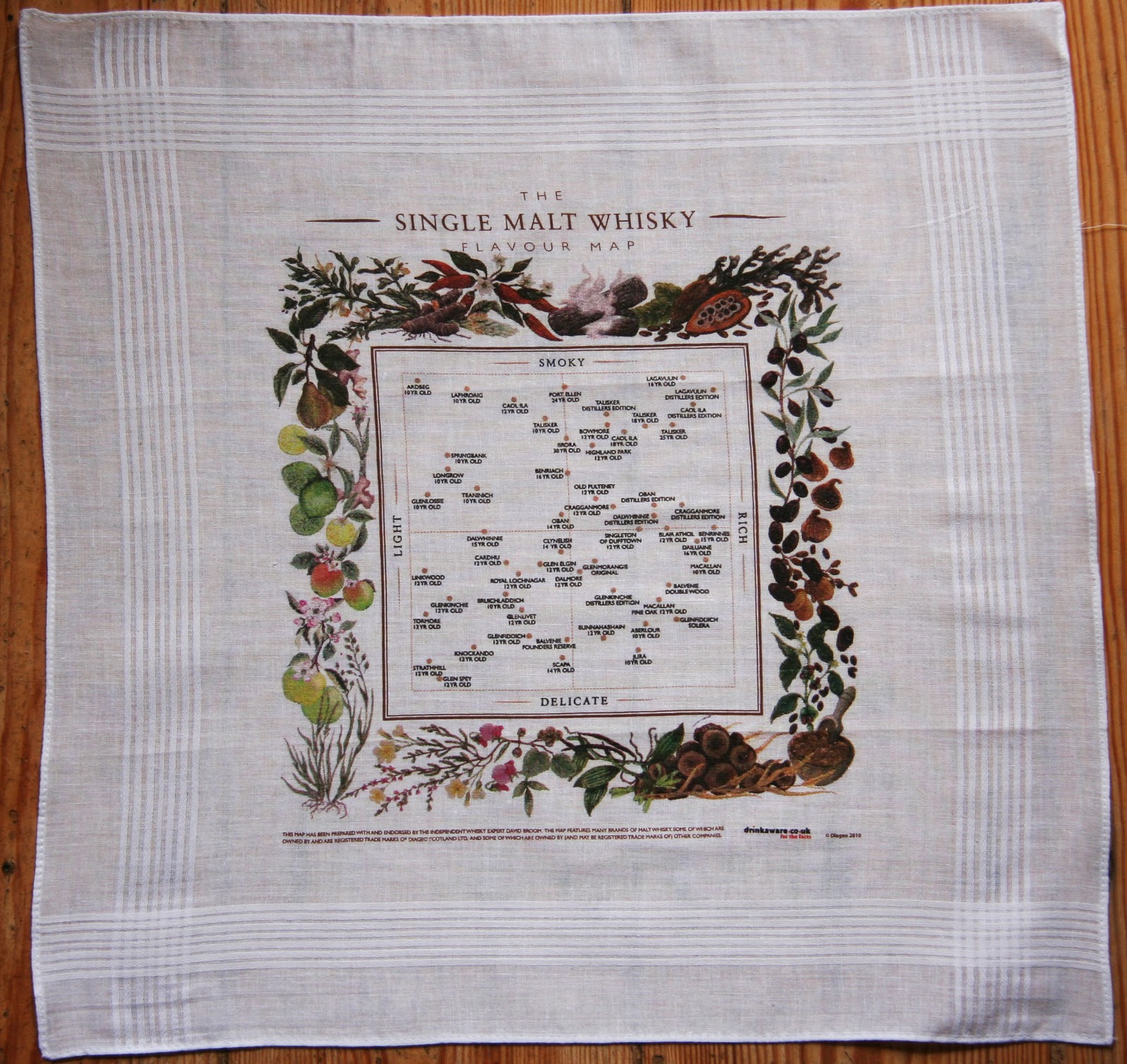
I received this little item recently from the Whisky Exchange as a bonus with an order—it’s a handkerchief printed with a single malt whisky flavour map! Just the thing for an evening spent drinking whisky and taking snuff, I would have thought.

I don’t know what you have to do to get one, as they don’t appear to be for sale. But perhaps if you ask nicely…


Wednesday, 21 September 2011

Draughts from the Windy City


Our last Candlelight Club event looked at Chicago during Prohibition so I set about tinkering with a menu of appropriate beverages.

I must say, I hadn’t realised just how corrupt the city was in those days. Al Capone apparently spent some $75 million on bribery, with the result that some of his speakeasies didn’t need to disguise the fact that they served alcohol. From 1927 even the city mayor was in his pay. At one point the Chief of Police admitted that half of his men were actively engaged in bootlegging themselves. There was a magazine called The Chicagoan, now little known but then intended as the equivalent of The New Yorker, and I’ve been looking at a copy from 2nd July 1927: not only does Prohibition and bootlegging feature quite heavily but it seems defensive, almost proud of the local hoods:

Chicago is the present capitol of large-scale bootlegging, her bootleggers the merchant princes of the profession… Any good bootleg office should guarantee a loop delivery in 30 minutes. Good firms usually scorn to adulterate their wares. They attempt to win and hold patronage by solid merchandising value… “Hell,” as one explained to this investigator, “we got no kick coming. Our business is gettin’ better and better. We’re all making money. Everybody’s happy!”

Al Capone
So what are some quintessentially Chicagoan cocktails? I guess we’d have to start with the Chicago Cocktail. No one seems to know where or how it came into existence but it was apparently being served under that name before Prohibition at New York’s Waldorf-Astoria as an import from the Windy City.

Chicago Cocktail
2 shots brandy
2 dashes of bitters (presumably Angostura)
Curaçao (somewhere ¼ and 1 tsp)
Sometimes a few dashes of gomme
Champagne to top

Also known as a Fancy Brandy Cocktail, this goes back to the dawn of mixology where the idea seems just to prettify the base spirit with sweetness and some aromatic high harmonics. It is also essentially a Champagne Cocktail with curaçao and different proportions. It is sometimes shaken and strained and sometimes served on the rocks. I have found one reference (Robert Vermere’s Cocktails: How to Mix Them) to its being improved with a dash of absinthe—but then isn’t everything? Being familiar with the Champage Cocktail I had a feeling that this version would be too heavy on the brandy, but in fact it works very well, and feels agreeably rich and decadent.

Chicago Fizz
1 shot rum (light or dark, depending on whom you believe)
1 shot port
Juice of half a lemon (about 1 shot)
1 egg white
1 tsp powdered sugar
Soda water to top
Shake all ingredients except soda, first without ice, then with ice, and strain. Top with soda water.

Again I can’t find any story for this drink but a fizz (or fiz as Jerry Thomas spells it) goes back to the nineteenth century and can be made with any base spirit. I’ve heard a tip that, with egg white recipes, you should dry-shake the ingredients together before adding ice, to give the egg a chance to whip up a good consistency; but certainly with this recipe you just get too much of a foamy head that way. I was using pasteurised egg white in cartons and found that half a measure was fine. It’s an intriguing recipe that works better than it sounds it will—the egg adds a silky texture but the whole is refreshing, with a sweet/sour vinous element from the port, and pleasantly pink.

Cohasset Punch
1½ shots dark rum (only Martha Stewart suggests light rum)
1 shot vermouth (recipes are evenly split between sweet and dry)
Juice of half a lemon (about 1 shot)
½ shot Grand Marnier (optional; triple sec is also worth trying)
½ shot syrup from a tin of peaches
Put half a tinned peach in a Champagne glass, half fill with shaved ice, shake the liquid ingredients and strain into the glass.

Odd that this definitive Chicago cocktail should be named after the town of Cohasset in Massachusetts. The story goes that William H. Crane, a very successful actor in of the late nineteenth century, was doing well enough to throw fancy parties at his summer house in Cohasset. Having played a long run at Chicago’s Hooley Theatre Crane brought one of the city’s better bartenders, Gus Williams, out to his next party to do the mixing. Williams came up with this drink and it was so successful he put it on the menu at his own place, Williams & Newman, in Chicago. In 1916 he retired and sold the recipe to the Ladner Brothers, whose saloon was then decorated with a neon sign proclaiming the “Home of the Cohasset Punch”.

The classic recipe doesn’t have the Grand Marnier—that was added by Wall Street Journal writer Eric Felton, I think. My own experiments have found that the syrup in tins or peaches round here doesn’t really taste of much—neither peaches nor syrup—so I tried replacing it with Monin commercial peach syrup or crème de pêche, which works much better. I think I slightly prefer it with dry vermouth. I’m not sure what the drinker is supposed to do with half a peach in their glass, so I replaced this with a couple of slices.

Southside
2 shots gin
1 shot lemon juice
½ shot gomme syrup
Half a dozen mint leaves
Muddle the mint in the bottom of the shaker then add the other ingredients, shake and strain.

Essentially a Gin Collins with mint. The story goes that, served over crushed ice, this was the beverage of choice for Chicago’s Southside gangsters, while the Northside crew preferred to take their gin with ginger ale. How it thence came to be the house drink at Manhattan’s 21 Club and later a staple of summer in the Hamptons, I do not know: Eric Felton (see above) pooh-poohs the origin myth and believes it was more likely invented at the exclusive Southside Sportsmen’s Club on Long Island itself. I was surprised how strong a presence the mint has if pummelled in this way, making for a delightfully fresh cocktail.

A Chicago speakeasy, apparently
Back in the day, Chicago was full of speakeasies. Many of them would have a legitimate business on the ground floor: Club Lucky was a hardware store, Emmit’s was a bank, John Barleycorn’s was a Chinese laundry, with booze carted in covered by dirty linen. The drinking went on in an upstairs room or in the basement. Emmit’s and Halligan came complete with escape tunnels. At least 30 of these places are still bars, but there are also new cocktail bars seeking to revive the spirit of the cocktail age, such as The Violet Hour. So I adapted one of the drinks from their list. They don’t reveal their recipes, but here is my version inspired by The Blinker.

The Violet Hour
2 shots bourbon
2 shots grapefruit juice
1 shot Chambord or crème de framboise
2 dashes grapefruit bitters
Shake and strain.

It’s an intriguing drink because it is very fruity, but refreshingly bitter-sweet because of the grapefruit juice. I was much taken with it, though one of our barmen, as he handed me one, sniffed, “It’s not my favourite from the list…” Clearly the grapefruit sharpness will divide drinkers.

One other I considered for our party is a well established drink called a Godfather, essentially a mixture of Scotch whisky and amaretto. Proportions vary but I think 2½ Scotch to 1 amaretto is about right. I did find one passing reference to the idea of adding a dash of absinthe, which actually works very well, so I’ve included the recipe and adjusted the name to reflect this:

The Godfather, Part 2
2½ shots Scotch
1 shot amaretto
Dash absinthe
Build on the rocks. I tried it with Islay malt whisky, thinking the smokiness might evoke gunsmoke, but it’s actually quite horrible—the iodine peatiness quarrels with the amaretto. This works better with blended whisky.

So here is a list that we can justify as Chicago-related. But do they drink these in Chicago? The Cohasset Punch was definitely served at Ladner’s until its demise in the 1980s, and it was even sold as a bottled premix. As for the others, in 1931 John Drury wrote Dining in Chicago and lists a number of locally popular cocktails: but he doesn’t suggest people were drinking the ones mentioned so far, and doesn't mention the Southside at all. He does reference:

The Gilbert To one jigger of Gordon gin, add one-half jigger of French vermouth and one-half jigger of Italian vermouth, a touch of Absinthe, and strain into cocktail glass. Concocted by Paul Gilbert, of the Chicago Evening Post, and a favorite of Ring Lardner, when both rested their weary reportorial feet on the brass rail at Stillson's. 


The Pink Lady To one jigger of Gin, add orange syrup to color, a dash of Apollinaris, and one-half a lime. Ice, stir well, and serve. Another Paul Gilbert creation, now become a standard cocktail. Said to be Walter Winchell's favorite. 


The Ticonderoga To one jigger of Dubonnet, add a dash of Italian vermouth, a dash of Grenadine and a touch of lemon. Emil Rutz, manager of the extinct Vogelsang's, concocted this—and the Loophounds liked it.


The Martini Into a shaker half-filled with cracked ice, pour two-thirds of a wine glass of Gordon Gin, one-half wine glass Italian Vermouth, and add a dash of Orange Bitters. Shake well, and serve with a piece of orange peel or an olive. 


The Mission To two-thirds Gordon Gin, add one-third French Vermouth; stir well and strain into cocktail glass into which a stuffed olive has been placed. This was a great attraction to the boys at the old Mission Bar in West Madison Street before Mr. Volstead appeared.

So this is what Chicagoans were actually drinking in 1931, though obviously the “Mission” is closer to the Martini as most of us understand it today.

And if you want some modern day verité, the Chicago edition of foodie site The Tasting Table offered this selection of the city’s best contemporary cocktails last year.

Tuesday, 13 September 2011

Pash-ion For Vodka #9 - Babicka Wormwood Vodka


I picked up my sample of Babička at a recent London Barshow—having tasted it at the stand I knew it was something I wanted to write about. Hartley and I tried a Wormwood distillate at the Sacred Distillery and were taken with how much of the flavour of absinthe the distillate had. So naturally a wormwood vodka is of similar interest.

Babička is from Czech Republica and takes its name from a 16th-century word from the country: these were old wise women or "grandmothers" known for their healing herbal remedies and use of witchcraft.

The vodka uses 100% Moravian corn as its base spirit

Own:
Nose: Herbal nose, with hints of fennel, star anise and wormwood. Some other woody elements and a little menthol
Taste: Very smooth, and then the flavour comes, herbally complex with a sweetness akin to a cough draught and a little aftertaste of rosehip sweets or Barratt's Fruit Salad chews. Very tasty.

Frozen:
Slightly syrupy and pleasantly viscous, nose subdued a little sage and a tiny berry note. The taste is subdued but the woody menthol notes are still there, with a green herb and red berry finish. A bit different but a definite quality to the flavour and to the product in general. My preference would be at room temperature.

Martini:
Rather nice, quite bitter and pleasantly crisp. Touch of Cinnamon Very smooth and completely unique. Superb.

Monday, 5 September 2011

Gin Mare: a gin you can't refuse


As the fad continues for producing “gins” that include all manner of bizarre flavours, Gin Mare, behind which a fair amount of marketing clout seems to have been put, looks like a bold move. In addition to juniper, coriander, cardamom and citrus peel (lemon plus both bitter and sweet oranges), we have thyme, basil, rosemary and olives. The idea is to create a self-consciously Mediterranean gin, something that denizens of that region will embrace as their own. (The name comes from the concept of Mare Nostra, “Our Sea”. Spain is a huge gin market so you can see the logic.)

Fortunately they allow us Brits to drink the stuff too. The bottle is striking, with an olive-leaf pattern prominent on the front along with the phrase “Colección de autor”. Some marketing bumf I’ve seen attempts to translate this, rather bafflingly, as “author’s collection”. I speak no Spanish, so I don’t know if they are getting at something artisanal here, a product created by craftsmen, or if it means the creation of an visionary auteur: it is, apparently, “the vision of a new generation of a family with a long tradition of distilling high quality spirits”. So, both traditional and innovative at the same time, conveniently.

The blue and white shades of the bottle represent the sky and the clouds, the sea and the surf.  The bold cap covers the whole neck and forms a handy 50ml measure. Its top is struck like a classical medallion and there are four vanes on the side that apparently represent the four Mediterranean botanicals (the basil is from Italy, the thyme from Turkey, the Rosemary from Greece and the Arbequina olives—the only olives to have their own DOC category—from Spain, though in fact the citrus also comes from Spain and the juniper is, they say, harvested on their own farms, so I assume that is Spanish too). But to me the bottle cap has a Futurist architectural quality and reminds me of Mussolini’s Fascist EuR development in Rome.*

The product was launched in February 2010 and the promotional literature shows that it was born as a titanic marketing exercise, attempting to encapsulate a relaxed Mediterranean lifestyle, a warm climate, a native love of gastronomy and a sense of escape. (This last one seems at odds—if you’re a native of the Med, surely you’re not escaping there? It’s only us pasty Brits who try that.) There are photos of beautiful people dressed in minimalist white and scenes of what Mount Olympus would look like if it were a club on Ibiza.

Typical Gin Mare consumers: these people are so relaxed they have forgotten
to build the rest of their house
But a lot of thought and effort have gone into the product too. All the botanicals are distilled separately (something I used to think only Ian Hart of Sacred did, but one hears of it more and more). Whereas most gins macerate their botanicals all together for about 24 hours, Gin Mare botanicals are steeped for varying times—from 36 hours for the olives up to a year for the citrus peel. At a tasting at Graphic in March we were told that the reason for the separate distillations is that the olive distillate varies a lot in heaviness and flavour, so this way they can keep the balance consistent. The distillates are hand blended and the finished product is bottled at 42.7% ABV.

That Futurist bottle cap
As if terroir, tradition and technique weren’t enough, the manufacturers have hedged their bets even further by erecting the still in an 18th-century chapel that was dismantled brick by brick and reassembled in its current location in an old fishing village between the Costa Brava and the Costa Dorada, presumably to make sure that God is also on their side.

So many New Gins seem to play down the juniper aspect and add sweet, floral notes, apparently to woo punters who perhaps are ripe to like the idea of gin, but fundamentally don’t like the taste (especially women, at whom some brands are specifically aimed). Gin Mare is, when you unscrew the cap, clearly gin—the juniper hits you first. But then there is obviously something floral, smooth and sweet going on too. On the palate I get something like cinnamon, warm and rich, and then there is the olive, quite noticeably, plus the woody, aromatic thyme and rosemary elements. This is the fascinating thing about Gin Mare, the way it manages to present sweet, smooth, floral qualities yet avoids ending up cloying like many modern gins, and somehow successfully marrying this with a distinct saltiness from the olives and the dry, savoury, resinous elements of the herbs too.

In a G&T this character remains pronounced, with both a distinctive herbaceous quality and a silky smooth mouthfeel. At the Graphic tasting we had our wrists slapped over the idea of garnishing the drink with lemon or lime (despite the fact that citrus is an ingredient) on the ground that they would overpower the flavours: instead we should use rosemary, thyme, basil or mint. In a Martini one should use an olive.**

I tried the gin in a few other classic cocktails:

Martinez (2 parts Gin Mare, 1 part Carpano Antica Formula red vermouth, 1–2 tsp maraschino, dash of Angostura bitters) Cracking. The herbaceous flavours of the gin marry well with the vermouth and balance nicely with the fruity sweetness of the maraschino.

Negroni (equal parts Gin Mare, Carpano Antica Formula red vermouth, Campari)
With Antica Formula this makes a warm, chocolately Negroni, with the sweet fragrance of the gin and the prominent vanilla of the vermouth creating a smooth feather-pillow for your tongue; but then there is that bitterness at the end, from both the vermouth and the Campari. Not sure it’s the very best Negroni I’ve had—perhaps it wants the steely juniper note in more conventional gins.

Dirty Martini (4 parts Gin Mare to 1 part dry vermouth, plus about ½ tsp of olive brine) It seemed an obvious thing to try and, as you might imagine, it works very well—although you are really just adding more of the salty olive character that is already there. Nevertheless it does emphasise the effectiveness of the botanical combination in the gin.

Graphic bar manager Sarah Mitchell with Duncan Hayter
from Gin Mare at the event in March
Gimlet (2½ parts Gin Mare and ¾ part lime cordial) Balances in a surprising manner—it brings out the floral character in the gin, though the savoury, salty qualities are still in there too. The warm, spicy elements poke through clearly. In fact in an interesting way this cocktail spotlights the complex balancing act that Gin Mare attempts—and for my money by and large achieves—though I sense it might be a love-it-or-hate-it thing for most people.

Gibson (A dry Martini with one or two cocktail onions as garnish) Having quite a savoury tooth I do like this cocktail and I figured that a gin with so many savoury elements as Gin Mare would work well. But I’m not sure I was right: in context Gin Mare came up with some surprising sweet elements that seemed to jar with the sulphurous allium flavour of the onion (reminding me a bit of sweet-pickled herring). It makes you realise that the dominant herbaceous notes aren’t as savoury as they seem.

Red Snapper (2 parts Gin Mare, 4 parts tomato juice, ½ part lemon or lime juice, Tabasco, Worcestershire sauce, black pepper, celery salt) Likewise an obviously savoury cocktail (and one of the few classic cocktails that sits easily with the extraordinarily savoury Aviation gin). And it was pretty good, yet again it didn’t work as neatly as I would have assumed. In this savoury, almost meaty context, Gin Mare showed itself to be more floral and sweet than I had thought. And I am reminded just how powerfully flavoured it is: this is a muscular cocktail context, with the acids of the tomato and lemon and the chilli and pepper heat, yet the Gin Mare immediately pushed its flavour profile through.

Aviation (2 parts Gin Mare, ½ part maraschino, ½ part lemon juice, ¼ part crème de violette) As gin shorts go this is relatively fruity/floral, so I didn’t expect it to work but I was wrong. This sort of cocktail, perhaps like the Gimlet, showed that Gin Mare actually has a strong floral perfume, that in this case sits quite happily with the violet and cherry flavours.

I’ve now nearly finished my bottle of Gin Mare in my experimentations, which is in itself a sign. The strong thyme, rosemary, basil and olive elements are impossible to ignore, yet this would make the gin sound like food, and as it turns out it is not that savoury as a mixer. It works well in combinations with a floral/fruity character. Forcefully characterful, it may well divide and perplex drinkers, but I still find myself fascinated by it.

Gin Mare can be had for about £34 a bottle (or £42 if you buy it from Harvey Nicks).

* See m’colleague’s recent review of Adler gin from Munich: adler means “eagle”, but it is reminiscent of the Adlerhorst, Hitler’s “Eagle’s Nest” mountain hideaway. So if Adler is “Hitler’s gin” then perhaps Gin Mare can be “Mussolini’s gin”. I believe that Churchill was partial to Plymouth in his Martinis. So, what would be Roosevelt’s and Stalin’s gins, I wonder..?
** This whole business of garnishes sometimes seems a bit pointless to me. Granted that nothing you can do to the constituent liquids will create the same effect as squeezing the oil from a strip of lemon rind on to the surface of your Martini, but many prescribed garnishes leave me thinking, If you believe your gin needs that extra element of grapefruit/basil/raw beef or whatever, why not just add that flavour when you distil it and serve it without a garnish? Much of it is just gimmickry, methinks.