Showing posts with label thyme. Show all posts

Wednesday, 23 September 2020

Test Valley Gin


In the Hampshire market town of Romsey to visit my elderly mother-in-law a few weeks ago, we were hunting for lunch among the tentatively opening shops (it’s a place with an ageing population, so I guess they have to be careful in COVID times). In a deli that I’d not set foot in before I noticed a display of local gins (inevitably these days, I suppose). One that caught my eye was Test Valley Gin, from Wessex Spirits.

They don’t give much away on the label other than that the botanicals include fresh herbs—I wondered if these were infused post-distillation, as the gin has a pale yellow hue. The gin’s website doesn’t elaborate much more, other than to mention fresh basil and thyme specifically (and they do indeed use the word “infused”).

Uncork the bottle and you are not overwhelmed by aroma—maybe a hint of orange. In the glass the bouquet is herbaceous with a sweet and aromatic angle. Knowing that there is thyme involved I can believe that this is the source, and perhaps the basil contributes to the sweet fragrance. I happen to have a sprig of fresh thyme to hand from the garden, and the fragrance is not the same, but related. There is a savoury woodiness too, and something vaguely salty like olives—in this respect the gin reminds me somewhat of Gin Mare. And as it opens up in the glass I’m sure I’m getting off wafts of something low and honky like bananas.

So a pretty complex nose. On the tongue it is immediately soft and sweet, with a delicate sappy herbal note, lingering pungently like watercress, and a sugary weight. Despite being diluted to a bottling strength of just 37.5% ABV (the minimum permissible for a gin, so I guess done to keep the duty as low as possible) it has a respectably long finish.

I try Test Valley in a Martini with Belsazar Dry vermouth: straightaway there seems to be a natural harmony between the herbaceous character of the gin and the botanicals in the vermouth, with the two ingredients forming a continuum, a wide vegetal vista on the tongue, plus a sweet, buttery mouthfeel. I initially mixed and tasted it without chilling, and I would say that any application of ice—whether shaken or stirred—has the disadvantage of of diluting what is already a fairly dilute gin, washing away some of the flavour. (Some stronger gins actually benefit from a bit of dilution and only really come into their own with a bit of ice, but not this one.) A solution might be what DTS calls the Diamond Method, keeping the gin in the freezer, but at 37.5% ABV I think that Test Valley Gin would start to freeze, unless you are able to have a dedicated booze freezer set to an ideal temperature.*

I also try a Negroni, though the results are less exciting. The gin certainly harmonises with the vermouth and Campari, but at equal parts it gets a bit lost, and even at 1½ parts gin it’s still hard to pick out.

A Test Valley G&T with prescribed thyme garnish


Although Test Valley do suggest a Martini as a suitable serve, their first choice is a G&T, garnished with a spring of thyme. It certain works, with that herbal character sitting comfortably with the tonic (Fevertree Light is my go-to). But I do find you have to add quite a bit of gin before the distinct flavour comes through—again this is probably a reflection of the niggardly ABV. So in my opinion a Martini is probably the best platform for this gin, making an intriguing and savoury beverage.

* Of course this is something you can turn to your advantage. I first discovered this issue with Bombay Dry/Bombay Original, which I prefer to Bombay Sapphire. In the past it was hard to come by in the UK, but when you found it it was a respectable ABV; now it has been relaunched here as the brand’s entry product they have reduced the strength to 37.5% to keep the price down. In order to avoid further dilution from ice, I tried keeping it in the freezer and found that it does indeed start to form ice crystal inside the bottle. However, I realised that if I quickly emptied the liquid contents into a jug, warmed the bottle to melt the ice left inside, poured the meltwater away, then decanted the gin back into the bottle, I had simply removed some of the water, leaving a higher ABV gin behind. Sure enough, after doing this a couple of times the problem goes away, as the residual liquid is presumably now alcoholic enough to resist freezing—and you end up with a more concentrated flavour.

However, I don’t know if some flavour component might be lost with the ice. So it occurs to me now that, instead of melting the ice then just pouring it away, you could actually use that meltwater to make ice cubes that you could then use to make your Martinis! Crikey, sometimes my genius astounds me.

Monday, 8 April 2019

Nissos Gin

I generally don’t have much time for LinkedIn. I tend to say yes to any request to connect but I’ve only been approached twice about potentially viable work opportunities, and on both occasions the people in question turned out to be bonkers and their project clearly pie in the sky.

So it was a welcome change recently when I was approached by Alexandros Kouris. He has a beer brand in Greece, Nissos, and is in the process of launching a gin too. He found me because of some gin judging I did and he wanted me to sample his gin-in-progress.

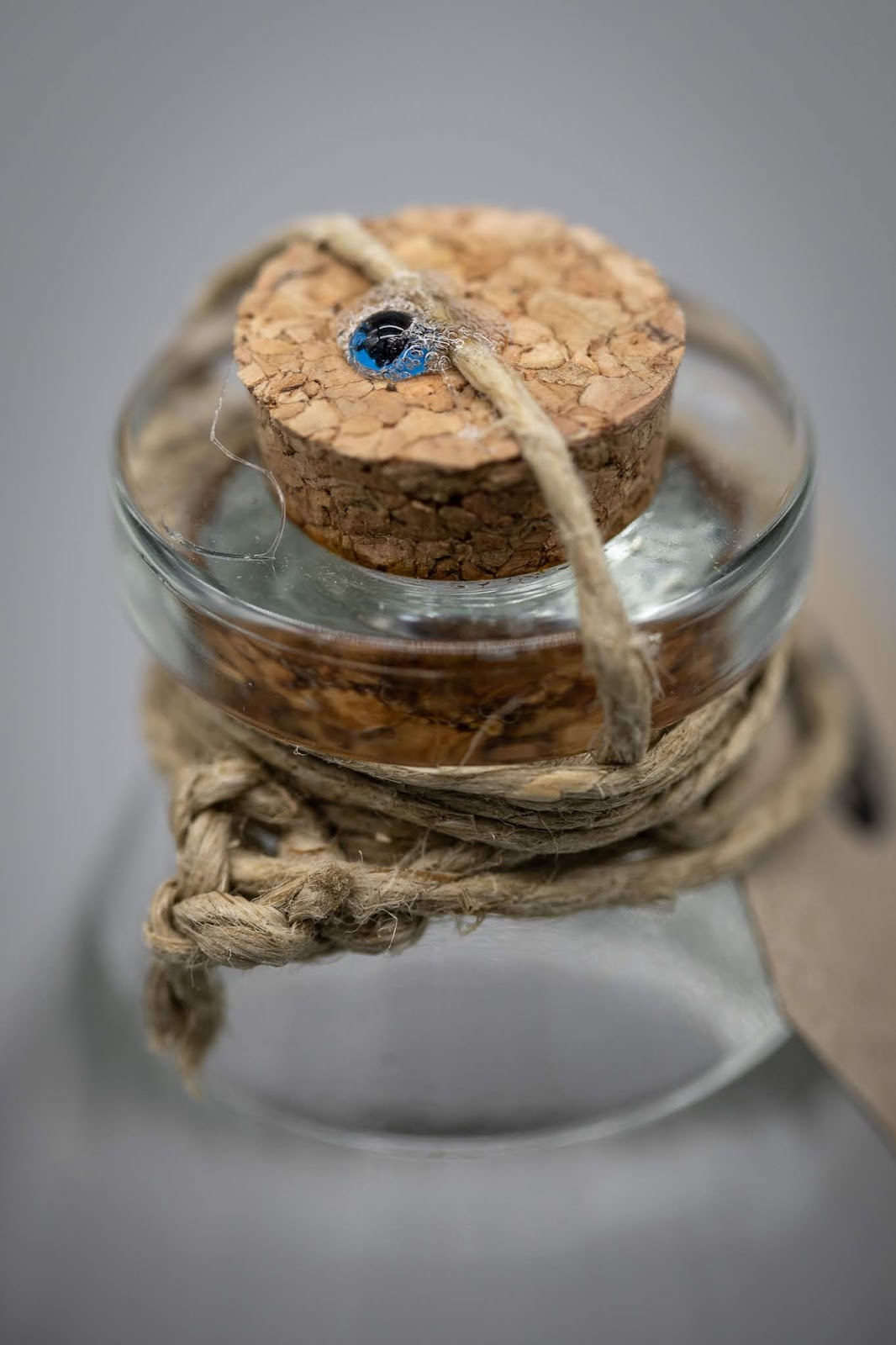
I don’t normally do “unboxings” but the package sent to me was certainly eye-catching. Inside the wooden box was a flask, the cork secured with string and a traditional glass “mati” bead glued on top. The “eye” design of the bead is a recurring motif in that part of the world and is intended to ward off the Evil Eye. But Alexandros insisted it was not there for any magical purpose, simply because his wife thought it looked nice.

The effort with the packaging is particularly appreciated considering that this is not even anything like the planned production packaging (see the image below).

I uncork the flask and from the bottle neck I first get juniper and citrus, then something floral, sweet vanilla and an earthiness too, with hints of chocolate and something that reminds me of cake.

I pour some into a glass and the aroma becomes a bit more savoury, an interesting balance of sharpness, with floral and leafy layers, woody spice like cinnamon or cedar and earthy roots.

On the palate it is powerfully flavoured, with sweet/floral elements and an almost menthol punch, plus something that seems drily aromatic, like saffron, but more floral—it made me wonder if there was an emphasis on orris root, but Alexandros tells me there is none in there. The earthy/rooty angle also made me assume that there was mastiha in it (see the previous post)—which would be an obvious choice to make something self-consciously Greek, but again Alexandros tells me there is none.

This is a complex gin tasted neat, bright and spicy with notes of ginger, but with a mellow, floral approachability. It is smooth and sweet on the tongue, combined with a spice that reminds me of gingerbread, and has a lingering aftertaste that also has the ginger/molasses character of gingerbread.

In dilution the warm, sweet spice notes become more dominant and the juniper less so, to the extent that if you’re looking for a classic G&T this might not be your best bet.

In an Aviation cocktail it sits very comfortably, blending so seamlessly with the fruit and violet flavours that it becomes hard to pick out the character of the gin itself. As you can see from the picture, I garnished this with lemon peel and the aroma of that meshed very neatly with the gin.

The production bottle design
After some goading Alexandros tells me there are ten botanicals: hops (well, he is a brewer), wild mint, thyme, cumin, cardamom, lemongrass, pepper and two kinds of local berry (which are used fresh rather than dried), in addition to juniper, of which there is not a lot. The spirit base is grape alcohol (“the same as used for Cognac”, he says)* and the gin is distilled in a copper pot still and bottled at 40% ABV.

I might guess that the citrus element I got initially must be from the lemongrass but Alexandros says that note comes mainly from the hops. I don’t really get cardamom specifically, but now that I know I can sense cumin, contributing to the dry spice angle that struck me. I think that the sweetness must be from the mint and the berries. I can also believe that the mint is responsible for the dominant spicy/pungent character, though Alexandros says, “The mint is not very prominent. Quite difficult to handle, this one, though it adds depth and of course makes it spicy.”

Nissos is a modern gin, and a poised, polished performer. Whether neat or in dilution, new flavours keep emerging. It manages to be both warmly pungent, evolving into dry, woody spice, but with a bright top note of citrus and juniper. I also keep thinking I get a whiff of honey. My experiments with cocktails suggest that while it’s unlikely to clash it may get a bit lost, so perhaps simple serves are the best way to appreciate its subtleties. Alexandos didn’t give an idea of when the gin might launch, but keep your eyes peeled.

* By which I assume he just means it’s a grape eau de vie, not that it comes from the Cognac region—which would be a bit mad when there must be plenty of grape alcohol nearer to hand.


An Aviation cocktail made with Nissos gin