Showing posts with label rosemary. Show all posts

Tuesday, 11 March 2014

Boodles gin returns home

The modern bottle design
Drifting through the spirits aisle of Sainsbury’s I noticed that they were now stocking Boodles gin. This took me slightly by surprise—DBS has always proclaimed it to be his favourite gin (and this from a man who has tasted hundreds), but I had never hitherto been able to taste it, as it was no longer available in this country. Clearly that is no longer the case.

The gin was named after Boodle’s, the gentleman’s club at 28 St James’s Street that celebrated its 250th anniversary in 2012. (This club itself was founded by the Earl of Shelburne, later to become Prime Minister, but was named after its head waiter, Edward Boodle.) According to the brand owner’s website it was created in 1845 and was a favourite of Winston Churchill’s (although I’ve also heard that Plymouth was his top tipple.) It doesn’t seem as if it was the house gin at the club, however. Throughout the 20th century it was bottled by Seagram in the US, ownership later passing to Pernod Ricard.

The back label
Made by Greenalls in a Carter-Head still* as a botanical concentrate (i.e. distilled with a high quantity of botanicals, and therefore with a very concentrated flavour), it was, by the time I became aware if it, being shipped to Arkansas where it was diluted with alcohol and water to get its flavour down to a palatable intensity and its ABV to 47.2% (which later dropped to 45.2%). Since 2013, although still made by Greenalls in the same way, it has been owned by Proximo, of Kraken rum fame, and is bottled in Burlington. Although still sold in the US at 45.2%, the version distributed in the UK is only 40% ABV. (This is quite a common pattern.) David certainly feels that the 40% version is not a patch on the higher strength expression.

Boodles famously has an understated juniper component, and this is indeed how it strikes you, the nose offering candied floral notes and something like lemon sherbet. Orange seems to be present, although in fact there is, unusually, no citrus among the nine botanicals—juniper, coriander seed, angelica root and seed, cassia bark, caraway seed, nutmeg, rosemary and sage. I’m guessing the impression of citrus is coming from the coriander and nutmeg, both rather lemony in their way. On the palate it is smooth, with an immediate impression of sweetness on the tip of the tongue, which then dries out. There is black pepper on the finish and, for me, a slight bitter aftertaste. As you add water you get more of an orange/lemon suggestion, and something like violets (presumably from the angelica, the root of which is doubtless adding to the sense of sweetness).

An Aviation cocktail made with Boodles
Some of those botanicals are pretty rare groove. Can I taste rosemary and sage? Not really. I can believe there is rosemary there, though its resinous herbaceous character occupies similar territory to juniper.

I believe Churchill was fond of a Martini, and I can see that the sweet, softness of this gin makes for an approachable example of this drink. I make one up, and get the same floral character with hints of vanilla and ginger. In an Aviation** the gin blends in smoothly and harmonises with the cherry and violet fragrance. It shows warm, dry spice that almost reminds me of turmeric or cumin. I think this gin likes an Aviation, and it’s interesting to note that I thought the same of Gin Mare, the only other gin I have tasted with rosemary in it.

Finally I try a side-by-side comparison with Tanqueray and Plymouth. Tanqueray has an up-front juniper nose and is dry on the tongue, while Plymouth has a softer nose and a smooth palate with plenty of orange peel. Boodles by comparison leads with that lemon sherbet element, which is refreshing, though I’m not keen on that hint of bitterness on the aftertaste. I decided to try and combat the latter by mixing the three gins with sugar and lemon juice. Now the Boodles comes across as coyly sweet and smooth compared to the others (perhaps too much so: one needs to control the sugar), and floral complexities unfold, with refreshing suggestions of lime.

I don’t think that Boodles could become my favourite gin, but I can see how it, like Plymouth, might appeal as a Martini ingredient. Like Gin Mare, it sounds as if it should be savoury but in fact blends best when you consider its forward floral character. But as for gins with unusual herbs in them, I prefer Gin Mare.

* The defining characteristic of the Carter-Head is that, instead of macerating in the alcohol prior to redistillation, the botanicals are placed in a basket within the still so that the alcohol vapour passes through them. This process, without any actual steeping in the liquid alcohol, extracts different flavours.

** Gin, lemon juice, maraschino and crème de violette, although after the last ingredient became hard to find many got into the habit of leaving it out. Of course without the crème de violette, your cocktail does not have the pale blue colour from which its name derives. I use the modern version from The Bitter Truth. You only need a small amount, but the violet note is distinctive part of the cocktail.

Monday, 19 December 2011

A cocktail for Christmas


Only a few days left till Christmas now, but still time for me to wish a hearty “God rest you!” to all you merry gentlemen and gentlewomen and to share a few tots of Christmas spirit.

I’m pleased to say that our seasonal cocktails went down a treat at the Candlelight Club this weekend, so I thought I’d share the recipes. However, I then realised that all but one of them involved ingredients you probably won’t have to hand—the Mince Flip uses mincemeat vodka (kindly made for us by DBS himself), the Cherry Christmas uses a rosemary tincture (made by infusing rosemary in vodka for about 24 hours), the Figgy Pudding uses fig liqueur and the Chestnuts on an Open Fire uses chestnut syrup. And of the course the Gold, Frankincense and Byrrh uses Byrrh and Goldschläger, not to mention Frankincense bitters!

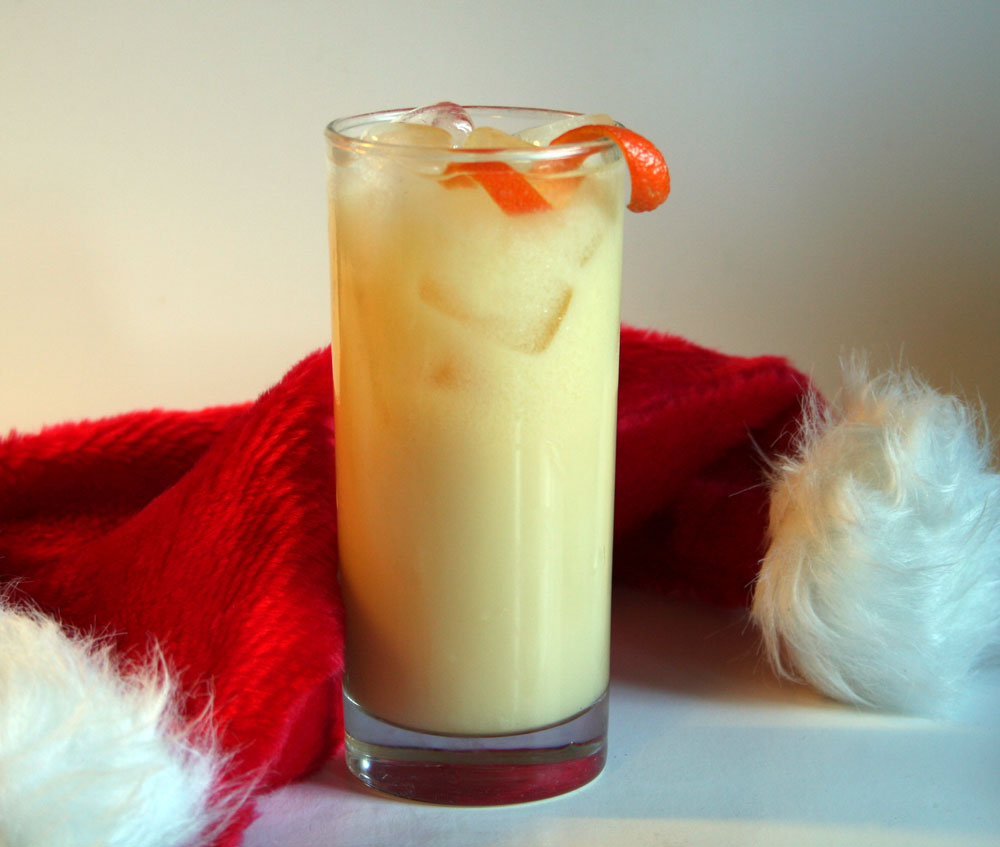
But the sixth cocktail only uses ingredients you can easily find in the supermarket. It’s a sort of cross between the Dark n’ Stormy mixture of rum and ginger beer and that cheesy classic the Snowball. Mrs H. has become quite addicted to them.

Ginger Snap
1½ shots rum
1 shot advocaat
1 shot ginger wine (optional)
Ginger beer to top

Either shake everything but the ginger beer with ice and pour into an ice-filled highball, or just build it in the glass with ice if you don’t have shaker to hand. Then top up with ginger beer. Advocaat is made from brandy and eggs and is a bit like alcoholic custard, lending a rich, puddingy quality to this drink, which makes it dangerously moreish! The ginger wine isn’t essential but adds a bit more gingery pep.

If you’re after inspiration for more easy-to-make Christmas cocktails, Tesco have launched a slick-looking Christmas Cocktail Finder app on their Tesco Real Food website. You can search for recipes based on the ingredients you have to hand, or by details such as sweetness, glass type or even whether it is shaken, stirred or blended (presumably handy for when you really fancy a cocktail but simply haven’t the energy to deploy a shaker).

Despite all these variables, the database currently has only 69 recipes on it, but that’s still plenty to keep you going and almost certainly includes combinations that will be new to you. And while something like Simon Difford’s similar searchable database has, by contrast, thousands of recipes, the emphasis with the Tesco version is that all recipes require only ingredients you can easily get hold of in a supermarket. Such as Tesco, for example. As a spin-off from the website’s recipe finder, it also tells you the nutritional content of each drink (though not the number of alcohol units, oddly). I’ve just found another advocaat recipe here, the Kentucky Cheesecake (203 calories), which combines advocaat with bourbon, amaretto, lemon juice and maple syrup: I’m going to have to go and try that one. (That’s the thing about advocaat, by the way—once it’s open you’re supposed to keep it in the fridge and consume within six months. But you’re not really going to be wanting to drink it in the summer, so the only solution is just to keep drinking it now…)

Now, for the record, here are those other recipes:

Mince Flip
2 shots mincemeat vodka
1 shot cream
1 shot sweetish sherry, such as Harvey’s Bristol Cream
Nutmeg

Shake everything with ice and pour into a Martini glass, then dust with nutmeg. The vodka is made simply by steeping mincemeat in vodka, though I couldn’t tell you exactly how David does it. Trade secret, I suspect!

Cherry Christmas
1½ shots gin
¾ shot cherry brandy
½ shot sugar syrup
¼ shot rosemary tincture
Dash of cherry bitters
Cranberry juice

Shake everything but the cranberry and pour into an ice-filled highball, then top with cranberry and stir briefly. This drink is all about the unexpected combination of cherry and rosemary. The precise amount of tincture you need will depend on how strong you have made it, so go easy to start with. We used Fee Brothers cherry bitters, which made quite a difference to the cherryishness of the drinks, as will the cherry brandy you use. Cherry Marnier has bright confectionary cherry flavour, whereas Cherry Heering is actually rather dark and savoury.

Chestnuts on an Open Fire
2 shots gin
1 shot apple juice
½ shot Laphroaig single malt whisky
½ shot chestnut syrup
½ shot lemon juice

Shake everything together and strain into a martini or coupe glass. I’ve lost track of the number of people (all ladies, now I think about it) who declare that they don’t like whisky but love this drink. It’s a relative of the Smoky Martini but lengthened and sweetened. You don’t have to use Laphroaig but it probably has the most smoky flavour so you don’t need much to make the point. The combination of spicy gin, fruit from the apple juice, chestnutty sweetness and smoky iodine from the whisky is fascinating. We used Monin chestnut syrup.

Figgy Pudding
2 shots bourbon
½ shot crème de figues
½ shot ruby port
Dash of Angostura Bitters
Orange peel garnish

Shake everything with ice and strain into a Martini glass. Squeeze a strip of orange peel over the top and drop it in. A variation of the Manhattan, the bourbon here sweetened and fattened by the puddingy flavours of figs and port with some Christmassy orange zing to finish. We used Briottet crème de figues, though there may be other fig liqueurs out there.