Sunday, 21 November 2010

Curiosity Cabinet #2 – Perigan's Cannabis Gin

The Curiosity Cabinet #2
Perigan's Cannabis Gin (37.5%)

OK, OK, calm down: I know that it's a crazy idea, but there is such a thing as a Cannabis Gin and this is the feature of the second Curiosity Cabinet.

Made by Beveland Distillers of Spain, the label makes no bones about what it contains, with the word "cannabis" featured at least four times on the front label, not to mention what appears to be a cannabis leaf dominating the front.

Sharp-eyed readers will note the attempt to add a touch of regality to the product by adding a coat of arms (possibly from clip art), and the border of juniper berries (no doubt to help to remind you that,"Yes, this really is meant to be a gin.").

A quick scout around online shows that Beveland have also made a Cannabis Vodka, a Cannabis Absinthe and a non-cannabis Perigan's Gin.

So is hemp one of the botanicals? No (I'm not sure how well it would work, actually). The gin is cannabis flavoured and I imagine the fluorescent mouthwash-green colour is also introduced during the flavouring process.


The Taste

Neat: The nose is overwhelmingly one of cinnamon. In terms of taste, cinnamon is again at the foreground, with a little juniper at the end. This is not a juniper-led gin.

Gin & Tonic: What's this, another taste of Christmas? Truly, this is the first Gin & Tonic that I have had that tastes of cinnamon. Beyond this, there was a little citrus. (Mrs. B seemed to quite like it though!) A poor example of a G&T, but not a bad drink.

Martini: The drink keeps Perigan's trademark spearmint green colour, but its trademark flavour (no, not cannabis; cinnamon) remains. A very flat Martini.

All-in-all, it seems:
(A) Perigan's doesn't taste of cannabis, and
(B) it doesn't make very good drinks. But, really, what did I expect?

Perigan's Cannabis Flavoured Gin is bottled at 37.5% ABV and Beveland stress that their product was marketed in accordance with the law. However, The Portland Group (a responsible drinking watchdog) investigated the brand after receiving a complaint from a publican in Bristol stating:

"This product is surely in clear breach of the code with, I feel, irresponsible and obvious illegal drug references"

The complaint was upheld and the importers (Ultimate Brands) decided to stop importing the product. I emphasise, though, that the contents of the gin was not in breech of the law.

As a result, it looks like it may be rather difficult to get your hands on some of this in the UK these days. The remainder of mine has been entrusted to the vaults of Plymouth Gin, where it now rests on their Gin Wall.


Friday, 19 November 2010

Become a Gin Genie

A dry Martini. By the end of the evening you'll be able to
spot one of these at several paces.

As you will have noticed, I spend an unhealthy amount of time at the regular Juniper Society sessions at Graphic in Golden Square, near Piccadilly Circus. I’m sure I’ve painted such an arcadian picture that you can hardly keep yourself away—to which end, why not join us on Monday 29th November? Plymouth Gin are hosting a free gin tasting and Martini Masterclass and have asked me to extend the invitation to any curious coves who might be interested.

Winston Churchill was a big Martini fan and
Plymouth was his gin of choice.
The event kicks off at 6pm and the fun starts as soon as you arrive, as a cocktail is pressed into your hand. You will taste a selection of fruit Martinis (steady at the back, there—some people do believe in them) before attending two sessions: in one you’ll learn about the history of this famous cocktail, what goes into it and how to knock up the perfect example to wow your Christmas and New Year guests at home. The other session will introduce you to the delights of Plymouth gin itself with a tasting and talk by the “brand ambassador”. (Plymouth is not just a brand of gin but actually an EU Protected Geographical Indication: only gin made in Plymouth—indeed I believe only a certain area of the city—can call itself Plymouth gin. This is more a historical curio than anything else, but DBS is always mooting the idea of surreptitiously renting property just within the zone and making our own Plymouth gin, just to throw a spanner in the works.)

Anyway, after all this training you will leave “true gin and Martini connoisseurs”, or at least rather giggly, which is almost as good. There is no need to book—just turn up on the day.

For more info see the Juniper Society page. For other Juniper Soc events see the Graphic calendar.

Wednesday, 17 November 2010

G & Tea?

Beefeater 24's bottle looks like it belongs
among the Crown Jewels
Can booze and tea sit happily in the same glass? Oh yes.

You have to feel sorry for Desmond Payne. He’s a master distiller (formerly at Plymouth, now at Beefeater) who’s been at it for 43 years—but always charged with distilling to other people’s recipes. He lives with a portrait of James Burroughs, the Beefeater founder who developed the formula 150 years ago, glaring down at him from the wall.

Finally he was asked to make his own gin, a special edition that would end up dubbed Beefeater 24, and DBS and I were present at 69 Colebrooke Row for a celebration of it a few weeks ago. (Mind you, I notice that it isn’t so much his own gin as his own “expression” of the Beefeater house style. Always the bridesmaid…)

I’d heard a story that the “24” in the name referred to there being 24 different botanicals, but this turned out to be codswallop: the gin has 12. “But it is not about how many botanicals you have or how exotic they are,” says Desmond. “It is about how they work together. Getting the right balance is crucial.” In fact the “24”  refers to the 24 hours for which the botanicals are left to soak in the base spirit before the whole soup is redistilled into glorious gin. Mind you, the 24-hour maceration is common to all Beefeater gin*—so what makes Beefeater 24 different?

Desmond explained that he at first tried a host of likely botanicals, but without success. While he was in Japan he craved a G&T—but quinine was not allowed, apparently, so no tonic water. Seeking a similar dry, sharp hit, he tried iced lemon tea—and was inspired to try using tea as the direction for Beefeater 24. What could be more English, as English as gin? He found that green tea worked best as it imparted the aromatic elements he wanted but without an overwhelming amount of tannin. But the presence of the tea also changed the relationships of the other botanicals—back to the importance of balance again—so a lot of tweaking was required.

The raven lurking on the inside of the label
Finally he had an end result ready for testing by a panel of esteemed mixologists: people liked it—but didn’t really pick up on the tea. So he went back to the lab and added Japanese Sencha tea with a fresh, green, slightly seaweed quality, that brought out the top notes. He was afraid that his tea dose would oxidise during the regulation 24 hour steeping, but was relieved to find that the alcohol preserved it. (Round about this time he discovered that James Burroughs’ father had actually been a tea merchant with a Royal Warrant—would Burroughs have approved of Payne’s new direction all along?)

When a batch of gin—or the mixture of spirit and steeping botanicals that will become gin—is distilled, different elements of the flavour emerge in a certain order: the distillery will actually smell different at different times of the day. In practice the citrus notes come out first, then juniper, then coriander. With Desmond’s tea injection he found that the high aromatic notes emerged at the very beginning while the tannic elements arose after the juniper. It’s normal for distillers to discard the very first and last distillate from a batch, but Desmond ended up making a “cut” that was particularly picky—in fact he discards some 30% of the juice that comes out of the still.

So what does it taste like? You can immediately tell how careful Desmond was to stay within the Beefeater house style, which I always think of as rather ethereal in its construction, with a delicacy that makes me think of quiet civil servants in wood-panelled rooms, as opposed to some of the two-fisted gins strutting on to the market now. Yet there is a subtle tea perfume here too joining the orange notes in the midrange, and a smoky element, but much more delicate that simply adding a peaty whisky rinse to your glass as in some “Smoky Martini” cocktails.

The Earl Grey Martini knocked up for us at Purl
The bottle in which Beefeater 24 is clad has had just as much thought and attention lavished on it. The patterns in the glass are taken from Royal Doulton ceramic designs: back in the day the distillery, like most, also produced a range of liqueurs and these were bottled in just such ceramic containers. The distinctive red punt is a nod to the Crown Jewels (this is Beefeater gin, remember) and if you look through the “window” in the bottom left corner on the back you can see a raven printed on the inside of the front label. The legend goes that if the Tower of London’s resident ravens ever leave, the kingdom will fall. “So if you finish the bottle,” Desmond adds, “put the cap back on so the raven can’t escape.”

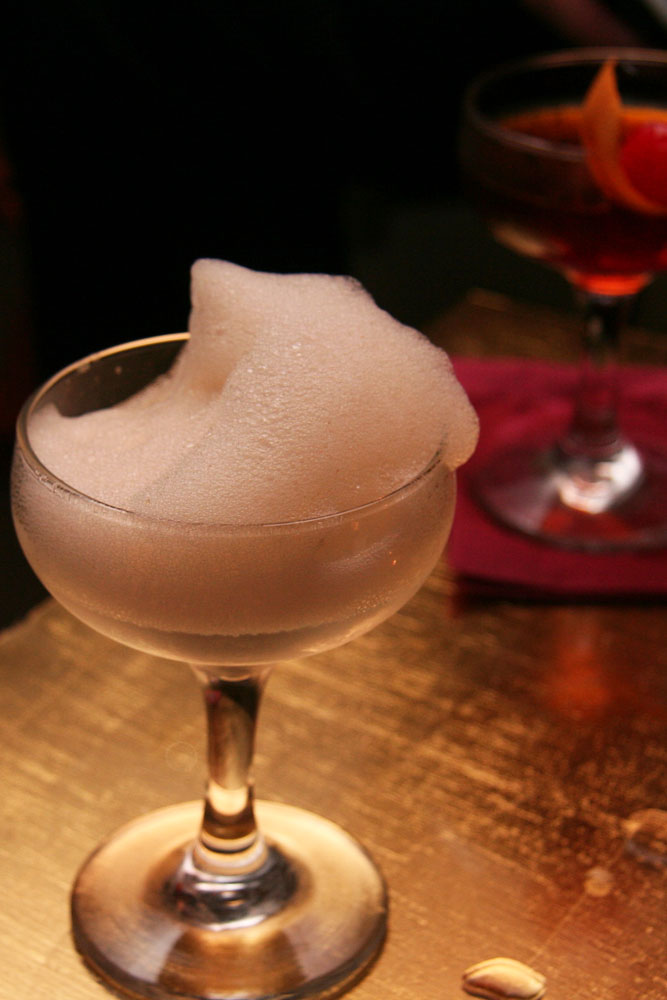
By interesting synchronicity, the idea of tea in booze seems to have cropped up quite a bit of late. At Purl a few weeks ago I came across their dry Martini served with an Earl Grey “air” (foam to you and me, though I gather there is a technical difference). This sits on the surface of the drink—looking rather as if the glass has just been washed up and not rinsed properly—and is actually one of the more convincing examples, in my opinion, of how molecular mixology can work. The tea flavour is all encapsulated in the foam: you hit it as you go in, but then strike crystalline Martini underneath, and the two elements are not just mixed all together. On a plate of food this separation of flavour elements is normal enough but it’s quite an achievement in a drink.

Two of David's homemade tea liqueurs
And of course how can we ignore Mr Bridgman-Smith’s recent experiments making his own tea liqueurs? I’ve tasted his lapsang souchong and his English Breakfast and I was mightily impressed. Homemade infusions have a tendency to fall into the “interesting, but…” category but I think he could convincingly bottle these and sell them at a farmer’s market somewhere. But the most interesting potential must be as a cocktail ingredient; at Graphic recently barman Adam took up the challenge and invented a smoky brew we dubbed the Fag Hag:

A Fag Hag cocktail
Fag Hag
30ml gin

20ml lemon juice

15ml lapsang souchong liqueur

10ml sugar syrup

20ml egg white

Dry shake the ingredients first to bind, then add ice, shake and strain into a glass.

You could probably achieve a similar effect using strong, cold tea and a little extra syrup.

Beefeater 24 is about £23 (or £29 if you buy it over the counter at Harrods)


* Beefeater claim that this 24-hour maceration is unique to them, but Hayman’s say their gin steeps for 24 hours, so do Berry Bros. and Rudd of their No.3 gin, Park Place about their SW4, and I have a feeling I’ve heard it about others too.

Tuesday, 16 November 2010

“Ham cam” interlude…

A mixture of pork leg, loin and belly
If you’re attending Saturday’s Candlelight Club pop-up cocktail event (and if not, you really should), you’ll know that the food menu will include a ham sandwich made with a homemade juniper-cured ham. Will, our foodmeister, has sent me these photos of the ham beginning its journey to yumminess. You’ll note that he has included not just juniper berries in the cure but also vermouth and Cointreau—so it is not so much a gin-cure as a sort of Martinez-cure. I suggested this to him and he said that it does indeed smell rather like a Martinez at the moment.

In goes the cure
Here are Will’s prelim-inary comments:

Pork, a bit over 3kg in all: 
pork leg (half—home butchered) 
pork loin, pork belly (for variety and curiosity) 


Cure:
1 gallon of water
2 lbs of curing salt: sodium chloride, sodium nitrate, potassium nitrate
¼ lb of dark brown sugar
A handful of bay leaves
A healthy scoop of juniper berries
A small glass of Cointreau 
A shot or two or vermouth (it ended up smelling rather lovely and so I stupidly tried tasting it... not a good idea) 


The secret ingredients of the "Martinez Cure". (I myself
regularly take the Martinez Cure. It hasn't worked yet but
I have every faith in my doctors and will keep trying.)
Method:

The cure was all heated together to steep the herbs and dissolve the salt apart from the alcohol and half the water which went in last to not kill the flavours and to help cool it. The pork all went into a large non-reactive (can't get much less reactive than enamel) pot and, once the cure had cooled to a cool room temperature (specifically my frigid sitting room temperature of 13 degrees), it was poured on top and weighted down with sterilised tiles wrapped in aluminium foil to keep the meat submerged.


The concentrated salt solution both sterilises the meat and draws moisture out of it, effectively “cooking” it.


The Ham Cam will be training its unblinking eye on our supper again, so stay tuned…


Sterilised tiles are used to weight the pig in its briny bath

Sunday, 14 November 2010

Introducing the Plasma Mary

A Plasma Mary on the rocks

Some years ago I was in a fancy restaurant and was served a complimentary amuse bouche that consisted of a shot glass of a clear, slightly pinkish liquid. It turned out to be tomato juice, highly sieved and strained but still very recognisable on the palate.

For some reason this came back to me recently and I got it into my head to try making a Bloody Mary from just such an extract—I suppose I was feeling a bit molecular and fancied the idea of something that tricked the mind by looking like a gin and tonic but tasting like a Bloody Mary. It’s probably been done before, but I’d never seen one.

I quickly found a recipe online from a Dutch chef for clear tomato juice. She actually has you zap Marmande/San Marzano tomatoes in a blender—by chance Mrs H. had been growing just this variety in our garden and had an end-of-season glut—and flavour the tomato pulp with Worcester sauce and tabasco before straining through a double layer of tea towel, along with 100ml of “vegetable soup”. I wasn’t sure what kind of soup she meant, so I made up 100ml of vegetable stock using Marigold bouillon powder. (I also missed out the vanilla vinegar, figuring it would be safer to adjust the acidity later with the lemon juice in the cocktail.)

Sieving the tomato pulp
At first I didn’t think it was going to work—the pulp just sits there in the strainer, glowering at you. But I did as I was told and left the whole lot in the fridge overnight and forgot about it. Sure enough after about 24 hours I had a bowl of pretty clear liquid, though hardly colourless. I found it delicious, in a much more savoury way than commercial tomato juice, which is more citric by comparison—and it made an excellent, and dangerously moreish, Bloody Mary. (Mrs Schmeinck is right: you can indeed use the leftover pulp as the basis of a nice pasta sauce.)

But the pursuit of clarity brings new problems. If you want to add more Worcester sauce or Tabasco it’s going to add colour; celery salt, on the other hand, doesn’t cause any problems though (and I’m interested to try celery bitters), and one could use white pepper, though I didn’t have any to hand.* And when you add your lemon juice you are reminded that this too is anything but clear. Having made up a finished drink I tried straining it again through a coffee filter paper. This again takes a hell of a long time, but you do end up with something that looks like a pale white wine. (I say that pointedly, as I was storing the juice in an old white wine bottle in the fridge and one evening I idly reached for a bottle to pour a glass of wine to go with whatever I was eating: it was only when I tasted it that I realised my mistake.)

The initial juice is clear but far from colourless
Because of the very savoury nature of this juice, I had the idea early on of using basil in the cocktail. I tried muddling it at the bottom though I was wary of damaging my hard-won clarity with bits of green floating around. What gave the most striking result, at least at the beginning of the drink, was rubbing a basil leaf around the rim of the glass before serving—you’re hit by this amazing perfume as you raise the glass, which fits perfectly with the flavour of the drink.

One other thing I want to try is infusing bits of vine stem or tomato leaves in the juice to try and extract that fresh zingy element that is so vibrantly, recognisably tomato yet tends to be missing from the actual flesh of the fruit (and is certainly absent from commercial juice). Some people are wary of doing this, as the leaves do contain a toxin. However, no less a source that Harold McGee, the father of molecular gastronomy, assures us that this is perfectly safe.**

An alternative serve to show off the clarity of the final version
If I can bring myself to make enough of this magic juice I’m going to serve this drink—which Mrs H. christened the Plasma Mary—at one of the Candlelight Club cocktail events, see if I can mess with a few heads…

Plasma Mary
2 measures vodka
4-5 measures clear tomato juice
½ measure lemon juice
celery salt/bitters
white pepper
Worcester sauce and Tabasco (optional depending on whether you introduced these elements while making the juice)

Stir all the ingredients with ice and strain into an ice-filled glass. Rub the rim with a basil leaf and garnish with more basil.

* I had some dried jalapeño flakes so I tried soaking a few to extract a liquid I could use to add heat, but the elixir turned out to be quite coloured, and I’m not convinced it’s the right sort of heat.
** Harry tells us that the leaves of the tomato (which is, after all, part of the nightshade family) do contain a potentially toxic alkaloid called tomatine. However, recent research has found that in our digestive systems tomatine binds tightly to cholesterol molecules—and our bodies absorb neither. So in fact tomatine reduces the amount of cholesterol you take in. (Source: Harold McGee, McGee on Food and Cooking (Hodder and Stoughton, 2004.)

Friday, 12 November 2010

Update from the Lab #2

Update from the Lab #2 – Old Tom and Forbidden Fruit


As promised in the last lab update, I shall be looking at making Old Tom Gin. This is by no means the last word on the subject and I know my fellow drinksmiths at the Institute are keen to look at this in greater depth.

My idea stems from a conversation we had with Tony at 69 Colebrook Row who mentioned that drinks expert David Wondrich suggested creating Old Tom gin by rinsing a glass with Scotch whisky, adding gin and sugar syrup and then using that to make your drink; a cocktail within a cocktail, you might say.

I scaled this up to make half a bottle's worth; I have another experiment coming up where I will need large quantities of Old Tom so being able to produce a substitute will be useful.


I added a small amount of whisky to gin and cane sugar I then gently warmed this until the sugar had dissolved and then cooled, strained and bottled the result.

The Taste: the sugar gives the gin a silky smooth quality (as you may expect) making it much more sippable. The whisky seems to tweak the flavour a little bit and certainly colours the gin a light gold. The juniper still comes through in the middle and at the extreme finish is a flavour akin to violet. This is a sweet gin and does resemble some of the other sweetened Old Tom gins in a basic way. Another work in progress but the work will be fun.

Forbidden Fruit
Not content with telling our lab observers merely about Old Tom gin, I decided to recreate a drink known as the Forbidden Fruit which appears in Louis' mixed Drinks (1906) under "Miscellaneous Drinks" see recipe below:

My first issue was that I had misremembered that the recipe calls for a grapefruit and went out and bought a melon, still we had a nice breakfast and starter for our dinner. Having obtained the right fruit I followed the recipe.


The result was a drink with an interesting temperature range, hot at the top and warm at the bottom. Mrs. B described it as a "serious drink which was also sweet and fruity". It was surprisingly smooth and rather drinkable, even to a non-brandy drinker like Mrs B. The grapefruit oil from the skin of the fruit mixed well with the burnt sugar and brandy and reminded me of a similar effect made from flaming orange, particularly nice (I'm told) over a Negroni.

This drink does involve fire so please make sure you take full safety precautions before making this drink, I used glove and apron and as you can see did it over the sink.

Thursday, 11 November 2010

Beefeater shows its winter coat

Beefeater Winter Edition

If the traditional gin style is like a sober suit and tie, then recent years have been like one long Dress-Down Friday, with new brands popping up that have the confidence to leave the house in whatever outlandish get-up they feel expresses their personal style. To extend this creaky fashion metaphor, Beefeater are now bringing seasonality into it as well—in the summer they produced a Summer Gin, flavoured with floral notes of elderflower, hibiscus and blackcurrant, and they have now unveiled their Winter Edition, enhanced with Christmas spices and complete with a label depicting a strangely timeless couple ice-skating on the frozen lake in front of their stately home. (Well, Christmas wouldn’t be Christmas without that, would it?)

If you’re expecting a Brockmans-style flavour overhaul (i.e. something that doesn’t taste like gin) you’ll be disappointed. Tasted side by side with regulation Beefeater, this is still recognisably in the Beefeater house style, but with an additional mid-note warmth of orange and cinnamon. There’s nutmeg and pine in there too. You could argue that by extending the flavours in these fat, jazzy areas, taking emphasis away from the starched-collar juniper high-notes, they are actually acknowledging the direction of some of the modern gins while not abandoning their traditions. Like tentatively partnering your sober suit with an exotic tie someone gave you for Christmas. (OK, enough with the clothing metaphors.) I like it. Tasting it neat I think actually like it better than the normal all-seasons version.

Beefeater suggest a few mixed drinks to showcase their new formula, so I decide to give a couple of them a try.

Winter Kir Royal. That's not my
house you know.
Winter Kir Royal
25ml Beefeater Winter Gin
25ml sloe gin
100ml Champagne or sparkling wine
Pour the gins into a Champagne flute and top up with the fizz. I used cava and some Plymouth sloe gin that I had to hand. The recommended garnish is a blood orange twist. It’s a good idea, though dominated by the sloe gin; you know my feelings on Champagne based cocktails, and some experimentation showed that reducing the sloe gin to around 10–15ml gives a subtler, more complex and better balanced drink by allowing the wine to make its presence felt.

A burglar's-eye view of
the Hot Apple Gin
Hot Apple Gin
1 part Beefeater Winter Gin
3 parts warm apple juice
Pour gin into a toddy cup or mug, heat the apple juice in a pan and add to the gin. Garnish with a cinnamon stick and grating of nutmeg.
Just the thing to curl up with when you come in pink-cheeked from some crisp outdoor activity like hunting or clearing snow or stealing potatoes. Since I seldom leave the house except to slide into some urban watering hole, I felt a bit of a fraud, but it’s a nice combination. I used a phial of artisanal apple juice purchased at a farmer’s market at great expense, fresh and foodlike on its own, but added hot to the gin it produced a rich drink that really brought out the spiciness of Beefeater Winter even without the added cinnamon stick.

Beefeater Winter Edition is packaged in a matching box and they’re obviously hoping we’ll be buying bottles of it to stick under the Christmas tree for each other. It  will be available for a limited period this winter from Selfridges, Harvey Nicks, Fortnums and Harrods for about £18 a bottle.