Tuesday, 9 November 2010

Goodness gracious, great balls of ice

Any ideas?

At Phil Duff’s erudite seminar on “The Prehistory and Evolution of Gin” during London Cocktail Week we were given a complimentary object courtesy of sponsors G’Vine. It looks like it’s got something to do with silicon breast implants for toddlers (only a matter of time, you mark my words) but in fact it’s for making ice balls.

An invention of the Japanese, who take the diligent art of bartending to almost penitent levels, the ice ball is a single lump of ice that is only just small enough to fit into a glass. The point of them—aside from looking rather cool—is that the lower surface area, compared to a similar amount of ice in normal cube form, means the ice melts more slowly, so it doesn’t dilute your drink as much. It’s intended for a beverage like an exquisite whisky that might be served on the rocks and nursed thoughtfully over a period of time, which you might otherwise find gets rather watery before you’ve finished it.


In Japan they were originally carved by hand (see video above), an incredibly labour-intensive process that produces a ball with an interesting rough-hewn texture. Someone invented an impressive bar-top device that looks like an evil robot from an 80s movie, made from blocks of aluminium, which uses pressure and thermal conductivity to shape a rough chunk of ice into a neat sphere in about 30 seconds. They now come with cheesy mould shapes, such as diamonds, footballs, baseballs, etc (see video below).


The two halves, with G'vine logo sunk into one
It’s pretty amazing to watch—but from a domestic perspective you would need a source of big blocks of ice in the first place—and the machine would set you back about £650. So this green silicon mould is a more accessible alternative.

It came with no instructions but you can see roughly how the two halves nest together to form a sphere. I initially tried pouring water through the small holes (which leaves you with as much water on the outside of the sphere as inside it), until I read somewhere that you should start by filling the bottom tray all the way up to the top of the skirt, then push the upper half of the mould down on top, displacing some of the water over the side but also up into the top dome, with the small holes just being there to allow air out. Once it’s frozen you just peel away the silicone halves of the mould.

A finished ball (made with tap water, I'm afraid).
You can just see the G'vine logo on the top
I tried it in a Negroni and I can vouch that even by the time I’d finished the drink (and I did take a decorous time over it, honest) the ball was still substantially intact. My only observation would be that, while it doesn’t melt as quickly as cube ice, by the same token it doesn’t actually chill the drink as quickly either, if you’re starting with ingredients at room temperature, but it does get there—and keeps your drink at the right temperature for longer.

Where can you get one of these moulds? I’m not really sure. The only reference I can find is that MOMA in New York apparently sold an identical thing in their gift shop. MUJI sell a different design that seems to do the same sort of job.

With the addition of whisky

Monday, 8 November 2010

Update from the lab.

Here in the Institute's south coast branch, with a plentiful supply of lightning storms to power my Vermouth Interocitor and my Quinine extractor, I have been busy with a few home-made projects.

Update from the Lab: 8th Nov 2010

#1 Mincemeat Vodka & Mincemeat Liqueur
I was inspired to make this by an end-of-the-aisle display in my local hypermarket. I added mincemeat to vodka (no sugar was required, as mincemeat
has sugar enough already) and left for a week, shaking at intervals.

Vodka: I was surprised at how much flavour has been infused into the vodka; the smell of the fruits and spices is there and that is represented in the taste. On the downside, the finish is a little harsh, but I think that this may be better for mixing in cocktails, whilst the liqueur may be better for sipping.

Liqueur: This is essentially the former spirit, diluted with extra water and sugar. The flavours of the mincemeat are still very present and Mrs. B says it reminded her of Stollen and Christmas. She is very keen for me to try using it in a hot cocktail.

#2 Ginger Tonic Water Syrup
This was my first attempt at making Ginger Ale Syrup, but it really turned out more like Ginger Tonic Water.

On it's own: This is an odd one; it definitely isn't ginger ale, but it has a savoury-ness and an understated sweetness that is hard to place. The ginger comes through, as does the bitterness from the Cinchona bark, but it is not as tart or tangy as tonic water syrup.

With Gin: Initially, this tasted just like a gin and tonic, but towards the end the bitterness is replaced by a gingery warmth; rather odd, but Mrs. B liked it.

#3 Ginger Ale Syrup
This was created in a similar way to the Ginger Tonic syrup, apart from the additional of lemon zest, the exclusion of Citric Acid and Cinchona Bark, and, before any water was added, the sugar, ginger and lemon were caramelised together. OK, it was the same as the Tonic syrup in that it contained ginger, water and sugar!

On it's own: As with all syrups, the trick is getting the right dilution. After a little experimentation, we were left with a sweet ginger ale, with a bit of citrus and a little fire towards the end; spicy, but not blazing. Quite nice for a first go.

With Gin (Gin Buck): The gin is more dominant and, in order to get the ginger through, I had to add more syrup, making it sweeter. For the next batch, I think I need a bit more ginger and a less sugar. A work in progress.


What I'm drinking:
It seems to be the latest trend in London Bars, a Gin & Tonic in the "Evans" style: garnished with both Lemon and Lime, citrus bliss! (I used Oliver Cromwell Gin & Waitrose Tonic)

What's Next?
Can one man make his own Old Tom Gin?

Sunday, 7 November 2010

Tonic for the troops

The guinea pigs prepare for the blind tasting
Although I often find myself sampling gins neat, I seldom actually drink gin that way for pleasure. Part of gin’s recent surge in popularity is precisely its versatility as a cocktail ingredient, but let us not forget the humble gin and tonic, which is how I suspect a lot of people almost always drink their gin. (It was for just this “silent majority” that SW4 gin was created.)

Mr Bridgman-Smith tests gins exhaustively in about 16 different ways: I’m not sure my tastebuds or my liver have the stamina, but you certainly can’t get the measure of a gin without trying a G&T. Yet it has always niggled with me that if you’re really comparing different products this way then you surely can’t ignore what probably makes up at least two thirds of your drink—the tonic.

DBS explains his elaborate scoring system. He is roundly ignored
It’s not surprising that we’ve seen a rise in the range of tonics out there too, with recent arrivals Q and 6 O’Clock joining Fever Tree and Fentimans which have been around a few years, and venerable brands such as Schweppes and Britvic. A couple of months ago we had a spontaneous tasting at one of our regular ginthusiast nights at Graphic, but DBS was determined to formalise the process and so, last Monday, we returned to blind-taste eight tonic waters.

Just as gin started life as a way of both making crap spirit taste better with a juniper infusion and as a way of preserving the medicinal benefits of juniper, so tonic water began in the days of the Raj as a way of making the daily anti-malarial quinine dose more palatable by diluting it with water and adding sugar. Inevitably someone realised it was even more palatable with gin in it.

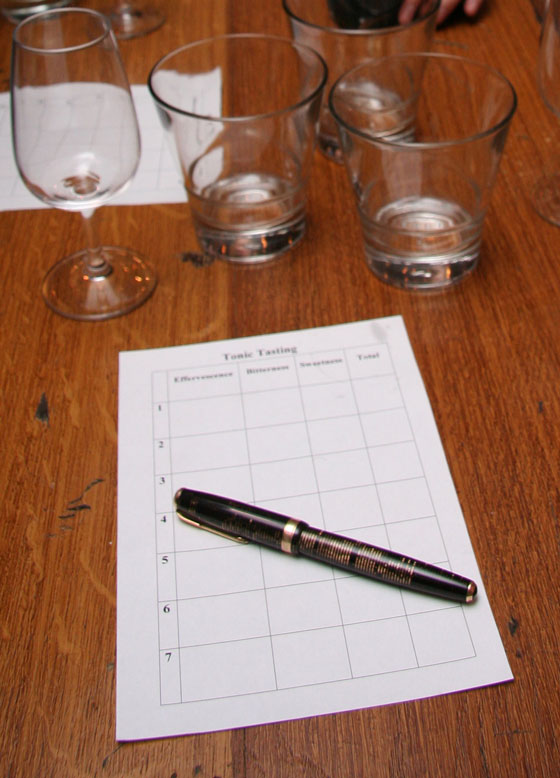
My scoring grid, before I cover it in tonic-spattered
tasting notes that ignore the categories of bitterness.
sweetness and effervescent DBS has carefully laid out
Quinine itself came originally from South America. In 1638 Countess Chinchona, wife of the Spanish Viceroy in Peru, was cured of a fever by a local healer using bark from the native quina tree; this popularised the substance across Europe, where it cured Charles II and Louis XIV, and the tree acquired the botanical name Cinchona Officinalis after the countess. However, the bark seems to have been in use in Rome (surrounded by malarial swamps in those days) at least as early as 1631, having been brought back by Jesuits (in fact it was known as “Jesuit’s bark”). The active ingredient quinine took its name from the native word for the tree, though “cinchona” turns up in the names of fortified wines like Kina Lillet and China Martini, which both contain extracts. Peru and the other countries where it grew outlawed the export of trees and seeds, and the bark became rare and precious, but eventually seeds were smuggled out to Indonesia and the tree became widely cultivated in Asia and the West Indies.

Mind you, modern tonic waters have much less quinine (but apparently still enough to make them fluoresce under UV lighting—there’s something you can try at home), although tonic is still recommended for treating nocturnal cramps. In fact anyone genuinely wanting to take therapeutic quinine might be interested in a concentrated tonic syrup that DBS and I were given to try by Louis Xavier Victor-Smith of Hendrick’s. It’s called Battersea Quinine Cordial though I don’t think it has actually had a commercial release yet. I thought it was yummy.

The quinine cordial they don't
want you to have
However, the Battersea Quinine Cordial was not among the tonics we tasted on Monday, although we had been sent a phial of John’s Tonic Syrup all the way from Arizona—it comes as a concentrate and you add soda water.

We initially tasted the tonics neat and DBS asked us to rank them in order of preference. Although the blindness of the tasting was laudable, owing to a shortage of glassware we had to taste the samples one at a time, which meant you somehow had to remember the flavours of all of them to make a comparison. DBS, ever the instinctive taxonomist, does like to know which of any group of samples is your “favourite”, but I often don’t have one—I’m just interested in the differences. Here are my tasting notes, in the order we tasted—bearing in mind that at the time I did not know what I was tasting in each case:

Tesco own brand Lime on the nose and palate. A bit one-dimensional. Quite sweet, lacking in bitterness. Not very effervescent.

Schweppes More fizz, more dominant bitterness, less citrus than the last one. Not much happening in the aroma department.

Britvic Very effervescent, giving an interesting mouthfeel. Balanced citrus notes. Nose is more complex than previous two.

John's Tonic Syrup, handmade at the Tuck Shop
restaurant in Phoenix, Arizona
John’s Tonic Syrup This one is frankly brown, which is a bit of a giveaway (although, as we didn’t even know which tonics were on test, I guessed it was David’s own homemade tonic syrup, which is pretty terrifying). This one was unexpectedly savoury and vegetal, with an extraordinary spicy, herbal nose and earthy root flavours. Plenty of bitterness—perhaps too much for drinking on its own. Leaves a disturbing tide mark of interesting scum around the glass. Overall, quite intriguing, but a bit outside the comfort zone if tonic water is what you're after.

Fever Tree Good mouthfeel from the balanced effervescence. Plenty of citrus on the nose, although unfortunately it reminds me of some cleaning product. Good level of bitterness, though a shade too much for drinking on its own. Good balance of lemon and lime, though the taste seems a bit crude.

Schweppes Slimline Big citrus nose—though not backed up on the palate, which is pretty empty. A slightly austere mouthfeel. Overall a bit watery, which at least makes it easy enough to drink on its own.

Fentimans Rather an overwhelming nose of citrus. Big exotic flavours, including lemongrass, are a giveaway: although we weren’t trying to identify the brands, Fentimans is pretty distinctive.

6 O’Clock Very bold! Nose does have a hint of varnish but on the palate it is rather tasty.

Obliged to rank them, I put Schweppes and Britvic joint first, 6 O’Clock third, Tesco fourth, Fever Tree fifth, Fentiman’s sixth, Schweppes Slimline seventh and poor John’s tonic last. In truth I was only certain about the last three, and even then I think Fentiman’s is actually quite nice but too overwhelming as a mixer. Likewise the brown syrup is fascinating but not what I look for in a tonic water. (Or perhaps it just takes a bit of getting used to?)

The winners, by popular vote
As a group, our overall rankings put Schweppes first, Britvic and Schweppes Slimline joint second, Fever Tree and Fentimans joint fourth, Tesco and 6 O’Clock joint sixth and John’s syrup limping in lasting place. Apparently these are pretty standard results for this sort of blind test, and in fact mirror a home tasting that DBS held, where Britvic came out a surprise winner.

I don’t drink tonic water on its own, so I had no real yardstick to compare against; but I do drink G&T, and we now had a chance to taste the top three (plus 6 O’Clock, for curiosity’s sake I guess) with gin (Bombay Sapphire in this case). I added Fever Tree too, because it is what I usually drink at home. The results were a bit different:

Britvic Dominated by citrus and sweetness—too sweet for my tastes.

Schweppes Less sweet than Britvic and more citric than Fever Tree. Has a sort of neutrality about it; arguably a benchmark taste for what a tonic “should” taste like.

Fever Tree Compared to the others this is all about mid-range notes for me, warm and almost spicy (Fever Tree don’t say what goes into it but do mention “botanical oils”), compared to the high citric notes that dominate some others. It’s probably worth experimenting with matching different gins and different tonic waters.

6 O’Clock Rather nice, though I kept getting an odd hint of mustard (I was alone in this observation). This tonic was actually created to match with 6 O’Clock gin, a combination I’d be keen to try.

Schweppes Slimline Doesn’t taste much of anything.

The lesson? Well, if you’ve always used the same tonic you might well be surprised by the differences if you shop around. Mind you, if your default tonic is Schweppes then this test at least shows that you can rest assured life is not passing you by.

Saturday, 6 November 2010

Clayton's Special Cocktail

Well, how could I resist? I stumbled across this one in The Savoy Cocktail Book (1930).The recipe appears simply thus:

Clayton’s Special Cocktail
½ Bacardi Rum
¼ Kola Tonic
¼ Sirop-de-Citron
Shake well and strain into cocktail glass.

We all know what Bacardi is, but what exactly is Kola Tonic? Just an antiquated name for Coca Cola? Yes and no. There is a still, concentrated drink called “Kola Tonic” from the brand “Rose’s” in South Africa, which is not too surprising considering that the kola nut is African in origin. (This drink is also very high in caffeine, I gather.) But then I discovered a “Kola Tonic” made under the brand “Clayton’s”.This must surely be the stuff intended by the original recipe.

Apparently originally blended by the Clayton brothers in Battersea in 1880, the drink is now made, for the panting worldwide market, exclusively in Barbados. It is non-fizzy, non- alcoholic and intended, by and large, to be drunk diluted. I gather that in the 1970s and 1980s it was heavily marketed in Australia and New Zealand as a non-alcoholic choice in the pub,“the drink you have when you’re not having a drink”.

What does it taste like? It tastes like...what you imagine Coca Cola was probably intended to taste like. One sniff of the bottle and it obviously smells of Coke, but there is a more pronounced lime element and also a hint of creosote, but in a good way, flavours that aren’t alien to Coca Cola but were always submerged by the synthetic nature of the globally marketed drink.

Monin make a lemon syrup but I didn’t have one to hand so I made my own from sugar and water, added the grated zest of one lemon and left it for an hour before straining it.

The resulting cocktail tastes, I admit, a lot like a Bacardi and Coke—yet somehow more alive, more fruity and zesty. Given that it is 25% syrup, I predicted it would be very sweet, but it is no sweeter than a regular Bacardi and Coke. (It may be that commercial sirop de limon is less sweet.) Certainly neat Clayton’s Kola Tonic is actually rather bitter, making it a more versatile cocktail ingredient than Coca Cola.

I've seen Clayton’s Cola Tonic in selected Waitrose branches and you can buy it online from thewhiskyexchange.com and the Kendrick Street Deli. Rose’s can be had from thesavanna.co.uk.

Thursday, 4 November 2010

Curiosity Cabinet #1

A Drink To Get Your Teeth Into

Early fans of The Institute for Alcoholic Experimentation (IAE) may be aware of Mr. Hartley's glass of bacon liqueur to celebrate the founding of our great institution.

Well, I don't have any bacon liqueur, but after someone mistook my mincemeat vodka for beef mince vodka, I started to think of drinks with a little more meat to them.

I started with some bacon, which I fried until crispy. Originally I was just going to use the fat from the pan (the "fat wash method"), but as this seemed rather measly, I didn't think I would have a leg to stand of in terms of giving the vodka any flavour; so, instead, I decided to beef it up a little by adding the crispy bacon, thus the flavouring was a joint effort between the two.


After leaving the meat and vodka to marinate for a while, I gave it a little taste (I didn't want to be called a chicken); it still had some of the fat in it and so wasn't very good.

After a further 6 hours of steeping, the bacon was thoroughly basted by the vodka and so I threw the former out and began to strain the spirit. Amazingly, the liquid began to clear until it resembled apple juice and, for the first time, I thought my experiment might not just be a turkey.

The last 10% of the spirit didn't make it to the final product (I only took the finest cuts), as it was mostly heavy sediment.

As regards the taste, the biggest problem with this seemed to be psychological; meaty alcohol is a bit odd and may turn the stomach of the hardiest. In fact, Mrs. B said it rather slaughtered her taste buds and, when asked if it had any redeeming qualities, not a sausage; not exactly high praise. Although it looks nice, it is merely mutton dressed as lamb.

I did have fun coming up with a cocktail though: the Bacon Sarnie, which consisted of a layer of tomato ketchup, followed by the bacon vodka and garnished with a triangle of lightly toasted bread. This wasn't too bad, but did butcher the Martini.*

I think more experimentation is definitely needed to wrestle with the gristle of meaty drinks, but I would say there is a reasonable steak that something tasty may emerge. Reducing the saltiness of the vodka would be a good start; next stop, the Full English Breakfast Cocktail.

* This wasn't really a Martini, it was just served in a Martini glass.

Wednesday, 3 November 2010

Martini gadgets of yesteryear

A Martini Scale
The American golden age of the Three Martini Lunch, with its obsession with making the cocktail with minuscule and carefully controlled quantities of vermouth*, gave rise to a range of inventions designed to take the human error out of producing the perfect drink each time. The "Martini spike" was a large calibrated syringe for injecting vermouth into your drink; others used droppers or atomisers, for breathing a hint of vermouth over your gin; another approach was actually to use a hygrometer to adjust your drink accurately using its specific gravity.**

At a Martini masterclass last week at Graphic, hosted by Martin Miller's gin, Mr Bridgman-Smith brought along a few devices from his collection.*** Pictured here is a Martini Scale. The idea is that you set as a fulcrum one of the pre-cut notches, depending on your desired ratio of gin to vermouth—5:1, 10:1 or 25:1. You fill the large container with gin, then add vermouth to the smaller cup until the arm just balances.

Adam deploys the Martini Scale, using a bar spoon to drip in just enough vermouth for it to balance

It's harder than it looks if you are going to be a stickler for getting it to balance precisely (and if you are not then why use it at all?). I can't help thinking that one could achieve pretty much the same effect by eye… and there would be less washing up to do as well. Moreover, if you're that much of a stickler, what are the chances that your idea of a perfect Martini will happen to fall on one of the three ratios on offer? (I can just imagine obsessives "modding" their Martini Scale by adding extra weights to tweak the balance one way or the other.)

DBS displays his Martini stones in operation
Stranger still were the "Martini stones" that DBS brought along with him. These are precisely that—small stones that you keep immersed in vermouth. To make your drink you simply plonk one or more in your gin. Why is this good? I haven't a clue. Is the idea that you choose your stone carefully by size and porosity (pumice for those who like more vermouth, moving through marble or granite for a drier drink; what's the least porous stone? Something like slate?).

I think the Martini stone owes its existence to a chain of reasoning rather than ground-up thinking. One of the ways of avoiding vermouth overload in the good old days was to soak your olives in vermouth and simply use what clung to them as your dose. But I gather that some perfectionists felt that the olives absorbed a bit too much vermouth—so they used stones instead.

But if you really have so little faith in your chances of mixing the perfect Martini every time, you may want to leave it to the professionals and either go to a bar—or buy your cocktail pre-mixed. DBS also produced a ready-mixed dry Martini cocktail made by Gordon's. It was OK.

A pre-mixed dry Martini
Hosting the Martini class was Jeff Masson, a Miller's ambassador and also the man behind the UK incarnation of Cocktail Kingdom, purveyor of, among other things, reproductions of classic cocktail books. He later sent us the image below of what is the earliest printed recipe for a "dry Martini" of which he is aware, from How to Mix Fancy Drinks, published in 1903.

I bought a couple of Jeff's reissued books, David Embury's classic The Fine Art of Mixing Drinks and The Modern Bartender's Guide from 1884. The latter doesn't feature the Martini, but it does have the Martinez, which the author O. H. Byron (about whom nothing is known—he may have been invented by the publishers) describes simply as, "Same as Manhattan, only you substitute gin for whisky." He offers two Manhattan recipes: one is two parts French vermouth to one part whisky plus Angostura bitters and gum syrup. The other is equal parts whisky and Italian vermouth plus two dashes of Curaçao and two dashes of Angostura bitters.

Martini recipe from 1903
If you make a Martinez based on this latter recipe you end up with something almost identical to the basic 1903 Martini, except for the extra orange bitters and use of Peychaud instead of Angostura.**** Moreover, Harry Johnson's New and Improved Bartender's Manual (1882), contemporary with Byron's book, does have a "Martini" recipe that is more or less the same as Byron's Martinez. Most modern  cocktail books will usually regard the Martinez and the Martini as different cocktails, presumably because by "Martini" we now think of the ascetic modern dry version. But given all the arguments about when, where and by whom the Martini was "invented" it's interesting to note that even this early "dry Martini" has much less in common with those later ones—for which so many techniques, theories and, indeed, gadgets existed to get them exactly "right"—than it does with the 1884 Martinez. It's clear that the one evolved gradually from the other, and Byron's wording also suggests the Martinez was simply a development of the Manhattan.

The cover of the book in which the above recipe was found
A more interesting question might be why a drink that is so difficult to define in terms of what actually goes into it and how it is made should end up inspiring so much love, care, protectiveness, ritual and mythology. What does it tell us about our drinking culture?

* The authors of The Martini Book, put out by the Gilbey gin company, offer the theory that every 30 years Martinis become one part drier.
** I suspect the fad for these contraptions was connected to a post-war affluence and optimism that led to a rise in domestic gadgets in general. I think something similar happened in the UK in the 1970s, a period that seemed to produce all kinds of pointless kitchen appliance, such as the electric carving knife. My parents-in-law recently offloaded a number of these on me, including the "Saucier" automatic sauce maker—an electrically heated pan with a rotating paddle inside—and another device which solves that frustrating conundrum of how to peel, slice and core a pineapple all in one go—Hitler would probably have won if he'd had one of those.
*** For a more in-depth and scholarly look at the history of the Martini, see m'colleague's essay 'The Silver Bullet', originally published in issue 18 of the New Sheridan Club Newsletter but also available online on the NSC website.
**** In fact a Martinez made following the first Manhattan recipe gives you something not dissimilar to the "dry Martini" too, though sans the citrus elements from orange bitters and curaçao and again using Angostura instead of Peychaud.

Tuesday, 2 November 2010

The Corpse Reviver No.2

A Corpse Reviver No.2

Halloween got me thinking about this classic concoction. I first encountered the Corpse Reviver No. 2 in an interview with Ted Haigh (a.k.a. “Dr Cocktail”, though I don’t think his qualification is recognised by the medical profession), an American cocktail historian credited with bringing this 1930s bar staple back from obscurity. Many have raved about the complexity of this drink, how you can taste all the elements. In that sense it’s a pretty good example of the whole point of mixology.

1 part gin
1 part Cointreau
1 part Lillet blanc
1 part lemon juice
1–3 drops of absinthe or pastis
Shake all the ingredients together with ice, strain into a Martini glass and garnish with a maraschino cherry.

Most sources seem pretty agreed on this, though personally I prefer to increase the gin and reduce the Cointreau, but I don't have much of a sweet tooth. (In fact reducing the Cointreau and lemon juice by a third creates something that seems to have its own name, the Miracle Cocktail). It's worth playing around with the absinthe so that it's making its presence known but not dominating. The monicker relates to the drink’s ability to revive the hungover, though Harry Craddock's The Savoy Cocktail Book (1930) observes: “Four of these taken in swift succession will unrevive the corpse again.”

Craddock actually specifies Kina Lillet but, as fans of the Vesper Martini will know, that is no longer made. Kina is more bitter than Lillet blanc, and in fact most of the slight variants on this recipe I've encountered seem to tinker with the Lillet, while leaving the rest as it is: it's worth trying all the Kina Lillet substitutes mentioned in m'colleague's separate article on the Vesper in his own blog. Simon Difford's Difford's Guide #8 (2009) presents three versions of the Corpse Reviver No.2, none of which uses Lillet—deploying instead dry white vermouth, Yellow Chartreuse or Swedish Punch*, the last one adapted from Victor Bergeron's Trader Vic's Bartender's Guide (1972).

The only major variant I have found under the same name is in Larousse Cocktails (2004). Discussing the Hemingway ("½ measure Pernod, 2½ measures Champagne", a.k.a. a Death In the Afternoon) it adds that replacing 1 tsp of the Pernod with lemon juice makes a Corpse Reviver No.2, a drink the author adds was invented in 1926 by Frank Meier at the Cambon Bar in the Ritz Hotel in Paris. You can see the connection here, though this drink sounds to me like a cross between the Corpse Reviver No. 2 and a French 75.

So what was the No. 1? The Savoy Cocktail Book has this recipe:

¼ Italian vermouth
¼ apple brandy or Calvados
½ brandy
Shake well and strain into a glass. “To be taken before 11am or whenever steam and energy are needed.”

This is the recipe one is most likely to encounter. One US online experimenter comments, “Its use as an invigorator is not without merit. I must say the looming workday is becoming much less so with every sip. There’s almost no harshness, despite the alcohol content, with the Calvados adding a bit of juiciness to it... I also added a schvitz of grapefruit oil to the top, which tends to brighten up flavours, particularly in a juiceless cocktail.”

However, there is another version of the No. 1. Larousse gives it as:

1 measure Cognac
⅓ measure Fernet-Branca liqueur
⅓ measure white crème de menthe
Stir with ice and strain into a Martini glass.

Elsewhere I have found this recipe referred to as a Savoy Corpse Reviver, though it post-dates the Savoy book by some 24 years: Alex'scocktailrecipes.com explains, “Created in 1954 by Joe Gilmore, the head barman of the American Bar at the Savoy Hotel, the cocktail was created for ‘morning after’ clients who required a hair of the dog, but couldn’t remember which dog from which pack of hounds had bitten them.” I suspect that variety is not the secret—the aromatic blast from the Fernet-Branca and the crème de menthe will open any eye.

*Swedish Punch, or Punsch, dates all the way back to 1773 when the Swedish East India Co. started importing arrack from Batavia, Java. Arrack is distilled from rice wine, sugar cane and/or coconut palm sap and barrel aged. Punsch is a blend of arrack and grain neutral spirit, spiced with cardamom, nutmeg and cinnamon. It used to be served warm. I've not tried any but I'm told the arrack gives it a smoky rum sort of flavour.