Tuesday, 11 February 2025

The Pink Lady cocktail


We’re attempting to move house after 31 years in the same place, a mind-boggling process that makes you realise how much stuff you have accumulated since you moved in as a twenty-something, all of whose worldly goods could fit into two loads in a Ford Escort. Apart from anything else, it’s made me consider all the dusty bottles that have accumulated, either at the back of the cupboard in the kitchen or on the shelves in the cellar—the latter tend to be ingredients for specific cocktails at Candlelight Club events of the past.

I know that, historically, if I’ve had a sample bottle of something interesting, I have a habit of not quite finishing it, in the belief that I might someday want to make a comparison between this product and whatever similar liquid I am currently examining. Consequently there are a lot of bottles down there with a centimetre or so of spirit at the bottom. But the Candlelight Club leftovers can sometimes be present in a couple of more or less full bottles, if we managed to misjudge how much stock we needed. We have Bärenjäger honey liqueur, Frangelico hazelnut liqueur and Briottet’s intriguing poppy liqueur—I suspect the latter was for one of our 1920s Shanghai themed events, riffing on an opium den concept…

Another of the Briottet liqueurs I found was their pink grapefruit offering, and it’s this that I’m focusing on today. You can buy this beverage on Amazon easily enough, and there are other grapefruit liqueurs out there too. I had the idea of using it to replace the curaçao/triple sec in a White Lady, to produce something I’m calling a Pink Lady. The classic White Lady has roughly two parts gin to one part triple sec and one part lemon juice, traditionally with some egg white to add a thick, silky texture and a foamy finish, though this is often omitted if you are a vegan, or simply can’t be bothered to separate an egg. Some recipes have slightly more of the liqueur (and Difford’s version keeps equal parts liqueur and lemon juice, but adds some sugar syrup). I found that the Briottet grapefruit liqueur (evidently made from actual grapefruit, judging by its cloudy appearance, rather than essential oils) is a bit subtler than something like Cointreau, so I ended up with 50% more of that than the lemon juice, to keep the grapefruit flavour present, then added a bit more gin so that it wasn’t too sweet.

Pink Lady
2 ½ parts gin (I was using Plymouth)
1 ½ parts grapefruit liqueur
1 part lemon juice
½–1 part egg white (optional: I’ve omitted it in the photo)
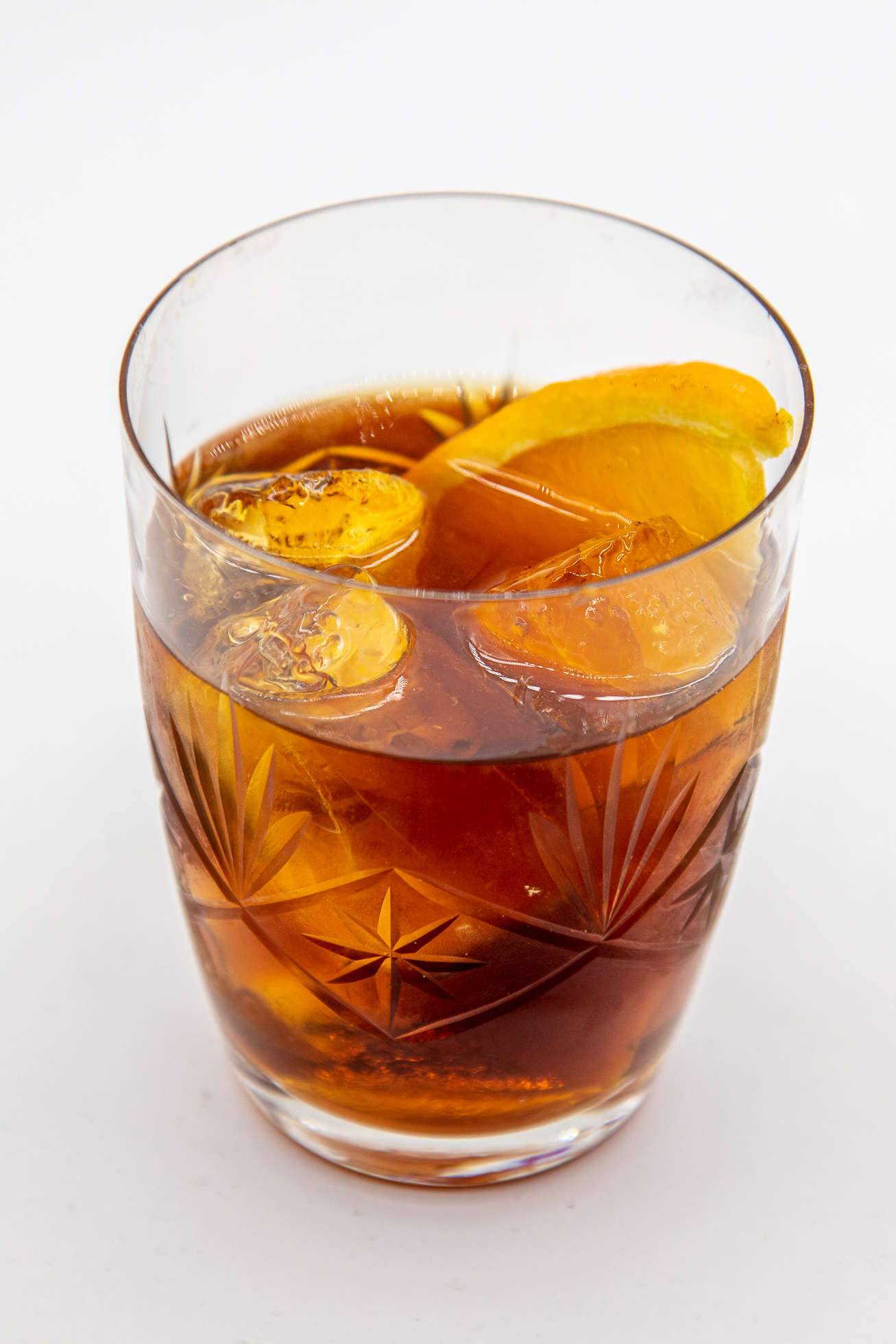
Shake all ingredients with ice and strain into a cocktail glass. Garnish with a strip of grapefruit peel or a slice of grapefruit.

What’s intriguing about this cocktail is that, even though it has liqueur in it, the bitterness of the grapefruit combines with the tartness of the lemon juice and the lean juniper notes of the gin to make something that comes across as, not exactly austere, but quite grown up. It’s full of flavour, but quite sharp. You can imagine a 1930s newshound or private eye propping up the bar with one of these while he considers his current moral dilemma, and it makes a good aperitif, priming the tastebuds for dinner.

I see Giffard and Bols also make grapefruit liqueurs, so there are a few to choose from. I also imagine it will go well with rum—I’m thinking variations on the Papa Doble—and I seem to have combined it in the past with tequila (Mexicans apparently mostly drink their tequila with grapefruit soda).

Friday, 17 May 2024

Gin is a cabaret, old chum


One of the last things I remember doing just before lockdown was a trip to the launch of Hendrick’s Lunar Gin with David T. Smith. This expression was more spicily floral than regular Hendrick’s and apparently had lavender essential oil in it. More recently, Mr Smith passed me the remains of a bottle of Hendrick’s latest offering, the Grand Cabaret Gin.

As usual they aren’t very specific about what goes into it, though they call it “an indulgent creation infused with a sensuous cabaret of decadent stone fruit flavours and shimmies of sweet aromatic herbs. Inspired by a 17th-century fruity French experiment, where distilling mounds of stone fruit unexpectedly yielded a truly tasty potion sparked the imagination of our master distiller, Lesley Gracie, to experiment with that same sense of poetic extravagance.”

On the nose it is certainly fruity, though after pondering it a while I conclude that the fruit it most reminds me of is raspberries (which aren’t stone fruit, so who knows where that comes from), with a solid orangey citrus note too. On the palate it’s a bit sickly, but with a herbal dryness that holds these tendencies back a little. It’s certainly a gin underneath, but the fruitiness dominates.

Adding tonic seems to bring out the cucumber for which Hendrick’s is famous, plus something brambly. As G&Ts go it’s got quite a sherbet vibe to it. I try a Dry Martini using Belsazar Dry: this brings out a slight caramel note, but overall it’s not a match made in heaven. The dry, herbal quality of the vermouth actually seems to quarrel with the juicy-fruit character of the gin.

With this in mind, I try an Aviation (a proper one, made with both maraschino and crème de violette), wondering if the florality of that cocktail would work well with the gin. It certainly doesn’t not work, though surprisingly the gin slightly gets lost. Perhaps its defining character is being masked.

I usually try new gins in a Negroni too, though I suspected that the muscle of the vermouth and Campari would whup the gin good and proper. But in fact the raspberry note rises clear above the bitter-sweet melée, adding a distinct and wholly harmonious layer. This is without doubt the stand-out serve for the gin of the ones I tried. I makes a distinctly summery drink (and I say this having tried it in late January) and, now that it is quite summery here in the UK, one that I can heartily recommend you try.

Wednesday, 15 May 2024

Fit for a king: Buckingham Palace gins

We were at the King’s Gallery in London to look at the exhibition about Georgian fashion, and as we drifted out we were inexorably steered towards the gift shop, where I was interested to see they sold gin. The gallery is actually part of Buckingham Palace and the Buckingham Palace Dry Gin they had on offer uses 12 botanicals gathered from the gardens there, including lemon verbena, hawthorn berries and mulberry leaves.

Priced at a fairly stiff £40, the gin comes in a handsome fluted bottle with a rather understated label that might almost look laser-printed if it weren’t for the gold foil decorative border. Other than the three botanicals mentioned above, I can’t find any other details about what goes into it, but as soon as you open the bottle you get a joyous hit of juniper and citrus. This remains strong in the glass, with the mentholly juniper dominating, with a hint of candied violets and a sharp aromatic like lemon balm or lemon thyme (perhaps the lemon verbena), plus something earthy—maybe from angelica or orris.

On the palate those high, bright notes remain, but on a base that is warm and full, almost chocolatey. Perhaps it’s the contrast with the brisk nose, but the liquid gives a sense of smoothness and sweetness on the tongue, almost like icing sugar, although there is a slight bitterness on the finish. In a gin and tonic it is cool and sophisticated, with a traditional juniper and citrus profile augmented by a hint of cucumber. It’s still warm and smooth compared to some gins but with the bright, aromatic lift and a G&T is surely all about.

In a Dry Martini it has a classic profile, but that bitter finish is noticeable. I’m using Belsazar Dry vermouth which adds a note of vanilla, but the juniper and citrus of the gin cut through clearly. In a Negroni its presence is quiet: it benefits from upping the proportion of gin in the mix. Overall, I suspect the makers reckoned their target market would be mostly drinking it with tonic, and deployed in this way it works well. 

Overall, I rather like Buckingham Palace Dry Gin. It is very classic in style, but with some sophisticated flourishes. Which I suppose is what you would expect from the King’s gin.


While at the palace I noticed that they sold another gin, called Buckingham Palace Coronation Gin. Inevitably curiosity got the better of me and I decided to try this one too—fortunately they were selling it on Amazon, so I didn’t have to go back to Buck House to get some. Interestingly, although this also comes in a fluted bottle, it is a different design, with a larger number of narrower ridges. I would have thought there would be an economy of scale if they’d just used the same bottle with a different label…

The nose of Coronation Gin is immediately warmer, with less of the aromatic high notes of juniper and lemon, and more lower notes, reminiscent of rose, honey and cinnamon. On the palate it has the same initial smoothness but with more of a honeyed mouthfeel, and without the herbaceous, resinous high notes of the Buckingham Palace gin. 

With tonic water, it makes a darker G&T with an interesting whiff of toffee-mint on the nose. On the palate this is continued: it’s like a dark cupboard filled with toffee mints, candied geraniums, damson jam and marmalade. It’s less of a sharpener that a G&T made with the first gin—perhaps more of a late-night contemplative gin (just like Hendrick’s Lunar Gin, but without the added essential oils). 

I try a Martini made with the Coronation gin. (With both these gins I started with a ratio of 4:1 but, feeling that the vermouth dominated a bit too much, moved to 6:1.) While the nose is more about the midrange, the palate is savoury, almost salty, but with a somewhat candied finish. There is an odd hint of banana. 

Given the gin’s warm, spicy approach, I suspected it might work well in a Negroni, and it does, in the sense that it sits harmoniously with the vermouth and Campari. But to a certain extent it is lurking in the background rather than making firm friends.

As you can probably tell, I preferred the Buckingham Palace gin to the more spicy Coronation number. The former’s classic profile makes it eminently usable, but it has sophisticated nuances that give it certain class as well. Is it worth £40 a bottle? No, probably not, so I won’t be making it my go-to. But if money were no object, it would have many of the qualities you’d look for in a house gin. Particularly a house like Buckingham Palace.

Thursday, 1 February 2024

Ancient Egyptian Cocktails at the Bloomsbury Club

Let the mystical pyramid choose your cocktail

To Bloomsbury, for the launch of a new cocktail menu at the Bloomsbury Club, in the bowels of the Bloomsbury Hotel—thanks to Megan and Katie from Cru for the invite. We struggled to find the place at first, not realising that the hotel had two cocktail bars, the other being the scintillating Coral Room, to which we’d been before. Such extravagance.

I’ve come across some pretty elaborate cocktails before—such as ones that are served under a glass dome filled with smoke, or one that came in a flask inside a hollowed-out Bible—but this whole menu is pretty high-concept even by these standards. It’s based around Ancient Egypt, on the grounds of the connection between the Bloomsbury Group of artists and the 1922 discovery by Howard Carter of Tutankhamun’s tomb. If you look it up, the connection is actually pretty tenuous, but it was all going on at around the same time. 

What greets you under the pyramid's lid
Each cocktail is named after an Egyptian hieroglyph. Which sounds like a good idea, until you trying asking for them by name in a noisy bar environment. Bellow at the waiter that you’d like a Hu, an Ib and a Ka, and you can’t help feeling that you sound like you’ve already had too many. According to the menu (a detailed booklet that is apparently available for sale, and which naturally I stole), each cocktail actually tries to embody the essence of the hieroglyph in its flavours. I told you it was high-concept.


It gets better. The menu insists that, inspired by the symbols inscribed on sarcophagi, the Bloomsbury Group adopted Ancient Egyptian mystical philosophies, in an attempt to glean universal human truths and come to know The Self. One part of this is the act of divination: although the menu doesn’t go so far as to say the Bloomsbury Group partook of this, the bar does give you, the customer, a chance to have a go. At the beginning of your evening you are presented with a pyramid (mixed media, mostly printed cardboard). Lift the lid and you find a central chamber containing a pendulum. You then allow the pendulum to swing over the top and slowly lower it until it touches one of the “tombs” surrounding the chamber. Lift the lid of this sarcophagus and your family will be cursed for a thousand generations. Only joking. What you actually find under the lid is the name of the cocktail you should order.

In the menu, there is a paragraph under each cocktail telling you what your cocktail choice reveals. Given that your “choice” has been made for you, at random, I guess it’s not revealing what it means that you chose it, but what it means that the gods chose it for you. For example, if you end up with the cocktail named after the god Nefertum, it means the god is calling you to “cast off your neuroses and find wonder in innocent things” (which enough of pretty much any kind of alcohol will do, I guess). If it is divined that you should chug a Meri, it means that “you have been too wrapped up in yourself lately. Meri is here to drag you outside and connect you with the wider world.” (So it’s Meri dragging you outside, not the bouncer—remember that.) “Plant flowers, savour the seasons, get muddy. Breathe energy into your relationships, particularly family. Discover unity everywhere.” (Slurring, “You’re my best mate, you are,” is a start, I presume.) So for an average price of £17, you’re getting therapy as well as a glass of booze, which is pretty good value for London.

I’ll be honest that after the first drink we fell to making our own choices, based on the ingredients listed in the menu. But here we realised that the process was not much different from allowing a pendulum to choose your drink for you, as the description is not much of a guide to what you get. For example, the Scotch-based Kheper includes double cream, yet it is completely clear. We mentioned to the waitress that it looked as if they’d forgotten to include the cream, but she explained it was “clarified cream”. (Can you clarify double cream?) Likewise the Meri contains “honey lassi”—yoghurt, right?—yet is not only clear but colourless too, which is weird as it has Eagle Rare 10-year-old bourbon in it. The Ib contains “saffron custard”, which makes you think it’s going to be like a Snowball, yet it too is clear.  (We struggled to detect either custard or saffron.) Meanwhile, the Champagne-based Manu really does taste like a classy Snowball, dominated by vanilla. (The ingredient is “vanilla salep”—I looked it up and a salep is an Ottoman drink made with flour from the orchid bulb.)

A Manu in the tall glass and a Se Shen with the rose petal
So the cocktail descriptions keep you guessing. But are they nice? Our group of four managed to taste all 12 cocktails on the menu, and in the first instance I would say that it helps if you have a sweet tooth. The Pyramid of Mars declared that Mrs H. should have the Kheper, but even for her it was too sickly to finish, dominated by golden syrup, though not without interest from the Drambuie, carraway, cinnamon, cloves and nutmeg also included (the carraway being the most noticeable for me). The gods assigned me the Nefertum, which was sweet too, presumably from the orgeat almond syrup, but balanced by acidity from persimmon, physalis and grapefruit. The base was 11-year-old Santiago de Cuba rum, which came through nicely.

The Meri, with its bourbon joined by cacao, crème de menthe, Branca Menta and honey lassi, sounds like it’s going to be a chocolately Old Fashioned, but, in addition to being colourless, it’s dominated by the mint (crème de menthe mint, not fresh mint), and the bourbon is reduced to a subtle woody ambience. Meanwhile the Ib, made with Chardonnay grape skin vodka, crème de peche, Galliano, saffron custard and peach and jasmine soda—which the menu itself describes as rich and creamy—turns out to be long, floral and refreshing, and was a firm favourite in our group. The Champagne in the Manu (which is slightly more expensive at £25) is clearly present, being the first thing that hits your nose, and its dryness offsets the sweeter elements. But, as I say, it’s vanilla that dominates, and one struggles to detect the tantalising “fig Sauternes” listed in the menu.

But the drinks are by no means all cloying. The Ir Ma’at, made from vodka, Italicus Rosalino di Bergamotto, dry vermouth and yuzu sake, is sharply bitter and aromatic. My two favourites were both pretty punchy: the Ka contains mezcal, green coffee beans, pineapple, lime and “coconut and rosemary agave”, and I would not have guessed that coffee and rosemary would go together so well. And the text for the Wadget warns that “A powerful force is about to surge up in you,” and they are not wrong about this spicy combination of tequila, rosé vermouth, strawberry, cacao, thyme and chilli salt.

Overall, a hell of lot of effort and thought has gone into this menu. Perhaps they’ve overthought it with the mystical pyramids, but they certainly don’t do any harm—and, as I say, the randomness of the drink selection isn’t much different from the surprise you might get if you try and choose a drink based on the way it reads on the page. If your ideal cocktail is a Dry Martini, then you may find some of these too sugary by three-quarters, but overall the menu has bitter and aromatic concoctions too. It’s just a question of guessing which ones they might be.


Tuesday, 17 October 2023

Vintage Pimm's No.5 and No.6—unopened bottles

My two 1960s bottles. Note that I'd already opened them by the time of the photograph


I’ve known for a long while that the fruit-infused summer classic, “Pimm’s No.1 Cup”, was actually just one of, at one time, seven different cups, each with a different spirit base. The gin-based No.1 was the original, created by James Pimm in 1840 as a tonic, sold by the tankard in his oyster bar. It contained a secret blend of fruit, liqueurs and spices. Scotch-based No.2 Cup and brandy-based No.3 were introduced in 1851 (though I’m not clear at what point these were bottled commercially). The 1930s saw the addition of dark-rum-based No.4 and rye-based No.5, while the 1960s added vodka-based No.6 and tequila-based No.7. All but No.1 were discontinued in the 1970s, although No.6 was brought back by popular demand between 2004 and 2021.*

So I was intrigued when a friend produced two battered bottles of No.5 and No.6, part of a dusty lot he’d bought at auction. (He does this quite a bit, and every time we meet he has some new curio to sample.) The labels are pretty ragged, but on one you can still see that the ABV is given as 55° proof (28.9 %), which would date them most likely to the 1960s. (They were originally 60° proof, lowered to 55° in the 1960s, and today Pimm’s is 25% ABV.)
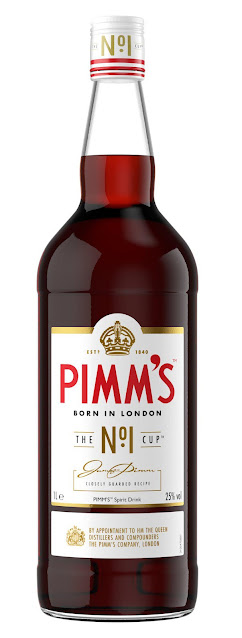
Pimm's modern plumage
Modern bottles still say “The original No.1 Cup”, though I note that there is no mention of gin (it’s simply described as “Pimm’s spirit drink”), and to taste it you aren’t immediately put in mind of gin. No ingredients are given, but then it is a secret recipe. My vintage bottles are actually blazoned “The original rye sling” and “The original vodka sling”.

I crack open the No.5 and the first thing that hits you from the nose is that it is very clearly made from rye, plus subtle fruit elements—not the sort bubblegum synthetic fruit flavour you find in some modern products, but hints of actual strawberry, orange and peach. On the palate it is rye-forward, plus a sweetness and those gentle fruit elements, then a striking chocolate finish. This is quite a departure from modern Pimm’s where the spirit base is not something you’re really aware of.

I open a bottle of the modern stuff that I have in a cupboard (so not the freshest, in fairness). It actually has the same sort of dry, subtle fruitiness on the nose as the No.5, but without the whiskey. On the palate it has a sweetish attack, a thick mouthfeel, but a slightly hollow body, and a faint finish of caramel. It’s a flavour sui generis, something we all recognise, though I would say it is greatly less redolent of fruit than the No.5. It’s true it’s an oldish bottle, that was first opened some time ago—but not nearly as old as my bottle of No.5! The No.5 is about the same sweetness, with a bitter element from the wood in the rye, but a much more vibrant fruit character. It’s actually quite exciting to taste this and get a glimpse of what Pimm’s is capable of being.

Perhaps I should have approached the vodka-based No.6 first, given that vodka is going to be a less powerfully flavoured sip than rye. But I’m surprised again that even here you can clearly taste that the base is vodka, quite a punchy vodka at that. And again the fruit elements are more freshly fruity than with my modern bottle. Whereas the modern No.1 is alcoholic, but doesn’t taste of a base spirit, just the other elements, the vintage No.5 and No.6 are very much a recognisable spirit, blended with other fruity elements. It actually makes me want to drink them neat (though this is clearly not how they were ever meant to be served) which is not something I would say about the modern No.1. Given that you’d expect the fruit elements to fade with time, I am amazed at how lively these 60-year-old drinks still are. (We’ve all found a bottle of some fruit-based liqueur at the back of a cupboard and discovered that it now has a dusty, funky off-ness that destines it for the sink.)

The vintage blends are clearly sweetened, though they seem less so than the modern blend. However, both have a bitter note (perhaps from the base spirit, although I’ve read that James Pimm’s original blend included quinine), so perhaps it is this that makes them seem less sweet.

The classic way to drink Pimm’s is with lemonade, so I pick up a bottle. Perhaps unwisely, I choose a trendy cloudy style, rather than the clear, sweet, fizzy “R. White’s” beverage of my youth. I say “unwisely” because this was probably not what was meant by lemonade in the 1960s, and probably has more actual lemon juice, but what the hell. Using three parts lemonade to one part Pimm’s, I compare my three samples. 

With the modern No.1, I wouldn’t want much more Pimm’s in the blend: its flavour comes through strongly enough, and I wouldn’t want any more sweetness.  Mixed with the lemonade, all three samples have a hint of caramel on the nose, but with the No.1 there is something else too, something synthetic, like vinyl matting. The vintage No.6 is subtle in this mix, and works better if you shift the balance to 2:1, though even then the Pimm’s flavour is more restrained than with the No.1. I prefer it, however, as it is a more refined flavour, though this is possibly because it is less sweet overall. 

I came to the No.5 expecting to like it, because I was so taken by it neat, but my immediate impression is that it quarrels with the lemonade. (I appreciate that there is no logic here, as a Whiskey Sour is a classic.) You get used to it, however, and returning to it later I warm to it. There is a buttery note that I come to like.

Later I acquire some more traditional clear lemonade (Fever Tree Light) and try the comparison again. With the modern No.1 a 2:1 ratio feels about right; it’s a familiar combo, though when you think about it, it is, again, not terribly reminiscent of fruit. With the vintage No.6 2:1 actually seems a bit strong, so I switch back to 3:1, which is in fairness the ratio suggested on the label. Wow! Even at 3:1 you can clearly taste the vodka base but the drink is also far more of a fruit cup than with the modern No.1, which tastes a bit flat and sour by comparison. This tastes more vivid, with layers of high and low notes emerging in what is a very balanced drink. With the No.5 2:1 is, unsurprisingly, too strong, so I switch to 3:1. After the vodka drink, you have to reset your tastebuds for the strong wood notes. This works a lot better than with the cloudy lemonade, though personally I think the vodka base is more successful.
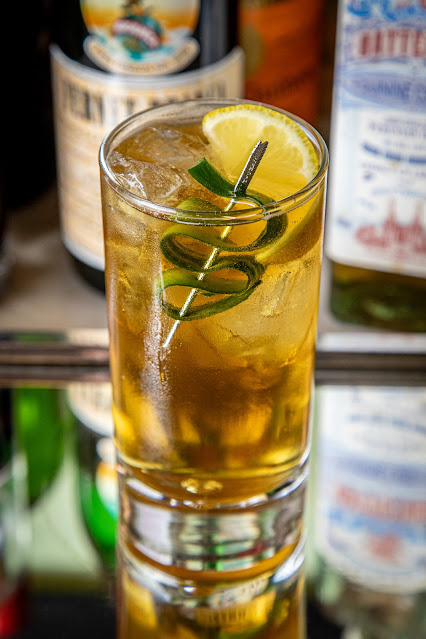
A No.5 Cup with ginger ale, featuring the label’s prescribed garnish of
“a slice of lemon and a sliver of cucumber rind”
The other mixer I wanted to try was ginger ale, which apparently is also traditional with Pimm’s, and I particularly wanted to see how it went with the rye. Using Fever Tree Light again, at 2:1 the modern No.1 at first seems to get a bit lost, though you can certainly tell it is there, both on the nose and the tongue. Once you get used to it it’s not bad. With the vintage No.6 2:1 feels a bit too strong, though at 3:1 it is also starting to get a bit lost, with the ginger dominating. I try nudging the proportions back in favour of the Pimm’s but then it seems too strong again. Overall this combination is not nearly as happy as with the lemonade; in fact I’d say the modern No.1 goes better with ginger ale, its low-mid character harmonising more with the ginger.

Mixing the vintage No.5 with ginger ale at 2:1 is again a bit strong, but at 3:1 it really comes into its own. Whiskey and ginger ale is a classic combination, and it is this marriage that underpins the drink, though the fruit element definitely contributes too. The perfect summer drink for whiskey-lovers, and even though it’s October as I’m drinking it, I am hugely taken by this concoction.

Another popular serve is the Pimm’s Royale, where Champagne is used instead of lemonade, here in a 2:1 ratio. This is obviously a drier drink, though this doesn’t seem to be an issue with the No.1, where the combination has a sort of toasty quality. 

With the No.6 I’m rather taken, though Mrs H feels it lacks something—that something perhaps being sugar. At 2:1 I feel that this blend is fruitier than when made with modern No.1, but then I did feel that the vintage samples had more vibrant fruit qualities to it. I quickly decide that this is an excellent drink.

With the No.5, Mrs H. pulls a face, though I rather like it. It reminds me of a Seelbach Cocktail (see footnote 2 here), combining the woodiness of whiskey, sweet fruit and dry Champagne. I have to admit that for modern palates, the Royale made with the vintage samples would probably benefit from some sweet element to balance them.

Of course all of these observations will probably be of little use to you, unless you too come across some vintage Pimm’s bottles. But if you do, be sure to snap them up. I’m told that from time to time a complete set of all seven cups comes up for sale at auction, but they tend to go for silly money.**

* I’ve read that Pimm’s bar had different sized flagons and the “No.1 cup” was a reference to the size of vessel. Which makes sense: why would he call the actual drink “No.1” years before Nos 2 and 3 were introduced?

** At the time of writing there is a single bottle of 1960s No.3 cup for sale on the Whiskey Exchange website for £199.


Monday, 12 June 2023

Gimme that gomme! Making your own gomme syrup

The gum Arabic powder as it comes (against white paper for colour comparison)


If you’re in the habit of perusing vintage cocktail books (of course you are) you may well have encountered references to “gomme syrup”. The purpose of this was to make cocktails sweeter, without adding any other flavours—as opposed to flavoured syrups such as grenadine (flavoured with pomegranate) or orgeat (almond-flavoured).

Indeed the term is often used just to refer to a simple syrup of sugar and water, and you certainly need to have a sugar syrup to hand to make many classic cocktails. Some people mix sugar and water 1:1 but I prefer 2:1 sugar to water. You can heat it up in a pan, but Ed McAvoy once showed me that you can make it quickly by filling an empty wine or spirit bottle two-thirds full with dry granulated sugar, then carefully topping it up with just-boiled water, and shaking it vigorously until all the sugar is dissolved. 

However, real gomme syrup also contains gum Arabic (hence the name, gomme), which comes from the sap of acacia trees and serves as a thickener. Nowadays you can buy commercial gomme syrup (though I think that when I first started taking an interest in these things about 15 years ago, you possibly could not). I’m not sure I’ve ever knowingly tasted any, so I decided to make my own.

Fortunately you can buy gum Arabic easily enough. I bought some from a health-food outlet on Etsy. Some examples I’ve seen come as brown crystals, buy mine arrived as a plastic bag of off-white powder. Searching online for recipes, I found they all tend to have the same proportions, though they vary in method. In the first instance you need to blend the gum powder with a little water—some say boiling water, some say room temperature. Beating or whisking out the lumps takes about 5–10 minutes. After this some people have you move straight on to the next stage, others say you must leave it for 48 hours. I went with another recipe that said to leave it for three hours, and it all seemed to work OK.

Gomme Syrup
1 oz or 4 tbs gum Arabic
1 cup granulated sugar
¾ cup water

Boil the water and add ¼ cup of it to the gum powder. Whisk until all the lumps have gone, then set aside for three hours. Put the remaining water and the sugar in a pan over heat, add the gum mixture and stir until all the sugar crystals have dissolved. Leave to cool, then bottle.

What the gum looks like after whisking with a little water


To establish what, if anything, the gum added, I simultaneously made a sugar syrup using the same proportions of sugar and water (so a bit more water than I would normally use for syrup), so I could compare the two. To look at, my gomme had a tawny tinge to it, while the plain syrup has no colour (see the photo below).

I should not have been sceptical, because the effect of the gum, while not dramatic, is quite noticeable. I made two Daiquiris (rum, syrup and lime juice), identical except one used the simple sugar syrup and the other used the gomme syrup. In the mix, with the colour of the lime juice present, the two cocktails were indistinguishable to look at, but the gomme clearly added a richer mouthfeel. 

This texture is something that other recipes (such as the White Lady) pursue by adding egg white; and indeed pineapple juice—when shaken vigorously—also produces a thick, creamy texture. But having tried it, I would say that gomme syrup has the advantage that, once made, it will keep, while egg white and fruit juice will not. (Also, if you have to crack an egg, then you’re left with the question of what to do with the yolk. Here in the UK you can buy pint cartons of pre-separated egg white in the chilled section of supermarkets, which is convenient if you need to make 50 White Ladies in a hurry, though a bit of a waste if you only want one.) Gomme also has the advantage over pineapple juice that it won’t make everything taste of pineapple.

Ordinary simple syrup on the left, gomme syrup on the right


Some sources say your gomme syrup will keep in the fridge for six months, others say just one month. A couple of people claim that adding a tablespoon of vodka will add another month of fridge-life, though I find it hard to believe that the resulting ABV of about 3% is going to have much of a preservative effect, compared to the high concentration of sugar. I’m also not clear what happens to the syrup after this: perhaps it’s just likely to go mouldy, which I have seen happen to syrups in the past.

I would certainly recommend giving gomme a go. While it’s a bit of a faff compared to regular syrup, once it’s done it’ll probably keep you going for quite a while, and my packet of gum powder, priced at £3.95, is enough to make four batches like this.

Sunday, 28 May 2023

Is this the Martini-lover's bible?


Hot on the heels of his book Negroni (OK, a bit over two years later) m’colleague David Smith has published his new work, Martini, again written in conjunction with Keli Rivers. As its name suggests, it is an exploration of variations of this classic cocktail.

In its purest sense a Martini is a mixture of gin and vermouth. The iconic Dry Martini uses dry white vermouth in a ratio that greatly favours the gin. (In the early to mid-20th century there seemed to be a cult of minimising the vermouth presence, by delivering it with a pipette, atomiser or even a “Martini stone”—a stone that was kept in a vessel of vermouth. One added the stone to the glass, trusting that what vermouth clung to it would be sufficient.) The traditional garnish is either an olive or a twist of lemon peel. A Perfect Martini uses a half-and-half mix of dry white and sweet red vermouth. You don’t encounter Sweet Martinis much, though the Savoy Cocktail Book (1930) does have one that uses “Italian” (i.e. sweet red) vermouth, rather than bianco (sweet white) vermouth as you might expect.

There was as time in the 1990s and beyond when it was fashionable for any cocktail to be dubbed a “[Something] Martini”, even if its ingredients had nothing in common with those of a Martini, simply by virtue of serving it in a v-shaped “Martini glass”. To his credit, Mr Smith does tend to stick to recipes with some relation to the basic idea of a Martini, with a base spirit (usually gin or vodka, though occasionally straying into tequila or rum territory) augmented with a smaller amount of vermouth or something standing in for vermouth, such as sherry, amaro, liqueur, etc., and sometimes also small amounts of citrus juice and/or syrup. We do get a Dry Manhattan, which would seem to be a whole different ballpark, but whereas a Manhattan more often uses sweet red vermouth, here it uses dry white, so I guess it’s a sort of Martini/Manhattan hybrid. Perhaps inevitably we encounter the Espresso Martini (see my previous post) and the Porn Star Martini but, being vodka based, they are at least slightly related to a real Martini. (The Porn Star Martini features passion fruit purée and/or liqueur, lime juice and an element of vanilla, either from vanilla syrup, vanilla vodka or vanilla liqueur, such as Galliano.)

We encounter classics such as the Dirty Martini, which includes brine from the olive jar, or the Gibson, which is a Dry Martini garnished with a cocktail onion. (No mention of the Murphy, however, where the garnish is a radish. Though, as I discovered, there is a good reason for this—it adds nothing.) We get the related classic the Gimlet, gin and lime cordial, along with its modern version made with fresh lime juice and syrup. Another classic is the Pink Gin, just gin and Angostura bitters, sometimes with water, but here we instead get the Pink Gin Up, with added dry vermouth, so a cross between the Pink Gin and the Martini. We get the modern classic the Vesper, created by Ian Fleming for his 1953 James Bond novel Casino Royale, which blends gin and vodka and uses Kina Lillet instead of vermouth. (Kina Lillet hasn’t been made since the 1980s; Cocchi Americano is a useful alternative, though here David suggests a 50:50 mix of Lillet Blanc and China Martini.) 

An Improved Appletini, a 2:1 mix of gin and Calvados with a little curaçao


Red vermouth is also represented, in the form of the classic Gin and It, where the “It” is short for Italian (sweet red) vermouth, as well as the Martinez: here it is also gin and red vermouth, though using Old Tom gin (usually sweeter than London Dry) and splashes of maraschino and bitters. (It’s an old recipe, possibly even older than the Martini, and other recipes feature curaçao or both dry and red vermouths.)

We get two versions of the Cosmopolitan, the original 1930s recipe of gin, curaçao, lemon juice and raspberry syrup, and the 1980s reinvention of vodka, curaçao, lime juice and cranberry juice. We’re also treated to some modern twists, such as the Leggero Martini, essentially a Martini spliced with a G&T, or the GT Turbo, which is in a way the opposite—a GT concentrated into a Martini glass, using a “tonic syrup”. There have been commercially available tonic syrups, but David suggests making one by heating tonic water in a saucepan until reduced to a syrup.

We get the historical curiosity which is The Saint, inspired by an incident from the 1930s when the bar on the airship the Hindenburg ran out of gin, so Pauline Charteris, wife of the novelist Leslie Charteris, suggested using kirschwasser instead. And the book finishes with some seasonal ideas, such as a Halloween-appropriate version of tequila, sherry and blood orange, garnished with “fangs” of grapefruit peel, or, for New Year’s Eve, the Millionaire’s Martini, with a splash of Champagne.

Martini is a slim volume of just 64 pages, but it contains much useful, well-curated material, offering both a grounding in the essence of the Martini, as well some variations, from the traditional to the exotic (fancy a Breakfast Martini, made with a spoonful of marmalade?). There is no jokey filler here:* the recipes are actually things you might want to drink. In each case specific gins and vermouths are suggested, but the recipes are not dependent on having those to hand, and hints are offered as to what kind of flavour profile would make a suitable gin for that recipe.

Martini was published by Ryland Peters & Small on 9th May, priced at £8.99

* Even the Mr Blue Sky, which has blue curaçao for colour and is garnished by a “cloud” of white candy floss

Tuesday, 23 May 2023

Luxardo Espresso Liqueur


Luxardo kindly sent me a sample of their new Espresso liqueur. They describe it as “a traditional Italian liqueur obtained from a thirty-days infusion of a selected variety of fine coffees (Brazil, Columbia, Kenya), with the Arabica type predominating”. It certainly tastes very coffee-ish: I’m assuming it contains water, neutral spirit (it’s bottled at 27% ABV), sugar and coffee.

The obvious thing to compare it with is
Kahlúa. The first thing to note is that the Luxardo product is quite a bit less sweet, which would certainly make it more flexible—after all, you can always add more sugar, but you can’t really take it out. Secondly, while the Kahlúa does taste convincingly of coffee, the Luxardo liqueur tastes specifically of espresso coffee, that earthy, bitter, high-roast flavour, with hint of berry fruit (and a touch of rubber). In fact there is more to it than that: Kahlúa is made from a rum base, and the nose has rum and vanilla notes as well as coffee, whereas the Luxardo liqueur has a simpler nose, really just of coffee and sugar. The Kahlúa’s palate has distinct rum elements, whereas the Luxardo does not have any noticeable contribution from the spirit base; and Kahlúa’s coffee note is less profound, whereas the coffee flavour of the Luxardo has considerable depth to it (more than most cups of coffee I’ve had). 

Espresso Martini
Luxardo suggest drinking the espresso liqueur neat, chilled or on the rocks, though I don’t know how many people will do that. I get the impression that it’s all about the Espresso Martini, a cocktail created by Dick Bradsell in the early 1980s, originally served on the rocks, but converted to straight-up in a cocktail glass in the 1990s—a decade when every cocktail seemed to be served this way and named a “[Something] Martini”, even if its ingredients bore no resemblance to a Martini. This is typically made from vodka, freshly made espresso, coffee liqueur and sugar syrup. (Perversely, Simon Difford, on his website, omits the syrup but adds a couple of drops of saline solution, and adds that he likes to squeeze a lemon peel over the top. However, in my copy of Difford’s Cocktails #8, from 2009, the recipe just has vodka, espresso and sugar, so he’s obviously changed his mind since then. On the website he gives Bradsell’s recipe from the 1990s and it includes a blend of Kahlúa and Tia Maria.)

On this occasion I use the recipe from m’colleague David Smith’s new book Martini (Ryland Peters & Small):

Espresso Martini
45ml vodka (he suggests Beluga, but I’m using my new favourite, J.J. Whitley Artisanal Vodka)
15ml coffee liqueur (he uses Conker, but obviously I’m using Luxardo)
30ml espresso coffee
10ml simple syrup
Shake hard with ice and serve in a cocktail glass: it should have an appealing layer of foam on the top (what I believe coffee nerds call a crema). Garnish with coffee beans.

Reflecting on Difford’s original recipe, is this cocktail essentially vodka and coffee with a bit of sugar? (Apparently Bradsell’s original was just this, created at the request of a model who asked for something that would wake her up, then f**k her up.) Given that the liqueur has sugar in it anyway, you could just mix vodka and the liqueur—interestingly, another of the three cocktail recipes on Luxardo’s webpage for the liqueur is a Black Russian, which is precisely this, vodka and coffee liqueur. It’s a viable drink, particularly if you don’t want anything too sweet. Compared to the Martini, it’s obviously more about the alcohol, whereas the Martini is quite different, from having actual espresso in it. Which is interesting, given that the liqueur is made from coffee beans. But there is something earthy about the flavour and also the texture, which I guess comes from the suspension of coffee particles. To be honest the Espresso Martini from this recipe is too sweet for me, though Mrs H. is drinking it happily.

Coffee Old Fashioned
The Luxardo webpage gives only one other cocktail suggestion, a blend of 45ml coffee liqueur with 5ml sambuca, which they call an “Espresso, What Else!” I don’t have any sambuca to hand, though I’m guessing this is a riff on the tradition of serving sambuca on fire with a few coffee beans floating on the top.

Instead, it occurs to me that the coffee flavour should pair well with bourbon, and indeed it does. I offer it to Mrs H. and she said it needed chocolate. I do actually have some chocolate bitters from Mozart, and I can confirm that 3 or 4 dashes of this does go very well, making a sort of Coffee Old Fashioned. Needless to say, I’m not the first person to have this idea, and if you Google “Coffee Old Fashioned” you’ll find a few iterations, several of which use orange bitters. In fact I find it works well with chocolate bitters, orange bitters or regular Angostura bitters.

Coffee Old Fashioned
50–60ml bourbon (rye would doubtless work too)
15ml coffee liqueur
3-4 dashes of Angostura, orange or chocolate bitters (or a perhaps a combination)
Build in a tumbler with ice.


Friday, 17 March 2023

Goodwood and Porthleven gins

A couple of new gins have come on to my radar in recent months. Of course, this is nothing but a teardrop in the ocean of gins that are constantly erupting on to the market, but one does what one can.

Goodwood is a place I associate these days with the Festival of Speed motorcar spree and the Goodwood Revival, which focuses specifically on vintage vehicles, and to which many of my chums in the vintage fraternity often go. Levin Down Goodwood Gin is produced for the estate and does include some botanicals sourced locally. I confess I was actually sent a sample last year, and it has taken me a while to get round to commenting on it. The bottle is notable in that the stopper is made entirely of glass, with a only a plastic grommet to give an airtight seal. The label features a drawing of a top-hatted rider in mid-air, apparently celebrating the days when Levin Down, a local hill, was popular for fox hunting—being too steep for farming—and the occasion when the third Duke of Devonshire galloped his horse down the hill so quickly that he flew over a gate at the bottom, inadvertantly inventing the hunt tradition of fence jumping. 

The label admits to local juniper, coriander, gorse and mint (plus presumably some other, non-local, botanicals). On the nose you get juniper plus orange and lime citrus notes, but also something distinctly savoury and vegetal. When I first opened the bottle this element, like nettles or sage, was rather dominating and frankly off-putting. After the bottle had been open a while it seemed to soften and the whole thing came a bit more into balance. I’ve never noticed this with a spirit before.

Now, some months later, I would say that, nosed neat, orange and lime lead the profile, but that other element is still there. I’m guessing it’s the mint. But the warm citrus dominates now, making for an inviting nose.

For the palate, I’ve written several adjectives: “pointy”, “toasty”, “waxy”. I’m not getting gorse, which I associate with a sort of coconut smell, but the mint is definitely there. My first reaction was that it was slightly curried, perhaps from the coriander, but that impression is quickly lost. There’s even a hint of banana, and the mint flavour is not so much fresh mint, but more like cooked mint—as in the mint sauce that in Britain is traditional with roast lamb.

I try a Dry Martini, using Belsazar vermouth, and that savoury element continues to dominate, but now with an unexpected note of caramel. In fact I would characterise this cocktail by flavours of mint and caramel. I try the gin with tonic water and, at my standard test ratio of 2:1, the gin is hard to pick out at all. I add a bit more to the mix, and a sort of rubbery note emerges. I’m beginning to get the impression that this gin does not mix well: with other ingredients it goes to pieces, becoming soggy and cloying.

My other new gin is one that I encountered late last summer on holiday in Porthleven, Cornwall. I feel it’s hard to keep up with Cornish gins, though this may be more a reflection on the amount of time I spend in Cornwall than on the greater concentration of gins there—nowadays every town, institution or stately home in the British Isles seems to have to have its own gin. Porthleven Gin is made by Serena Pengelly, who actually runs the excellent Ship Inn on the harbourside. Porthleven actually already had a gin distillery, Curio, whose gin I reported on a few years ago. Initially Serena’s gin was made by them, but then she switched to the Rock Distillery

Compared to Goodwood, Porthleven gin is more exuberant and forthcoming on the nose, with a cool, juicy, slightly blackcurranty nose. On the palate, however, it is not fruity as I was expecting, but characterised by strong dry spice high notes, perhaps from the coriander, and possibly the celery seeds, listed among the botanicals. (It also contains orange, juniper, angelica and orris roots, and pink peppercorns.) I try a Porthleven Martini alongside the Goodwood one, and it is effortlessly superior, with that dry spice squaring up to the vermouth to make a dry, contemplative, grown-up aperitif. In a G&T—in the same 2:1 proportions that defeated the Goodwood—that same coriander thrust cuts through, with peppercorn notes swirling in its wake, to make a dry, crisp drink. Whereas Goodwood gin rather falls apart when you mix it, Porthleven gin almost gets better, which must surely be a hallmark of a good, practical gin.

While sipping the Goodwood neat I tried to think of other flavours that it might work well with. Perhaps sharp lemon juice might balance the slightly wallowing character? So I tried both gins in a White Lady: two parts gin to one part lemon juice and one part triple sec (I omitted the egg white on this occasion, out of pure laziness). 

Again, in these standard proportions the Goodwood gin was hard to detect at all. I raised the proportion to 2½ parts and it began to emerge as a dark, low-note presence (again with a hint of banana). Not unpleasant, but not very ginlike. It’s odd, because, neat, the gin seemed to have a pronounced citrus character, which you’d think would go with orange and lemon, but as soon as you mix it, it seems to collapse into a soggy gloop.

By contrast, a Porthleven Gin White Lady is an instant triumph, with the bright, dry coriander notes rising up—though you can feel the other elements too, such as a welcome suggestion of violets (which might be from the orris)—all slotting into place with the cocktail’s other ingredients.

While I’ve been writing this I’ve been sipping on a generous Porthleven G&T, from a bottle that is now nearly empty, which tells you all you need to know. Not sure what I’m going to do with the rest of the Goodwood, though…


Sunday, 29 January 2023

The Mexican Blackbird


During lockdown the New Sheridan Club started entertaining the troops with a weekly virtual pub quiz, delivered via Zoom. This has continued post-Covid as a monthly treat, and a couple of months back one of the questions was actually a task—to create a cocktail in ten minutes using whatever ingredients were to hand, which the quizmistress then judged conceptually rather than by actually tasting it, obviously. One contestant let himself down by putting lighter fluid in his concoction (or so he claimed), whereas my invention was more conventional.

I had some crème de cassis which I’d bought for some other project, and I was reminded of the El Diablo cocktail from the 1940s, which combines this with tequila. I think I’d also recently restocked with Cocchi Americano, which I use as a substitute for Kina Lillet in vintage recipes. It’s bitter-sweet and I always feel it has an element of ginger to it, and I also think that tequila goes well with that flavour too (in fact the El Diablo is lengthened with ginger ale). So my cocktail was slightly inspired by the classic Corpse Reviver No. 2, which is equal parts gin, lemon juice, Kina Lillet (or Cocchi Americano) and triple sec, with a dash of absinthe. In this case I actually used two parts tequila to one part each of lemon juice, Cocchi Americano and crème de cassis. To make it more visually fun, I added the cassis last, pouring it through a funnel that I put into the drink, against the bottom of the glass, so that the liqueur formed a lower layer.

When it comes actually to drinking the cocktail, I would recommend mixing it all together: even if you have a sweet tooth and fancy the neat cassis, the rest of the drink is a bit tart without it. For me, I found I actually preferred it with only half a measure of cassis, as the Cocchi adds some sweetness too.

Mexican Blackbird*
2 shots tequila
1 shot Cocchi Americano
1 shot lemon juice
½ shot crème de cassis

I heartily recommend this cocktail. As you raise the glass you are first hit by the petrolly herbaceous note of the tequila. Then on the tongue is the unmistakeable blackcurrant unctuousness of the cassis, but any possibility of cloying sweetness is immediately scooped out by the tartness of the lemon juice and the bitterness of the Cocchi—making for a distinctly grown-up cocktail. You can taste all the elements and they riff off each other in a way that encourages contemplation.

*A song by the immortal ZZ Top


Wednesday, 19 October 2022

Maverick spirits from Brewdog


I was intrigued to notice on the supermarket shelves two spirits made by BrewdogLone Wolf Gin and Seven Day Vodka

Brewdog, as their name suggests, are best known for brewing beer, and have established their brand mainly through controversy. They have repeatedly produced what they claim is the world’s strongest beer: Tactical Nuclear Penguin was an alleged 32% ABV and, when a German brewer trumped them with a 40% beer, Brewdog came back with the tastelessly named Sink the Bismarck at 41%, followed by The End of History at 55% (a record that has since been claimed by Snake Venom from fellow Scottish brewery Brewmeister, alleging an ABV of 67.5%). Brewdog are forever being censured by the UK’s Portman Group, a drinks industry self-regulation body, and are also litigious themselves, having threatened legal action against a pub called Lone Wolf and another called Draft Punk, which they considered an infringement of their Punk IPA brand.

The super-strength beer was achieved through freeze-distillation, chilling it to a temperature low enough for water to freeze but not alcohol, allowing the ice to be removed leaving a more alcoholic liquid behind, but Lone Wolf and Seven Day Vodka seem to have been distilled in the normal way. The distillery boasts a “triple bubble” still, with three bubble-shaped swellings in the neck rising out of it. A traditional pot still is not that efficient at separating out the elements in the fermented mash, producing a distillate that retains more of the flavour but usually means the process has to be performed two or three times. The triple bubble still, which seems to be a sort of pot/column still hybrid, can effectively perform these multiple distillations in one pass, with an emphasis on purity rather than retaining flavour from the mash. Head distiller Steven Kersley also says the design allows plenty of copper contact—copper is the material of choice for stills as certain undesirable elements in the vapour stick to it, drawing it out of the final distillate.

The distillery’s line-up of stills, with the triple bubble job on the left. Last year they moved operation to a new facility in Ellon, which (judging from photos) lacks the huge mural of a wolf.

Vodka brands tend to bang on about purity rather than flavour. Maybe they just decided that this is a better marketing ploy, since most people probably think vodka doesn’t taste of much anyway. In reality, if you sit down and taste several vodkas side by side you quickly realise how much variety there is, at least if you’re tasting neat. If you want purity you can, of course, just buy 96% pure neutral spirit and add water. In reality the various filtration processes that vodka is subjected to are more about imparting a desired flavour.

Seven Day Vodka is so called because they say it takes seven days to make, three of which are in the triple bubble still, starting from a wheat and barley base. It has a nose of vanilla and icing sugar, with a hint of red berries and cocoa nib. On the tongue it is smoothish, though with a bitter, slightly sharp top note—a tad sour with a ghost of vegetation—that overbalances the palate, with too little coming from the chocolately body.

Vodka cocktails tend to smother the taste of the vodka itself, though I find that a vodka Gimlet (vodka and lime cordial) can retain the character of a characterful vodka. Sadly this is not a very characterful vodka and I find myself repeatedly adding more vodka to the mix in the hope of striking a harmonious balance.

Interestingly, this is one of the few vodkas that benefits from being served from the freezer. Although it’s a hip way to drink vodka, all too often I find this just kills the flavour, and it’s disastrous for subtle and sophisticated products like Haku. Perhaps Seven Day Vodka just doesn’t have many subtleties to kill, but in all honesty it is highly approachable served this way, with an impression of gentle sweetness, the cocoa character coming to the fore and with a slight, odd, hint of ginger on the finish. This is certainly how I will deploy the rest of this bottle.

Lone Wolf Gin takes its name from the original name of the distillery, intended to be a battle-cry for turning your back on convention and doing things your own way, though (after a physical move) the place is now just the Brewdog Distillery. Unlike the vodka, this gin is not short on flavour, though perhaps again lacking in subtlety. Regular readers will know I like a gin that tastes of gin, and this one is certainly juniper-led, with a fierce resinous waft of it on the nose, joined by lemon and lime citrus, a warm caress of lavender and some earthy notes. On the palate the juniper continues to dominate, an evergreen pine thrust, accompanied by a lightly chocolate low-mid and a slightly bitter finish.

A Dry Martini is usually a good showcase for a gin’s nuances and its interplay with dry vermouth, but a Lone Wolf Martini is crude and frankly a bit silly, with that pine-resin character completely dominating. In a Negroni (gin, Campari and sweet red vermouth) it makes a bit more sense: this cocktail is a complex blend of powerful flavours with strong sweet and bitter elements, and the gin easily makes its presence felt. But that presence is a sinus-scouring resinous one, so that has to be something you want. Perhaps the best serve is a simple gin and tonic, where even quite a modest proportion of gin will be clearly detectable.

Brewdog don’t list all the botanicals on their website, but it turns out that in addition to Tuscan juniper they do use Scots pine as well, which explains a lot. Elsewhere online I’ve found references to grapefruit peel, pink peppercorns, Angelica and orris roots, Kaffir lime, mace, lemongrass and, indeed, some lavender. Going back to it I’d agree there is aromatic pink peppercorn on the nose.

A Brewdog Vesper

Given that I have both a gin and a vodka from the same distillery and—for want of a better word—the same philosophy, it makes sense to make a Vesper. This cocktail, described in the James Bond novel Casino Royale, requires three parts gin to one part vodka to half a part Kina Lillet, well shaken, and garnished with a large strip of lemon peel. (Kina Lillet hasn’t been made since the Eighties and Cocchi Americano seems to be the closest analogue.) On the face of it you’d think the proportions would render the vodka irrelevant, but I found with Roku gin and Haku vodka, from Suntory, something interesting happened. And here I can confirm the same: despite the high concentration of gin, this drink presents a subtler and softer offering than a Lone Wolf Martini, doubtless partly because the Cocchi is bitter-sweet, but I sense that that the vodka is also lending a sweetening, mellowing effect. Make no mistake, that pine juniper character is not to be denied, but if you have these products then this is a good way to deploy them.

As you can tell, I’m not vastly impressed by either of these spirits, but I should point out one thing they have in their favour: they are relatively cheap. The vodka is just £20 for a 70cl bottle and the gin £25 (though I think I bought mine marked down to £21). Both are 40% ABV. By comparison, most “craft” gin seems to be around £35–37. 

On the other hand, however, Tanqueray, Bombay Sapphire and Sipsmith are all cheaper than Lone Wolf and I’d sooner drink those.

Brewdog also make three “flavoured” gins (I mean, it’s not as if the regular gin is short of flavour)—peach and passionfruit, cactus and lime and cloudy lemon—a navy strength Gunpowder Gin (featuring additional Szechuan and black peppercorns, bitter orange and star anise), plus three flavoured vodkas: raspberry and lime, passionfruit and vanilla, and rhubarb and lemon. I haven’t had the opportunity to taste any of these, but I tend to take a pretty dim view of this sort of thing.

Thursday, 11 August 2022

Red vermouth title fight


Like many people, I have Antica Formula to thank for the revelation that red vermouth could mean more than just Martini Rosso. Since then, the Second Golden Age of Cocktails has brought us many new vermouth brands, but for a while now my go-to has been Belsazar (both their red and their dry white). 

Recently Mrs H. and I were having lunch at the National Gallery’s new Ochre restaurant. We had a couple of exquisite cocktails before eating and I (unsurprisingly) got talking to the gentleman who would probably nowadays be called the Beverage Director. I was asking about the ingredients in my drink and he was keen to show me the red vermouth he had used, and even gave me a taste of it. It was made by Cocchi and I was intrigued. (I later discovered that Cocchi actually make two, their Cocchi Storico Vermouth di Torino plus their fancy Dopo Teatro Vermouth Amaro  with a dose of quinated Barolo in it,* but I think it was the former he showed me.) So I decided to get myself some to try at home.

A week or two earlier I had been drifting through Waitrose in Romsey and spotted a red vermouth from the sherry house Lustau, made from a blend of dry Amontillado and sweet Pedro Ximenez sherries, and was intrigued enough to scoop up a bottle of that. I’d been happily using that to make Manhattans, but now I decided it was time to put these three vermouths up alongside each other to see how they varied and whether I still felt that Belsazar should be my house pour.

I’d mentioned Belsazar to the Beverage Director and he agreed it was nice, but said that it had too much sediment in it to be of use in a professional cocktail environment, where appearances are important to the experience. He has a point. Belsazar red is seldom less than hazy, and towards the end of the bottle you do get a visible sediment slithering at the bottom of the neck as your pour. I have sometimes wondered whether it would be a good idea just to pour each new bottle in its entirety through a coffee filter before rebottling it, but so far I have not got round to trying this out.

Sampled neat, Belsazar has a sharp, rhubarb nose, with clear notes of orange and an earthy undertone. On the palate it immediately strikes me as having a good sweet/bitter balance—assuming you like a bit of bitterness. I’m also getting some fresh mint, and cinnamon on the finish. The base wines are from the Baden region of Germany, the sweetness from grape must and the fortification from fruit brandy; I can’t find any information about the precise botanicals.

The Lustau has a similar earthy aroma, again with clear orange citrus, but somehow both sweeter and meatier on the nose. The sharpness is more delicate, like rosehip rather than rhubarb. On the tongue there is an unavoidable sherry flavour, with less botanical intensity than the Belsazar, but it still has a deft sweet/bitter/sour balance, with a gentle drying tannin on the tongue (perhaps from the wood that the sherry has been aged in) and, oddly, a hint of spicy heat. The label admits to wormwood, gentian, coriander and orange as botanicals.

The Cocchi Storico is new to me, and quite different. It is not so predominantly sharp on the nose, more sweet, with strong notes of coffee and vanilla. On the palate it does immediately seem softer and sweeter than the others, but there is a bitterness that builds. There is coffee again and strong notes of orange peel. (The label admits to cocoa, citrus and rhubarb in the mix, and the website adds cinchona, star anise, achillea, rose petals, juniper, quassia wood, mace and coriander.)

Tasting these three neat, the Belsazar is clearly the least sweet and the most rooty and earthy; it seems muscular and rustic compared to the relatively urbane Lustau and Cocchi. Not, of course, that I do tend to drink vermouth neat—though if I were to, I think the Lustau would be my choice out of these, and in fact this is a recommend serve. The Cocchi is probably too sweet for me to want to drink much on its own.


Manhattan

For most of us, cocktails are the way we consume vermouths. So my next step is to make a Manhattan. In fact it’s a simplified Manhattan, in a ratio of two parts rye whiskey to one part vermouth (I normally might use more whiskey than this, say 2½ parts, plus bitters, of course, and usually a dash of maraschino). 

The Belsazar is immediately noticeable on the nose in this cocktail. On the tongue the bitterness is clear and the mint element meshes happily with the mintiness of the spirit.** This is a punchy Manhattan, a solid pre-dinner cocktail to whet the appetite, with lots of rough, bitter herbs to partner the sawmill wood of the spirit.

The Lustau, on the other hand, is a subtle presence. At 2:1 you’re just getting sweetness and some sherry ghost notes. If you increase the proportion of vermouth you can bring up the sweetness and the languorous sherry character, like shafts of afternoon sunlight on a leather armchair, making for a pleasant, Old World sort of Manhattan. It makes me realise how well whiskey and sherry can go together. But even at these enhanced proportions the spice and herbs keep a low profile.

With the Cocchi vermouth the coffee/chocolate strand is dominant. Even though the bitterness is certainly clear too, this vermouth makes a sweet, smooth, after-dinner sort of Manhattan, with a candied fruit finish.

Negroni

I think it’s safe to say that, after the Manhattan, the other classic red vermouth cocktail is the Negroni—equal parts gin, red vermouth and Campari—so I try this with my three vermouths. The Belsazar elbows its way in first, vigorous fruit and sharp rhubarb on the nose, and pepper and ginger on the palate. This is a Negroni to blow away the cobwebs and sharpen your palate for dinner. Or more cocktails.

The Lustau Negroni is dominated by the Campari on the nose, but there is still a sweetness and a silky strand of honeyed wood on the tastebuds. It is quiet and subtle, with just a genteel sherry rasp. A refined example of the cocktail.

The Cocchi Negroni has that signature mocha note, and is strikingly sweet compared to the other two. Maybe a bit too sweet and chocolatey for this cocktail—these qualities come to dominate and rob the drink of its aperitivo sparkle.

So what have I concluded? I’ll probably stick with Belsazar for these cocktails, though I might experiment with the Lustau more, even just on the rocks. It comes in a bottle that is only 50cl, rather than the normal 70cl, but at the moment this is just £10 in Waitrose, which is pretty good value compared to the others.

As for the Cocchi, even though I found it intriguing and beguiling when I first tasted it at Ochre, I have to admit that I struggled to find a purpose for it, seeming as it does less satisfactory in these two classic cocktails. Feeling that the coffee/chocolate note worked better with rye than with gin, I wondered if the addition of Campari to counter the sweetness might make everything come together in a Boulevardier (whiskey, red vermouth and Campari). I tried this—but up alongside a Boulevardier made with Belsazar too, to compare. If you fiddle around with the proportions with Cocchi (i.e. get the whiskey and Campari levels up enough to counter the sweetness) you actually get a balanced, nutty version of the cocktail. But is it better than the bitter, fruity sucker-punch version with Belsazar? Hmm…

* I encountered this first at a trade show, during a demonstration of things to drink with chocolate, and I can confirm that Barolo Chinato is a fascinatingly good candidate for this notoriously difficult match.

** Am I the only person who thinks that American whiskey often has a minty flavour to it?