Showing posts with label Negroni. Show all posts

Friday, 17 May 2024

Gin is a cabaret, old chum


One of the last things I remember doing just before lockdown was a trip to the launch of Hendrick’s Lunar Gin with David T. Smith. This expression was more spicily floral than regular Hendrick’s and apparently had lavender essential oil in it. More recently, Mr Smith passed me the remains of a bottle of Hendrick’s latest offering, the Grand Cabaret Gin.

As usual they aren’t very specific about what goes into it, though they call it “an indulgent creation infused with a sensuous cabaret of decadent stone fruit flavours and shimmies of sweet aromatic herbs. Inspired by a 17th-century fruity French experiment, where distilling mounds of stone fruit unexpectedly yielded a truly tasty potion sparked the imagination of our master distiller, Lesley Gracie, to experiment with that same sense of poetic extravagance.”

On the nose it is certainly fruity, though after pondering it a while I conclude that the fruit it most reminds me of is raspberries (which aren’t stone fruit, so who knows where that comes from), with a solid orangey citrus note too. On the palate it’s a bit sickly, but with a herbal dryness that holds these tendencies back a little. It’s certainly a gin underneath, but the fruitiness dominates.

Adding tonic seems to bring out the cucumber for which Hendrick’s is famous, plus something brambly. As G&Ts go it’s got quite a sherbet vibe to it. I try a Dry Martini using Belsazar Dry: this brings out a slight caramel note, but overall it’s not a match made in heaven. The dry, herbal quality of the vermouth actually seems to quarrel with the juicy-fruit character of the gin.

With this in mind, I try an Aviation (a proper one, made with both maraschino and crème de violette), wondering if the florality of that cocktail would work well with the gin. It certainly doesn’t not work, though surprisingly the gin slightly gets lost. Perhaps its defining character is being masked.

I usually try new gins in a Negroni too, though I suspected that the muscle of the vermouth and Campari would whup the gin good and proper. But in fact the raspberry note rises clear above the bitter-sweet melée, adding a distinct and wholly harmonious layer. This is without doubt the stand-out serve for the gin of the ones I tried. I makes a distinctly summery drink (and I say this having tried it in late January) and, now that it is quite summery here in the UK, one that I can heartily recommend you try.

Thursday, 11 August 2022

Red vermouth title fight


Like many people, I have Antica Formula to thank for the revelation that red vermouth could mean more than just Martini Rosso. Since then, the Second Golden Age of Cocktails has brought us many new vermouth brands, but for a while now my go-to has been Belsazar (both their red and their dry white). 

Recently Mrs H. and I were having lunch at the National Gallery’s new Ochre restaurant. We had a couple of exquisite cocktails before eating and I (unsurprisingly) got talking to the gentleman who would probably nowadays be called the Beverage Director. I was asking about the ingredients in my drink and he was keen to show me the red vermouth he had used, and even gave me a taste of it. It was made by Cocchi and I was intrigued. (I later discovered that Cocchi actually make two, their Cocchi Storico Vermouth di Torino plus their fancy Dopo Teatro Vermouth Amaro  with a dose of quinated Barolo in it,* but I think it was the former he showed me.) So I decided to get myself some to try at home.

A week or two earlier I had been drifting through Waitrose in Romsey and spotted a red vermouth from the sherry house Lustau, made from a blend of dry Amontillado and sweet Pedro Ximenez sherries, and was intrigued enough to scoop up a bottle of that. I’d been happily using that to make Manhattans, but now I decided it was time to put these three vermouths up alongside each other to see how they varied and whether I still felt that Belsazar should be my house pour.

I’d mentioned Belsazar to the Beverage Director and he agreed it was nice, but said that it had too much sediment in it to be of use in a professional cocktail environment, where appearances are important to the experience. He has a point. Belsazar red is seldom less than hazy, and towards the end of the bottle you do get a visible sediment slithering at the bottom of the neck as your pour. I have sometimes wondered whether it would be a good idea just to pour each new bottle in its entirety through a coffee filter before rebottling it, but so far I have not got round to trying this out.

Sampled neat, Belsazar has a sharp, rhubarb nose, with clear notes of orange and an earthy undertone. On the palate it immediately strikes me as having a good sweet/bitter balance—assuming you like a bit of bitterness. I’m also getting some fresh mint, and cinnamon on the finish. The base wines are from the Baden region of Germany, the sweetness from grape must and the fortification from fruit brandy; I can’t find any information about the precise botanicals.

The Lustau has a similar earthy aroma, again with clear orange citrus, but somehow both sweeter and meatier on the nose. The sharpness is more delicate, like rosehip rather than rhubarb. On the tongue there is an unavoidable sherry flavour, with less botanical intensity than the Belsazar, but it still has a deft sweet/bitter/sour balance, with a gentle drying tannin on the tongue (perhaps from the wood that the sherry has been aged in) and, oddly, a hint of spicy heat. The label admits to wormwood, gentian, coriander and orange as botanicals.

The Cocchi Storico is new to me, and quite different. It is not so predominantly sharp on the nose, more sweet, with strong notes of coffee and vanilla. On the palate it does immediately seem softer and sweeter than the others, but there is a bitterness that builds. There is coffee again and strong notes of orange peel. (The label admits to cocoa, citrus and rhubarb in the mix, and the website adds cinchona, star anise, achillea, rose petals, juniper, quassia wood, mace and coriander.)

Tasting these three neat, the Belsazar is clearly the least sweet and the most rooty and earthy; it seems muscular and rustic compared to the relatively urbane Lustau and Cocchi. Not, of course, that I do tend to drink vermouth neat—though if I were to, I think the Lustau would be my choice out of these, and in fact this is a recommend serve. The Cocchi is probably too sweet for me to want to drink much on its own.


Manhattan

For most of us, cocktails are the way we consume vermouths. So my next step is to make a Manhattan. In fact it’s a simplified Manhattan, in a ratio of two parts rye whiskey to one part vermouth (I normally might use more whiskey than this, say 2½ parts, plus bitters, of course, and usually a dash of maraschino). 

The Belsazar is immediately noticeable on the nose in this cocktail. On the tongue the bitterness is clear and the mint element meshes happily with the mintiness of the spirit.** This is a punchy Manhattan, a solid pre-dinner cocktail to whet the appetite, with lots of rough, bitter herbs to partner the sawmill wood of the spirit.

The Lustau, on the other hand, is a subtle presence. At 2:1 you’re just getting sweetness and some sherry ghost notes. If you increase the proportion of vermouth you can bring up the sweetness and the languorous sherry character, like shafts of afternoon sunlight on a leather armchair, making for a pleasant, Old World sort of Manhattan. It makes me realise how well whiskey and sherry can go together. But even at these enhanced proportions the spice and herbs keep a low profile.

With the Cocchi vermouth the coffee/chocolate strand is dominant. Even though the bitterness is certainly clear too, this vermouth makes a sweet, smooth, after-dinner sort of Manhattan, with a candied fruit finish.

Negroni

I think it’s safe to say that, after the Manhattan, the other classic red vermouth cocktail is the Negroni—equal parts gin, red vermouth and Campari—so I try this with my three vermouths. The Belsazar elbows its way in first, vigorous fruit and sharp rhubarb on the nose, and pepper and ginger on the palate. This is a Negroni to blow away the cobwebs and sharpen your palate for dinner. Or more cocktails.

The Lustau Negroni is dominated by the Campari on the nose, but there is still a sweetness and a silky strand of honeyed wood on the tastebuds. It is quiet and subtle, with just a genteel sherry rasp. A refined example of the cocktail.

The Cocchi Negroni has that signature mocha note, and is strikingly sweet compared to the other two. Maybe a bit too sweet and chocolatey for this cocktail—these qualities come to dominate and rob the drink of its aperitivo sparkle.

So what have I concluded? I’ll probably stick with Belsazar for these cocktails, though I might experiment with the Lustau more, even just on the rocks. It comes in a bottle that is only 50cl, rather than the normal 70cl, but at the moment this is just £10 in Waitrose, which is pretty good value compared to the others.

As for the Cocchi, even though I found it intriguing and beguiling when I first tasted it at Ochre, I have to admit that I struggled to find a purpose for it, seeming as it does less satisfactory in these two classic cocktails. Feeling that the coffee/chocolate note worked better with rye than with gin, I wondered if the addition of Campari to counter the sweetness might make everything come together in a Boulevardier (whiskey, red vermouth and Campari). I tried this—but up alongside a Boulevardier made with Belsazar too, to compare. If you fiddle around with the proportions with Cocchi (i.e. get the whiskey and Campari levels up enough to counter the sweetness) you actually get a balanced, nutty version of the cocktail. But is it better than the bitter, fruity sucker-punch version with Belsazar? Hmm…

* I encountered this first at a trade show, during a demonstration of things to drink with chocolate, and I can confirm that Barolo Chinato is a fascinatingly good candidate for this notoriously difficult match.

** Am I the only person who thinks that American whiskey often has a minty flavour to it?

Monday, 22 March 2021

Apples but not pears: the London Vermouth Company


I suppose no one should have been surprised that, hot on the heels of the recent gin boom, where half a dozen new gins seem to be released each week and every town or visitor attraction has its own brand, there should then be a vermouth boom. Well, maybe not a boom exactly, but certainly when I was a youth you basically had Martini and Cinzano, plus some dodgy supermarket clones. If you were a bit classy there was Noilly Prat and bar-trade insiders might favour Dolin. But now new brands are springing up all over the world, including Regal Rogue from Australia and my current favourite Belsazar from Germany. Often the USP will be the use of local wines as a base. 

The latest aromatised infusions to tickle my jaded palate come from much closer to home—London (specifically Queen’s Park, which is the other side of the city from my manor, Greenwich). A friend emailed with a mysterious request for my mailing address—he said a friend of his had something to send me. In due course three bottles arrived from the London Vermouth Company

Set up by Ben Leask, Andrew Wealls and Guy Abrahams, three friends with diverse backgrounds but a shared interest in food and drink, the LVC, as its name suggests, focuses on the local sourcing. Mind you, it’s a bit of a fudge, as not a lot is grown in London itself. But the S.E. Dry vermouth uses Bacchus wine from the South Downs, gooseberries from Essex and Bramley apples from Kent, so near London if not actually in it. (It does contain London honey, though, from Dulwich, not far from me.) The Amber Limon uses Kentish rhubarb, but I’m assuming the blood oranges are not from anywhere very nearby. And Camille’s Red uses dry wines from Kent and Surrey, but also ruby port. 

The Amber and the Red also feature largely unnamed botanicals (numbering 21 and 23 respectively), although the website does mention that Indian cardamom features in Amber Limon and S.E. Dry, orange flowers from Marrakesh in Amber Limon and Camille’s Red, and Indonesian cloves and black pepper in the red as well. But they were at least able to find local bay leaves, grown in Guy's back garden.

In each case the founders asked a specialist to concoct the recipe: the amber and red vermouths were crafted by drinks expert Camille Hobby Limon, of The Bar With No Name and Zetter Townhouse, while the S.E. Dry was created by chef Steven Edwards, winner of MasterChef: The Professionals in 2013. Neither had made a vermouth before, but the chaps behind LVC specifically wanted to see what happens when someone who is a genius in one field takes on a challenge in a different one.

S.E. Dry

Uncorking the bottle releases rather a complex and intriguing aroma—honeysuckle sweetness, nettles, elderflower, raspberries, meringue and candied fruit and angelica. All rather tantalising and exciting. But when you slosh some of the liquid into a glass the bouquet suddenly changes and becomes more overwhelming and actually less appealing, with a heavy layer of flowers that have “gone over”. There is still a bright orange/grapefruit citrus character, but now with the burdensome confectionary miasma of hard-boiled sweets, along with something pungently herbaceous.

On the palate there is a strong, sharp vegetable note of rhubarb, with roiling meadow flowers and stalks. It’s a bit cloying, though the balance is medium sweet overall. I try some Belsazar Dry alongside for comparative purposes. I always think of this as quite savoury, with almost a saline note, but I’m surprised to find it is actually no less sweet than the S.E. Dry; however the flavour is sharper, more about tart berries than mulching flowers.

I try the obvious and make a Dry Martini with it. This actually works better than I expected. It’s not much like Belsazar; it’s more floral and has an overriding aroma of elderflower and gooseberries floating above it. I don’t think it’s likely to become my new favourite vermouth but, especially when partnered with a stern, savoury gin, it can make for a soft, summery Martini that balances the hard juniper edges of the spirit.

Amber Limon

As mentioned, this stars rhubarb and blood orange, and is indeed amber in colour. Sniffing the open bottle yields a smell not dissimilar to the Dry but tighter, more citric, toasty and perfumed. Like hip marmalade. But once again, in the glass the aroma gets overwhelmed by heavy floral overtones, but this time I can’t help being reminded of synthetically-fragranced paper hand towels.

On the tongue there is a totally unexpected resinous spice like frankincense, along with floral and herbal weight. It’s a bit like wandering into a patchouli-doused head shop. There’s a bit of violet and strawberry in there too, citrus tartness and rhubarb bitterness, plus a lemon balm note that runs through both vermouths. But that patchouli note dominates. 

There aren’t really any classic amber vermouth recipes so I try making a Negroni using this one. For me this is dominated, as soon as you smell it, by a note that reminds me of creosote though Mrs H. gets mainly boiled sweets again. I eventually managed to balance it up a bit by adding more Campari and gin, but it really is a bit pointless using this vermouth in the first place.

I do a search for bianco vermouth cocktails and discover that Simon Difford thinks the El Presidente—Cuba’s Martini, made with rum and vermouth—it best made with bianco. A 2:1 blend of white rum and the Amber Limon certainly doesn’t clash, though it isn’t transformative either. You still have to like the vermouth’s cloying pungency. Another Difford suggestion is bianco vermouth with tequila, and this turns out to be more successful. The herbaceous prickle of the tequila locks horns with the heavy floral and resinous notes of the vermouth; with Olmeca Altos Plata I find that at 2:1 the vermouth is actually rather swamped and you need 1:1 proportions to get a good balance between the two. Difford’s recipe includes a bit of maraschino—thought I don’t think it needs sweetening—plus lavender bitters; I have none to try, but I can imagine the result would be a very complex cocktail, full of fleshy vegetable layers and late-summer floral tendrils.

One other thing Difford suggests is an Algonquin cocktail, which uses rye whiskey, vermouth and pineapple juice. I don’t have any of the latter, but a mix of rye-high Four Roses Small Batch bourbon and the Amber Limon is also very interesting, the spirit’s woody rasp more than a match for the vermouth.

Camille’s Red

In addition to the two English wines, ruby port and those spices, this apparently includes bonfire toffee—toffee made with black treacle (molasses). A sniff of the bottle offers a promising dark scent of orange and woody cinnamon, a bit of clove, plus that candied layer all these vermouths seem to have. In the glass it is less cloying than the other two; there is rhubarb, something floral, coffee, toffee and ruby port notes.

For my taste, the balance of sweet and bitter on the palate here is the most successful out of the three, with herbal, rooty and candied elements. Out of the three this is probably the only one I could drink neat—despite the dominating “potpourri” note that they all have—though in comparison Belsazar Red is tighter, leaner and certainly more bitter.

I try a Manhattan using this vermouth; it’s certainly distinctive, with strong wafts of citrus and rhubarb on the nose, but on the palate it lacks something in the middle. Oddly, it has a cough-mixture quality but seems kind of dry too. Adding a dash of maraschino helps, but again you’d be better off just using a different vermouth.

In a Negroni things start to look up. Straightaway the blend has what I can only described as an openness or transparency. I think the rhubarb and grapefruit elements sit comfortably with the citric bitterness of the Campari and the heady thrust of the juniper in a vivid harmony. There is also an intriguing perfumed aftertaste. The vermouth really comes into its own here, but you’d better be OK with bitterness. I tried it with several different gins and it is a solid winner.

The stated aim here, to make specifically London vermouths, is a bit hit and miss—not only do so many of the ingredients come from other countries, but the whole idea of vermouth has nothing to do with British food and drink traditions (other than our willingness to drink the stuff, though that applies to most boozes). But have they created something that tastes particularly Londonish? Rhubarb is a strong presence, which is fair play, though if you wanted a bittering agent then hops would also have been authentic for the region. And if the smell of over-mellow honeysuckle and elderflower makes you think of England then that is a thread that runs through these offerings. It’s a smell I get from gins sometimes and it usually makes my nose wrinkle and my lip curl, but to each his own. 

As I say, Camille’s Red makes a bright, open, vivid Negroni and the Dry makes a blossomy, summery Martini. The Amber is the most challenging for me, but initial experiments suggest it’s best matched with the powerful savoury flavours of tequila and American whiskey.

No.1 Amber Limon and No.3 S.E. Dry are £24 for 50 ml, and No.2 Camille’s Red £26 for 50 ml, all from the London Vermouth Company online shop 


Tuesday, 2 March 2021

Negroni Safari

David T. Smith,  drinks writer and sometime contributor to this blog, has just published a new book on the Negroni cocktail. You may wonder how one can fill a book on the subject of one cocktail, but this volume is essentially a collection of variations, from subtle tweaks on the classic form to seasonal variants and radical reinterpretations.

In its basic form the cocktail is a blend of equal parts gin, Campari and red vermouth, and it has enjoyed quite a renaissance over the last decade or so. Generally speaking I take a dim view of people who peddle so-called variations of a drink which in reality are just borrowing a name that people will recognise and perhaps trust—the world is full of “[insert word] Martinis” which in fact contain none of the ingredients of a Martini but are simply served in what is often called a “Martini glass” (more properly a “cocktail glass”). Yet the Negroni is more open to legitimate variation than a Martini because it has more ingredients and each has many varieties—there are legion gins out there, plenty of red vermouths, and even Campari is part of an Italian tradition of bitter, herbal amari.

I developed a taste for Campari while honeymooning in Venice in 2000. A huge Campari sign loomed over the Lido (now gone, I think) and the locals’ aperitif of choice was the “Spritz”, a mixture of Campari, white wine (sometimes sparkling) and fizzy water. The Austrians who ruled the place in the early 19th century started all this, using seltzer water to thin the strong local wine. Nowadays Aperol (sweeter, fruiter, less bitter) has taken over from Campari in the Spritz—Venice is filled with tables of bright orange drinks where they used to be red—and you have to ask specifically for a Campari version, although in fairness it was always acceptable to make it with either, as well as Select Pilla or Cynar, an amaro flavoured with artichoke.

A bright red, bitter drink that's bottled at 25% ABV, Campari was invented in Turin by Gaspare Campari in the early 1800s and his son was responsible for the iconic advertising images that helped promote it through the 19th century and beyond. The recipe is allegedly a closely guarded secret but is said to involve some 60 ingredients. In flavour it comes across as herbal and citric with a bitter finish. Its colour traditionally comes from cochineal, a cactus-boring insect from South America, though in 2007 they replaced this with an artificial colouring.

The Negroni owes its existence to another cocktail, the Americano. By 1862 Gaspare had his own bar, Caffè Campari, in Milan, where he devised a blend of Campari, sweet red vermouth and soda water, calling it a Milano-Torino, after its origins. It later became known as an Americano because of its popularity with tourists. Legend has it that, in 1919, one Count Camillo Negroni went into the Caffè Casoni in Florence and asked the barman, Fosco Scarselli, to beef up his Americano with gin. (Whether at this stage the gin actually replaced the soda, I’m not clear.) This became Negroni’s favourite drink and it took his name. (To give you an idea of the cultural significance of the drink, there is actually an ongoing spat about who invented it, with the contemporary Negroni family insisting that their ancestor Count Pascal Olivier Negroni is the real creator. They even claim that Camillo never existed, though it’s fairly certain he did; the truth about his alleged careers as a cowboy and riverboat gambler are another matter. See www.drinkingcup.net/the-real-count-camillo-negroni for a taste of the vehemence.)

Mr Smith’s book, written with Keli Rivers, includes a range of variants where the role of the Campari is played by other bitter drinks, as well as some long-established concoctions which are essentially Negronis with the gin replaced by another spirit: the Boulevardier, first published in 1927, uses bourbon and the Old Pal, from the same era, uses rye whiskey. I myself have previously experimented and found that it works with tequila, Cognac, rum or Scotch, and similar variants appear here. 

Other versions focus on the fruitiness of Campari and the fact that a Negroni is traditionally served with an orange slice garnish, and add orange, grapefruit or pineapple juices. David also suggests pre-mixing a batch of Negroni and letting it “age”, or trying one of several types of White Negroni, using white vermouth and something like Suze to create an almost colourless version (see also this delightful version made with Luxardo Bitter Bianco).

Inevitably there is a “Royale” version with Champagne (although a Negroni Sbagliato, using Prosecco instead of gin, has been an Italian tradition since the 1980s), a Christmas-oriented Snowball version with Advocaat, even a “float” version with ice cream. But perhaps the strangest is the “clarified” version, where a convention Negroni is mixed with lemon juice and milk—the acid curdles the milk which draws the colour from the drink, so that when you strain it through a cheesecloth or coffee filter you get something that tastes like a Negroni but is a pale straw colour. Whether this is worth the effort only you, gentle reader, can decide.

Negroni will be published by Ryland Peters & Small on 9th March, RRP £7.99

Sunday, 6 May 2018

Pale fire: the perfect aperitif for a summer's day

During my investigations into Luxardo’s famous maraschino I came across Luxardo Bitter—I’d not heard of it before but it is an amaro made from an infusion of various herbs, spices and fruits. The basic bitter is bright red, so clearly in the same ballpark as Campari. (The colour of Campari is a gimmick, originally made with cochineal, i.e. crushed beetles, but nowadays synthetic, so I would assume the only reason Luxardo’s product would be the same colour is to try and encroach on the same market—but there are actually quite a few red amari out there so perhaps it is traditional.)

But they also make a Bianco version, which Luxardo describe only as an “infusion of bitter herbs, aromatic plants and citrus fruits in water and alcohol”. It is sweet and plump in the mouth, with a delicate complexity, floral notes and a pronounced rooty bitterness. I have some Campari to hand, and by comparison it is less sweet with stronger fruit notes, a distinct note of orange peel and a black pepper finish. I have read that Luxardo Bitter Bianco has some wormwood infused towards the end of the process to give it a lingering bitterness.

What really caught my eye was a reference to the Bitter Bianco in the context of a “White Negroni”. I’m a big fan of the Negroni cocktail, a drink with a colourful history, allegedly created when one Count Negroni asked for the soda in his Americano be replaced with gin (though there is bitter rivalry between different origin stories). It’s a powerful beverage—all the ingredients are alcoholic—that enjoyed a revival a few years ago. A mix of equal parts gin, Campari and red vermouth, it has a bitter-sweet flavour bursting with all the herbs and roots that have gone into the component infusions, with juniper rising over the top and strong orange notes (it is usually garnished with orange). And of course it is a deep red colour from the vermouth and Campari.

If you actively search for White Negoni cocktails the recipe that comes up most often actually has Lillet Blanc standing in for the vermouth and Suze standing in for the Campari. But there is a version that uses Luxardo Bitter in place of the Campari and bianco vermouth in place of the red vermouth. It is a fairly new drink, as Bitter Bianco was only released in 2016.

I guess the main schtick with this cocktail is its colourlessness compared to a regular Negroni, but it certainly works on its own terms, with a good sweet-bitter balance and a pronounced vanilla flavour from the vermouth (I used Cinzano Bianco). It’s less aggressive that a normal Negroni, subtle and thought-provoking. I can imagine pondering its delicate intricacies on a gentle summer’s afternoon. I get the impression that most people garnish a White Negroni with orange as normal, but I felt it was more chromatically harmonious to use lemon.

For more Negroni variants see this post from 2015.

Friday, 7 April 2017

Strange fruit and the Moroney cocktail

We have a couple of little fruit trees in pots, an orange and a lemon, which struggle to thrive in our London garden. Over winter we brought them indoors and I watched as the orange tree produced a couple of fruit. Sadly, it wasn’t very happy and started dropping its leaves until pretty much all that was hanging from its spindly branches were the two fruit, and the stems supporting them were the only green, healthy looking ones. I was hoping that they would in time look like, you know, oranges; but by the point they both dropped off last week they were still resolutely green.

After a week sitting in the fruit bowl they clearly weren’t about to change colour, so I sliced one open. Rather gratifyingly, the inside looked just like an orange. A little on the small side, but nevertheless orange and juicy, like an orange should be. Its juice was somewhat astringent, but definitely orange juice.*

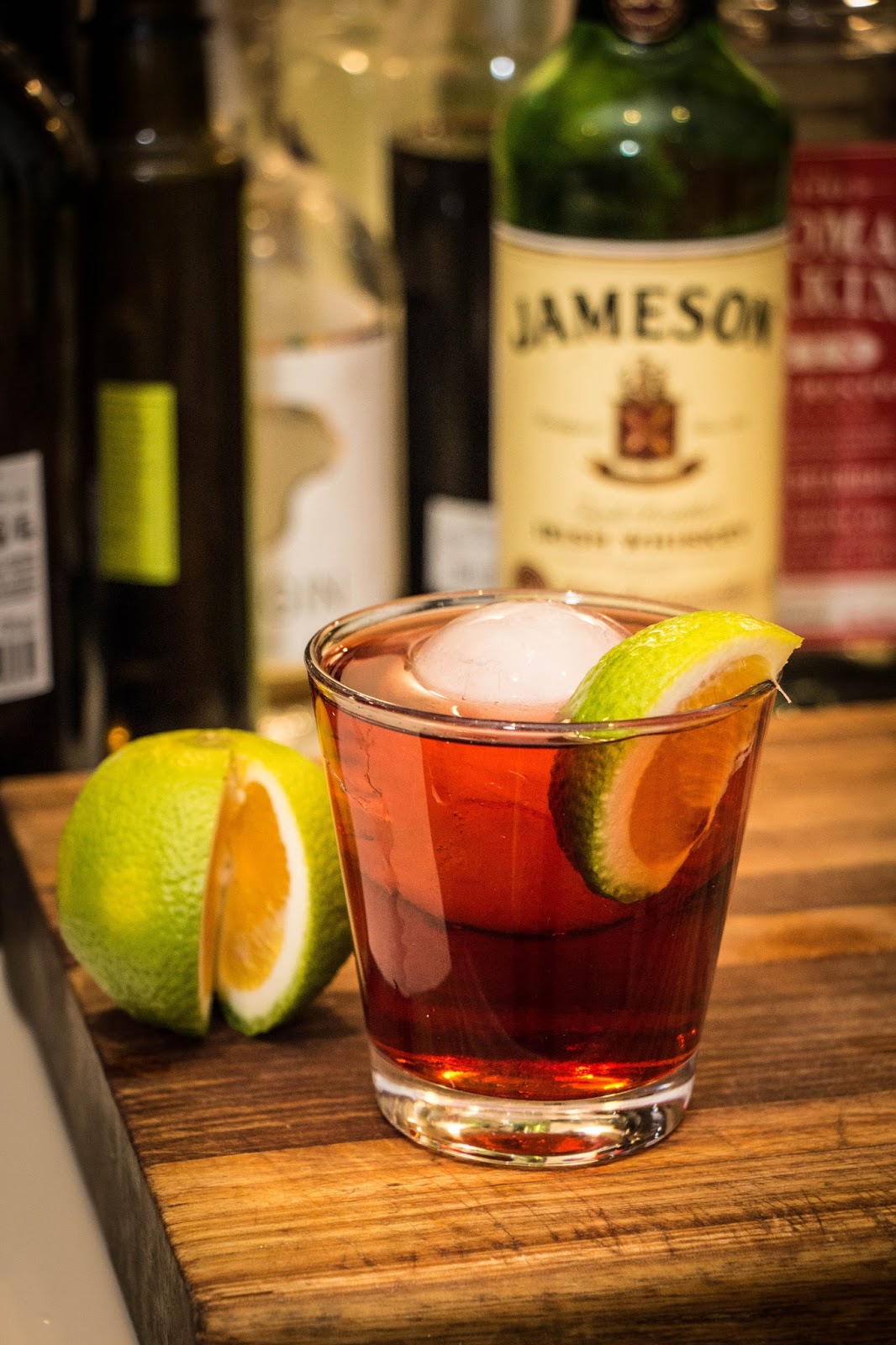
In fact the combination of the green skin and orange flesh is rather striking and, in combination with the white pith, reminiscent of the Irish flag. When I thought about cocktails traditionally garnished with an orange slice I immediately hit upon the Negroni (equal parts gin, Campari and red vermouth) and, to give it an Irish twist I tried using Irish whiskey instead of gin. Or course there is every reason why this should work, since the same thing with American whiskey is a Boulevardier, and I’ve noticed in the past how Irish whiskey, with its milder character than Scotch, lends itself better to cocktails.

Ladies and gentlemen, I give you the Moroney. And very well it works too, with the caramelly warmth of the whiskey balancing the herbal bitterness of the amari with a bit of sweetness from the vermouth (I used Martini Rosso and Jameson whiskey in this case).

I wish I’d thought of this in time for St Patrick’s Day last month. Perhaps I can pretend it is to mark the 101st anniversary of the Easter Uprising…

Ice ball courtesy of a G'Vine ice ball maker


*When I posted a photo on Facebook a friend observed that once upon a time oranges were actually green, until later being bred to have orange skin, so I can tell myself that we must have a Heritage Orange Tree.

Saturday, 10 October 2015

Hansard, the ghost of a gin

I was on holiday in Venice last month, staying in a self-catering apartment. On the first night we sloped into a supermarket for supplies and I was intrigued to see that the only gin they sold apart from Gordon’s was this, something called Hansard.

Such is the perceived “Britishness” of gin in many parts of the world (probably more those that don’t have so much of an indigenous gin habit) that the name didn’t really surprise me. (For those who don’t know, Hansard is the journal of record in the UK parliament.) Let’s not forget the name and label of Castle Bridge gin from Ghana. It is clearly labelled as “London Dry Gin”, but the front label also adds: “Produced according with traditional recipe [sic], from neutral spirit with the addition of juniper distillate.”

This is at once disarmingly frank and intriguing. So it has just the one botanical? It would be perfectly legitimate to make a multi-shot distillation with just juniper, then add more neutral spirit to dilute the botanical intensity, plus water to get the ABV down, and still justifiably call it a London Dry Gin. And, let’s face it, this stuff is €4.99 for a 70cl bottle, so they are clearly sparing a lot of expense in the manufacture.

The Italians may not be great gin drinkers but this is, after all, the nation that created the Negroni, and local bars are full of the usual international brands, such as Bombay Sapphire and Tanqueray, as well as more exotic marques that I recognise from home. So who is Hansard aimed at? It is made on an industrial estate in Finale Emilia, Modena, by Casoni Fabbricazione Liquori S.P.A., a family firm dating back to 1814, who produce a range of spirits, liqueurs and amari. Why is the front label in English?* It could be aimed at tourists, but I suspect it is simply to give it an impression of being an import from Britain (in a market where most products actually are).

I can’t find out anything online about the brand, and the ingredients are simply given as “water, alcohol and gin distillate”. I can certainly believe that it has just one botanical, as juniper notes rise up, along with a distinct note of caraway and anise sweetness (which I could believe is an element of the juniper character), and maybe a hint of sweet orange? It is smooth enough on the tongue but dry, with an element of sugar flavour, but not sweetness. Overall it does not seem terribly strongly flavoured at all.**

It makes an unexciting G&T, adding dryness and bitterness to the tonic but not much else apart from subdued caraway. In a Martini with Noilly Prat you mostly get the vermouth; as with the tonic, if you add more gin to get a balance, it just drags down the taste of the other ingredient.

Perhaps appropriately, the best use I’ve found is in a Negroni—up against the powerful flavours of the Campari and red vermouth it serves the useful role of adding strength (though note that it is only 38% ABV), damping the sweetness and injecting a bit of juniper/caraway steel. But of course there are plenty of gins that do a better job, and if you keep adding more gin to see what happens eventually it starts to fall flat again. I also start to notice that dry sugar taste coming through, perhaps from the base spirit.

I’m not much impressed by Hansard. Although it is not rough as such, I find it rather unbalanced and, despite possibly having just one botanical, not much like gin.


*And why does no one doing this ever get an English speaker to proofread the label?

** When I initially opened the bottle I got juniper and anise/caraway. I then poured a hefty slug into a glass and covered it with clingfilm before giving the bottle to DBS. These notes are mostly made later from the sample in the glass, so it is possible that the flavour has lessened. I certainly get more caraway now than juniper but it is not strongly flavoured of anything.

Sunday, 5 July 2015

Some Negroni variants

A Mr President cocktail
I like a Negroni (equal parts gin, red vermouth and Campari), and I seem to have this in common with much of the world, as it is on trend these days. (Which is interesting when you consider that it is quite bitter—perhaps we are just getting more sophisticated in our cocktail palates, or perhaps it is the appeal of the vintage/heritage aspect.)

I was therefore intrigued when I later encountered the Boulevardier, which is effectively a Negroni with the gin replaced by bourbon or rye whiskey. It was created by Harry MacElhone, of Harry’s Bar in Paris, for Erskine Gwynne, socialite, nephew of Alfred Vanderbilt and editor of the Boulevardier magazine. It appears in Harry’s book Barflies and Cocktails, published in 1927, where it is given as equal parts bourbon, Campari and red vermouth. (Harry’s earlier ABC of Mixing Cocktails has an Old Pal cocktail that is equal parts Canadian—i.e. rye—whiskey, Campari and dry vermouth, which is a pretty dry drink. Oddly, a cocktail with the same name appears in the 1927 book made with red vermouth.) You often now find the Boulevardier with the whiskey elevated to 1½ parts, though certainly with Redemption Rye or Rittenhouse 100 Proof equal parts is easily enough. I would certainly put this cocktail up there with the Negroni; if you like Campari you should try it, as it is essentially a Manhattan with added Campari. Even with milder Maker’s Mark bourbon I think equal parts works fine, though ramping the bourbon to 1½ is still interesting.

Count Camillo Negroni, alleged inventor of the cocktail of
the same name. However, the contemporary Negroni family
insist that their ancestor Count Pascal Olivier Negroni is the
real creator. See here for the low-down on the spat 
All of which got me wondering what would happen if you tried using other spirits in place of the Negroni’s gin.* What about rum? In Havana’s Prohibition-era glory days as a watering hole many extant cocktails seemed to spawn an equivalent that used rum instead of the original base spirit—the Sloppy Joe’s Cocktails Manual has three “President” cocktails, all essentially a Dry Martini made with rum instead of gin, with a few other bits and pieces thrown in. Sure enough such a thing as a rum Negroni already exists: the Kingston Negroni uses pot still Jamaican rum, while the Mr President uses white Cuban rum (though the proportions are different here: 1¼ shots rum, ¾ shot red vermouth, ½ shot Campari). I’m not entirely convinced about either of these: the white rum is easily smothered by the other ingredients, contributing only a little sugar character; although clean, I find it a bit too sweet. In the dark rum version (I used Myers’s) the rum certainly makes its presence felt, though I suspect that I am ultimately not really a fan of this sort of Jamaican rum with its dry, dusty, woody rasp, and it is debatable here whether this quality compliments the rooty bitterness of the Campari or quarrels with it. I think on balance that this is a successful combo, in that you can certainly taste all the ingredients in the mix, although they seem to be circling each other warily. Compared to the Boulevardier, however, it is definitely less inspired.

A Milano is simply a Negroni made with vodka instead of gin, or an Americano (originally known as a Milano-Torino) made with vodka instead of soda. Ultimately it lacks the complexity of the Negroni or the Boulevardier, as you can’t taste the vodka, even if you bump up the proportions. It is also known as a Negroski. This cocktail need detain us no further.

A Rosita cocktail
Inevitably, where one whisky goes another will follow, and the Scotch Negroni uses blended Scotch instead. I used Famous Grouse and, although I am not generally a fan of Scotch-based cocktails, this one undoubtedly works. The whisky balances against the orangey fruit notes in much the same way as it does in a Blood and Sand (Scotch, orange juice, red vermouth and cherry brandy) and seems to add a chocolatey warmth.

Replacing the gin with Cognac (I tried Courvoisier Exclusif) is surprisingly successful, and quite different from the other variants. The fruitiness rises up, suggesting apples and prunes, and it balances in a very satisfying and complex way, though the overall effect is more a warming autumn drink (I imagine—I’m writing this during a heatwave here in the UK). I also tried it with Calvados and it works too, in the same fruity way, though it lacks the complex spread of flavours that the Cognac offers.

Finally we come to the Rosita, made using reposado tequila (I used Tierra Noble**). Simply replacing the gin with tequila at equal parts, the tequila sits squarely in the mix; the recipe I found gives 1½ parts tequila and although this still works I’m not sure it’s necessary. (The recipe, from Gaz Regan's Bartender's Bible, actually has the vermouth as an even blend of red and dry white; this gives a subtle and quite dry result, though I think I prefer it with just red vermouth.) It’s a fascinating combination, with the petrolly, smokey, herbaceous agave flavours entwining with the bitter, orange notes of the Campari. It works in a similar fashion to the Scotch version, with smoke being present in each case and each a relatively subtle blend compared to the minty, sawmill punch of the rye whiskey version.

Out of all of these, for me the Rosita takes first prize—it’s not just “interesting” but is a cocktail I will definitely come back to—thought the Boulvardier and the Cognac Negroni are definitely worth trying too.

* Of course there is much more you can do to a Negroni than just vary the base spirit. In fact Gaz Regan has written an entire book about it… 

** I was given a couple of samples at a trade show, but I don’t think they ever did sort out distribution in the UK. Which is a shame as it’s a great product.

Sunday, 18 January 2015

Don't be afraid of Fernet-Branca

Fernet-Branca is one of those cocktail ingredients from the dawn of time, when there wasn’t too much to choose from. Many younger people may never have heard of it, and those who have often roll their eyes and dismiss it as rocket fuel, but to the best of my knowledge it was never out of production and does seem to be experiencing a cautious revival. It was specified in one of the cocktail recipes prepared for us by Brian Silva at the Excelsior Club events that we did last year, which is what got me thinking about it.

Fernet is a style of bitter infusion that was peddled as a tonic and cure-all in early advertisements; the name comes from Dr Fernet, an imaginary Swedish Man of Science originally billed as co-creator, who was claimed to have lived to more than 100 thanks to the restorative powers of his tincture. Fernet is traditionally drunk as a digestif. Apparently they are keen on it in Argentina (where they drink it with cola), and in the US it’s particularly popular in San Francisco, which accounts for 25% of the country’s consumption.* Fernet-Branca (which I have to admit is the only Fernet I have encountered, though there are other brands) was created in 1845 in Milan by Bernardino Branca and went on to be produced by Fratelli Branca at their distillery. I had idly assumed that it was an aromatised wine, so I was surprised to see that it is actually 39% ABV and thus has more in common with something like Gammel Dansk than vermouth. In fact some see it as an alternative to Angostura Bitters, and indeed the label proudly calls it “The international bitters”.

Of course the recipe, as is traditional with these things, is a secret, known only by the firm’s president, Niccolò Branca, who personally measures out the ingredients. But the back label calls it “an infusion from a unique blend of selected blossoms and rare aromatic herbs, carefully aged in the historic Branca cellars”. (Specifically, aged for 12 months in wood, according to the Fernet-Branca website.) The site lists myrrh, linden, galangal, chamomile, cinnamon, saffron, iris, gentian, aloe, zedoary, colombo and bitter orange, but it is said that there are fully 27 (or alternatively 40) ingredients, among which rhubarb and red cinchona bark might also number. Rumour has it that production of Fernet-Branca accounts for 75% of the world’s saffron consumption.

A Hanky Panky cocktail
Fernet-Branca is a brown colour (from caramel colouring, I believe) and has a strongly aromatic nose with woody spice underneath. There is mint and also coffee, chocolate, balsam, menthol, sandalwood, sesame seeds… This is carried over on to the tongue but if you expect sweetness (perhaps from the aroma’s similarity to cough medicine) then you are in for a shock as it is quite dry and bitter.

I gather that Fernet-Branca has been gaining popularity as a cocktail ingredient again, as punters become more interested in classic cocktails, drier and more bitter than the long, sweet, fruity cocktails of the 1980s. In a way it doesn’t surprise me that they like it in Argentina, as my taste of classic Argentine cocktails made it clear that the national palate likes a bitter element. Perhaps the best known cocktail containing it in this country is the Hanky Panky, probably the most famous creation of Ada Coleman (see my last post) during her long tenure at the Savoy’s American Bar. The story goes that she created it for Noel Coward’s mentor Sir Charles Hawtrey when he came in one day announcing he was tired and needed something with a bit of pep. He took one sip and announced, “By Jove! That is the real hanky-panky” (an expression which apparently meant sorcery, rather than sexual naughtiness as it did in the US).

Hanky Panky
1½ shots gin
1½ shots red vermouth
2 dashes Fernet-Branca
Shake with ice, strain and garnish with a twist of orange peel

The vermouth and the Fernet merge in an aromatic continuum, with the gin joining in too, depending on how powerful the high juniper presence is in the gin you choose, and it is worth playing around with the quantity of the Fernet to suit your palate. It’s a bracing drink, a perfect pick-me-up or aperitif to stimulate the tastebuds. But the high proportion of vermouth does mean that your bottle needs to be in good condition, not old, oxidised and turning brown.

As it happens, the Savoy Cocktail Book (1930) contains both the Hanky Panky and also the “Fernet Branca Cocktail”, which has exactly the same ingredients but in fiercer proportions: 2 parts gin to 1 part red vermouth to 1 part Fernet-Branca. The book adds, “One of the best ‘morning after’ cocktails ever invented. Fernet-Branca, an Italian vegetable extract, is a marvellous headache cure. (No advt.)” This is a recurring theme—Fernet-Branca’s puissance as a cure of hangover, nausea, cramps, poor digestion, etc, etc.

Meanwhile, Cocktails: How to Mix Them (1922) by Robert Vermeire has a “Fernet Cocktail” that is equal parts Fernet-Branca and either Cognac or rye whiskey, plus a dash of Angostura and two dashes of sugar syrup. I was convinced that I had encountered something similar as a “Corpse Reviver No.1”, but when I looked, most recipes I found under this name were a combination of equal parts Cognac, Calvados and red vermouth. However, eventually in Larousse Cocktails (2005)—which is admittedly often out there on its own—I find a “Corpse Reviver” consisting of 3 parts cognac to 1 part each Fernet-Branca and white crème de menthe. This sounds like it is going to be rather sickly, but in fact it is well balanced, with the liqueur’s sweetness balanced out by the bitter Fernet, creating something like a brandy Old Fashioned with a refreshing minty aromatic pep.

Under Vermeire’s Fernet Cocktail recipe he notes, “This cocktail is much appreciated by the Canadians of Toronto.” There must be something in this as there is also a well-known Fernet cocktail called a Toronto.

A Toronto Cocktail, served on the rocks, though it is sometimes
shaken and strained into a cocktail glass
Toronto Cocktail
2 shots Canadian whiskey
¼ shot Fernet-Branca
¼ shot sugar syrup
(Some recipes add a couple of dashes of Angostura)
Stir with ice, strain and garnish with a strip of orange peel

Although I can find no mention of the origins of this drink, it is pretty primordial in what it is doing—it is a cocktail in the original sense of a spirit augmented by sugar, bitters and/or water—and is essentially the same as Vermeire’s Fernet Cocktail, just with different proportions. It is also similar to the Boulevardier, which uses Campari instead of Fernet for bitterness and red vermouth for sweetness. You also find the Toronto made with American rye whiskey, and sometimes with more Fernet-Branca in the mix (though I’ve not seen it with as much Fernet as Vermeire’s version). To drink, it is much like an Old Fashioned, with the combination of Fernet and whiskey (I used Canadian Club) evoking a chocolate/caramel flavour. I think it highlights the appeal of Fernet-Branca in a cocktail, creating a drink that is both comforting and invigorating at the same time.

Amusingly, on the blog of James Boudreau, a bartender from Montreal, he says that he had to leave Canada before he encountered the Toronto cocktail, as Fernet-Branca was not available in his home country. So it may be that the drink was not created in Toronto, but was so named simply because it used Canadian whiskey. But does this mean that Vermeire was misled when he said that the drink was popular in Toronto, or perhaps that Fernet-Branca used to be available there in the 1920s but had fallen out of fashion by Boudreau’s time?

Meanwhile Brian Silva’s recipe for us was a twist on the (currently hugely fashionable) Negroni:

Negroni Aprés
2 shots gin
1 shot Aperol
½ shot Fernet-Branca
½ shot Amer Picon
Soda (optional)
Add all the ingredients to an iced cocktail shaker. Stir for one minute.
Strain into an iced rocks glass

The name is a reference to Brian’s view of this an a digestif version of a cocktail that is normally an aperitif. I’m not so sure about that myself—the bright, aromatic, bitter-sweet flavours from three different amaros (plus an emphasis on bitter orange flavours) still seem to me to be classic get-the-juices-flowing territory.

Another more modern cocktail that we served recently is one I found on Simon Difford’s website. It goes by the name of Staffordshire Delight which is a pretty awful name, but it is a great drink:

A Staffordshire Delight cocktail
Staffordshire Delight
2 shots golden rum
1½ shots pineapple juice
½ shot Fernet-Branca
½ shot lime juice
½ shot orgeat (almond syrup)
Dash of Angostura Bitters
Shake everything together and strain into an ice-filled glass

This is a complex drink. It can be hard to get the balance right, but it is worth persevering. You clearly get the minty aromatic freshness of the Fernet, its bitterness balanced by the orgeat, the almond notes of which slip into the middle ground, with the rum giving power and the pineapple a silky texture.

Finally, there is another combination that I have encountered more than once, a blend of equal parts Fernet-Branca, lime juice and ginger syrup or liqueur; one recipe added an equal part gin to this (a Fernet Reviver) and another instead an equal part red vermouth (an Eva Peron). On paper you can see how this works, an equal balance of strong sweet, sour and bitter elements—and ginger is a traditional cure for nausea, so we are back in touch with Fernet’s curative background. In practice, however, the Fernet does dominate, although you can taste the other ingredients. It’s certainly warming, with the ginger adding its fire to the Fernet, and the gin version is inevitably drier than the vermouth one. But I have to say that I certainly don’t get the feeling that this drink is doing me any good…

* I gather it is the tipple of choice for bartenders, as an eye-opener when starting a shift—on the grounds that no one will miss the purloined liquor, owing to the dark bottle and the general unpopularity of the contents…

Wednesday, 31 December 2014

Maplay - Distilled Maple Syrup Spirit

This is my first and last post of the year. 2014 seems to have slipped away at the IAE south coast branch; not quite as bad as "The Lost Weekend", though. Now, if I was going to write about anything, it would be Maplay.

This is from the US and is made by fermenting and distilling maple syrup, which is then aged. An interesting point for readers is that this is genuine moonshine, i.e. it is illicitly distilled (at least in its country of origin). As such, it has no official bottle, but a picture of spirit can be found below.

On its own (room temperature)
Nose: Bright, with some dry, woody notes to start, before moving onto rich and intense maple and nut flavours, as well as hints of vanilla, butterscotch, and cream brule.

Taste: There's a pleasant texture to the spirit, with the alcohol upfront and then a gently unfolding patchwork of sweet confectionery and spice notes, very similar to the nose with the addition of stone fruit and a touch of chocolate and plum jam. The finish is long and lingering, with lots of dry, nutty maple and pecan notes.

Frozen
Beautifully viscous, with an intriguing dry - almost grainy - woody start. This is followed by the flavour of very dark chocolate (think 95%), then sweeter notes of roasted cashews and pecans, as well as a subtle maple element that is rather delicious. There is also a slight herbal, fruity note throughout, somewhat reminiscent of vermouth.

Manhattan
This is an intriguing drink, which has elements of both a dry and a sweet Manhattan backed up by the complexity of the spirit, which is easily equal to most whiskey versions. Rich spice, vanilla, and cassia are accompanied by hints of cinder toffee, toasted nuts, and that dry, maple element. If you like Manhattans, this is one to try.

Negroni
A soft and smooth drink with the characteristic bitterness of the drink at the end. The Maplay gives some of the dryness and spice that you would expect from a gin, but also adds a complex sweetness and complements the sweet vermouth very nicely.

Old Fashioned
Simply superb. This is easily my favourite way to enjoy the spirit. I've been a fan of substituting sugar for maple syrup in whisky Old Fashioneds for a while, but this just takes it one step further. Simple, yet luxurious; the bitters, water, and sugar seem to tease out a whole array of flavours from the Maplay - all of the notes previously referred to come through in a chorus.


In Conclusion
As you can guess, I really like the Maplay and it is a shame that, for the moment, it remains unavailable. It is a fascinating spirit with a legion of potential fans out there ready to discover it. My favourite drink was the Old Fashioned.

Monday, 10 November 2014

Big Gin makes a big impression

While helping to judge the recent Craft Distilling Expo Gin of the Year, it was my great pleasure to meet Ben Capdevielle and Holly Robinson of Captive Spirits Distilling, part of the wave of “craft”, “boutique” or “artisan” distilling that is sweeping the US at the moment. Based in Ballard, near Seattle, they make Big Gin, both in its standard form and in a version that has been aged in ex-bourbon barrels.

Theirs is not a happy-go-lucky tale of casting around for something to do and hitting on the idea of making a gin on a whim.* Ben is actually a third-generation distiller—his grandfather was a distiller for Templeton Rye** during Prohibition—and the pair spent four years visiting distilleries and experimenting with botanicals and distillation variables before finally launching their product in 2012. “We are using the traditional method of making gin,” Holly explains, “and creating a small scale, boutique brand just using two 100-gallon pot stills. We are exclusively a gin company, instead of making a variety of spirits like most of the budding brands. We have a few other gin-centric products that will trickle out in the next few years…”

Holly and Ben (second and third from the left) at the Craft Distilling Expo Gin
of the Year judging
As the name suggests the idea was to make a bold, unashamedly gin-flavoured gin. “We took this away from all the big players in the gin game,” Holly says. “Consumers are used to drinking Beefeater, Bombay, etc—we wanted something that ginners could identify with, instead of trying to reinvent the wheel.” The botanicals are indeed mostly conventional—juniper, coriander, bitter orange peel, angelica, cassia, cardamom, orris—plus grains of paradise (not unusual either, being present in Bombay Sapphire) and Tasmanian pepper berries. The spirit base is made from corn. “This was the most neutral base we found to impart the botanicals,” Holly says.

Uncork a bottle of Big Gin and it is certainly big, with a strong waft of juniper. But it is more complex than that, with orange peel, dried fruit and a pronounced floral note like crystallised violets, perhaps from the angelica. There is also a herbal stemmy quality and a hint of ginger. It is big, bright and rich.

A Last Word made with Big Gin
On the palate it is powerful but remarkably smooth and sweetish, given that it is a hefty 47% ABV. Perhaps the corn-spirit base lends this sweetness. The flavour follows on from the nose, with that floral note to the fore and a slight peppery-bitter finish. It easily works in a Martini or gin and tonic, basically making its own rules. It is well-suited to a Negroni, clearly making its presence felt, whereas more delicate gins can sometimes get lost in the present of the Campari and vermouth.

Another muscular cocktail to test a gin is the Last Word, traditionally equal parts gin, Green Chartreuse, lime juice and maraschino: it has a balance between the sweetness of the liqueurs and the tartness of the lime, but these elements and the herbal blast from the Charteuse can drown the gin. I have to say that even Big Gin struggled here. But I noticed that on Simon Difford’s website he is now advocating a 3:1:1:1 ratio (the 3 being the gin). With Tarquin’s Cornish Gin I find that it does really need these proportions before you can really taste the gin in the mix, but Big Gin reaches that point at only 2:1:1:1.***

An Aviation made with Big Gin
I felt that Big Gin was less successful, however, in an Aviation, being perhaps too powerful for the subtle flavours of the maraschino and crème de violette (of which there is only about a teaspoon, otherwise the colour of the cocktail veers from the pale lilac-blue meant to represent the sky, from which the drink gets its name: try something like 50ml gin, 12.5ml lemon juice, 12.5ml maraschino, 5ml crème de violette).

You can get a sense of the big, savoury qualities of Big Gin from the recommended cocktails on the Captive Spirits website. The Out-of-Towner involves making a fennel syrup (plus gin, lemon juice and triple sec), and two of the recipes use elderflower liqueur (such as St Germain). The Morning Paper tops gin and elderflower with sparkling wine and a splash of grapefruit juice, and there is definitely a continuum between the gin botanicals and the sweetly pungent qualities of elderflower.

Although Captive are determinedly not planning to make a whiskey, they are interested in pushing their gin in different directions, such as the bourbon barrel aged example now on the market. “All the worlds best spirits are aged in bourbon barrels,” Holly explains. “With Big Gin being so flavorful, we thought it could stand up well and one could still actually taste the gin. Thankfully, we were correct.”

A Martinez made with Bourbon Barreled Big Gin
Ageing gin is all the rage it seems, but at a tasting of several of them earlier this year I did feel that none of the examples seemed particularly successful, with the wood notes somehow quarrelling with the essential gin flavour. But there is certainly a tradition: Seagrams have always rested their gin in charred new oak barrels to smooth off the rough edges of the spirit.

The barrel-aged version of Big Gin came as a revelation to me, however. Perhaps there is something about the prominent orange notes in the gin which marries well with the wood flavours, or maybe there is something about these particular barrels (which presumably have had bourbon in them for a long time, damping down the sawmill quality of fresh wood). On the nose the sharp juniper of the base gin is softened but still present, while a warmth and sherried sweetness are added, plus an enhancement of the dried fruit flavours I noticed before and a pleasant woody, almost mossy, mustiness. On the palate there is excellent integration of the aromatic gin elements and the tannic, vanilla wood flavours, plus clear notes of bourbon, emphasising the orange peel.

On a whim I try to make a sort of sweet Martini using Regal Rogue Bianco and the result shows remarkable balance and harmony from two strongly-flavoured ingredients, a little like a Martinez with orange and herbal notes all blending well. I try making a Martinez, using 2 shots gin, ½ a shot each of dry and sweet vermouth and a dash of maraschino, the result is sublime. Likewise in a Negroni it works as well as the normal Big Gin but with an extra dimension that fits naturally, as in a Manhattan or Boulvardier**** (which it virtually is). It really is a revelation.

A Spring Fling made with Bourbon Barreled Big Gin
There is a recommended cocktail, the Spring Fling, that once again uses elderflower liqueur, this time with the barrel-aged gin plus dry vermouth and some celery bitters. It’s an extraordinary tour de force, with the elderflower merging with the big herbal flavours of the gin, followed by a sweetness emerging and woody notes, then a fiery warmth. You also get a sense of sun-kissed Mediterranean aromatic herbs, like thyme or oregano. The prescribed garnish is grapefruit zest, but I only had lemon to hand and its aroma floats over the other flavours, balancing without muddying.

If you like gin then you should try Big Gin. It’s nice to come across a product that is not trying to make a “gin” for people who really want vodka, nor is it trying push the flavour in outré directions for reasons of gimmickry alone. But at the same time Big Gin is distinct. And it is big.

In the UK you can buy Big Gin through Master of Malt for £39.96 and the bourbon barrel aged version for £44.85.

* Talking to Holly you realise that the process of starting up a distillery is more of a bureaucratic slog than most of us realise, especially in the US. “There is a lot of red tape, but mostly several different levels of permitting, each of which cannot commence without the previous—it's a domino game. First Federal, than State, then City, then Fire, etc… Every state/city has different ideas of what/how things should be done. That’s the confusing part. Once that is all waded through, it’s a slow start to getting product out the door.” To help with all of this the couple got a third partner, old friend Todd Leabman, to help with the paperwork and accounting.

** The good folk of Templeton, Iowa, apparently carried on distilling whiskey throughout Prohibition and Al Capone is said to have like it so much he would send a driver all the way there from New York to stock up. 

*** It an interesting experiment, because if you start with the punchy sweet-and-sour traditional recipe and just add more gin, it’s easy to think, “Oh, no, this is getting too dry.” But if you come back to it later and try it you do realise it as a good, subtler cocktail. All the lime and Charteuse are very much there, but now you can taste the details of the gin too. Hurrah.

**** 1½ shots bourbon or rye whiskey, 1 shot Campari, 1 shot sweet vermouth, so a sort of mash-up between a Negroni and a Manhattan. It was invented by New Yorker Harry McElhone after he emigrated to Paris, fleeing Prohibition, and set up Harry’s New York Bar. He created it for ex-pat Erskine Gwynne in honour of his Parisian magazine The Boulvardier.

Wednesday, 11 June 2014

Opihr gin's eastern promise

We had a Casablanca-themed Candlelight Club event last month and one of the cocktails devised by our mixologist David involved Opihr gin, of which I had not previously heard. Launched last year by Quintessential Brands and distilled at Greenall’s, it describes itself an an “Oriental Spiced Gin”, and the schtick is that the botanicals come from the fabled Spice Route—the interactive website carries you on a sea voyage, taking on board cubeb berries from Malacca, Tellicherry black peppers from Malabar, cumin seeds from Turkey, juniper from Italy, coriander from Morocco and sweet orange peel from Spain. I gather there are ten botanicals in total, the others being cardamom, grapefruit peel, ginger and angelica.

The name comes from a Biblical region, the hangout of King Solomon and famed for its wealth and exotic spices. The bottle is rather appealing, featuring a pair of colourful elephants. What’s not to like about a gin with elephants on it?

Opihr themselves describe the gin as having “citrus notes balanced with earthy aromatics and warm, soft spices”. On the nose the first thing that hits you is a sherbet-like sweetness, then a strong element of limes, oranges, and dry lemony coriander seed. You can detect juniper in there too but it is not very dominant. It’s quite complex, the enticingly juicy Opal-fruit lime character balanced by savoury notes of cumin and maybe turmeric.

On the tongue this gin is strongly biased towards cardamom, which gives it an exotic sweet-seeming approach, strongly redolent of rose. Cardamom is a common enough spice in gin but the heavy presence here serves to make this product smack of the souk. There is coriander too and some black pepper on the finish.

This character persists in a G&T, and also in a Negroni (equal parts gin, red vermouth and Campari). I find that often more subtle gins get lost in this punchy concoction, and it can be a good place for in-your-face spirits such as the Hernö juniper-cask-aged gin with its almost eye-watering resinous juniper fumes. So I was surprised that Opihr’s distinctive cardamom character came coiling up from the cocktail. It works well, with the sweet smoothness balancing against the bitterness of the Campari and vermouth.

An Opihr Gin & Tonic with prescribed chilli garnish
It’s a gin that is relatively easy to drink on its own, and it is possible that (as with D1) this was something the developers had in mind. It works perfectly well in a Martini, the gin’s essential character blending with the bitter herbal elements of the vermouth without trouble. As you might expect, the rose-like quality of the cardamom sits comfortably with the floral character of the crème de violette in an Aviation cocktail (gin, maraschino, lemon juice and violette). In fact you could argue that it blends in a bit too much, almost getting lost. I might have thought that this citrusy gin would be an obvious contender for a Gimlet (gin and Rose’s Lime Cordial), and it is an interesting combination; but the sweetness of the cordial actually emphasises the drier spices of the gin and seems to evoke a bitterness. It’s a somewhat awkward union and I’m not sure this is really the best gin for this cocktail.

One recommended serve is a G&T garnished with a red chilli pepper! I give it a try, and (insofar as a cocktail with chilli in it is a good idea) it doesn’t not work. I guess we are used to the combination of chilli, cardamom, coriander and cumin in curries, and it is normal enough to balance chilli heat with sweetness; while the gin isn’t actually sweet, the cardamom does give an impression of sweetness. They also suggest using the gin in a Red Snapper (a Bloody Mary made with gin instead of vodka), another cocktail with peppery heat in it.

Despite the Spice Route USP, none of the botanicals is unique to Opihr—London Dry Gin, that most quintessentially English of spirits, has always been made with spices shipped in from all over the world. Whether you’ll like Opihr depends on how much you like cardamom and to what extent you think gin really should be dominated by juniper. I assume it is, like so many new gins these days, aimed at people who would not normally drink gin at all, hence the emphasis on the impression of sweetness from botanicals like orange and cardamom (liquorice is often used to achieve the same effect), and the downplaying of gin’s defining flavour, juniper. I quite like it myself, but because of the lack of juniper it would not be my desert island gin.

Monday, 17 February 2014

Quintinye Vermouth Royal

Vermouth, the aromatized wine that mostly hails from France or Italy, is one of the founding cocktail ingredients, along with spirits and bitters (and like bitters vermouths were often medicinal in their original conception). Yet, while every week brings another new gin, it is not often that someone launches a new vermouth. So I was interested to be invited along to the launch of the Quintinye Vermouth Royal range.

The three products, a Blanc, a Rouge and an Extra Dry, hail from Eurowinegate, the folks behind G’Vine gin, and the launch showed a familiar head-on aplomb. The venue was the Café Royal (geddit?), in the extraordinary grotto of mirrors and gold ormolu that is the Grill Room. Various staff, including Gaz Regan, were drifting around dressed like courtiers from 17th-century Versailles. (The DJ was so attired as well, though, disappointingly her music occupied fairly safe house territory with not a tinkling harpsichord to be heard.)

At the launch we are transported to the Palace of Versailles
So what is “royal” about this vermouth? And what’s with the name? DBS was there and grumbled about the moniker, which he thought was obscure and complicated. He may have a point: if someone can’t pronounce the name of a product are they less likely to buy it? As it turns out, the range is named after Jean-Baptiste de la Quintinye, botanist to King Louis XIV of France. Quintinye was commissioned by the Sun King to create the kitchen gardens at the Palace of Versailles, and each bottle of the vermouth features a drawing of him. The manufacturers like to think they are carrying on in the tradition of this herbalist visionary.

Even Gaz Regan is in costume
These vermouths are created in the Charentes region, home of Pineau des Charentes, a sweet “wine” that is created by blending grape juice with Cognac, a process that preserves some of the delicate characteristic of the grape which might normally be lost in the fermentation and distillation process. Pineau de Charentes is used in the blends of wines that go into these vermouths and this seems appropriate, given that G’Vine gin, as well as being based on grape spirit, includes vine flower in its botanicals (as do all the Quintinye vermouths). Clearly EWG are all about preserving the essence of the fruit that lies at the heart of all their products, the grape.

In addition to this unusual wine base (plus some Cognac for fortification) the vermouths contain a wide array of infused botanicals—18 in the Blanc, 27 in the Extra Dry and 28 in the Rouge. Chief among these is wormwood; this may be something you had associated with absinthe, but in fact vermouth (the name of which derives from vermut, the German for wormwood) must contain it under EU regulations. (EWG’s Jean-Sébastien Robicquet points out that in the US anything with wormwood in it must be submitted for testing by the FDA—presumably still wary of it because of its association with the long-illegal absinthe—and since many producers can’t afford the $10,000 fee, they prefer to leave that ingredient out. Mind you, I doubt that many consumers will be intrinsically outraged to discover their vermouth contains no vermut, even if they might prefer the taste of vermouth with it in.)

Some of the cocktails on offer
Other ingredients include vine flower, angelica, orris, cardamom, cinnamon, bitter orange, nutmeg, ginger, cinchona bark (source of quinine and a key element in quinated vermouths like China Martini and the long-lost Kina Lillet), liquorice and the bitter Quassia Amara.

We start our tasting with the Blanc. The nose is rich, sweet, with hints of orange, cucumber and grapefruit. It reaches out to your with a gentle but enticing floral aroma, with elderflower, a whiff of coal tar and a faint earthy bitterness. In that latter respect it actually reminds me of Campari a little. On the palate there is an unexpected dimension: it’s a sort of slightly sour, slightly over-ripe floral note that I get from some white absinthes, and I suspect it comes from the wormwood. It vaguely reminds me of Plasticene and I’m not keen on it. But overall it is a subtle drink, with a honeyed underlying sweetness, not cloying at all. I can see this appealing as an aperitif chilled on its own or over ice.

Next up is the Extra Dry, staple of the classic Dry Martini. There is a strong family resemblance to the Blanc, but it is more intense—that twisted floral element that I’m not keen on is much more prominent and there is not the inviting, fruity sweetness of the blanc. It is sharper and drier with a tarragon/anise pungency, and notes of bergamot and pencil lead.

DBS doesn't know which cocktail to try first
Although these are clearly sophisticated, subtle blends, I have to confess that I’m not that keen on them neat, because of the dominance of that (I assume) wormwood element. But how many of us drink vermouth neat? And I quickly discover that in a cocktail context these are different beasts. Mix either of these with gin to make a sweet or dry Martini and that disconcerting element vanishes (in all but the wettest mix). Using Tanqueray as a fairly classic sort of gin, a half-and-half band with the Quintinye blanc produces a highly approachable drink with juniper to the fore but the mellow fruity sweetness of the Pineau curling seductively around the edges, warming orange, and finally some spicy/bitter sparks firing off at the end.

Even at 50:50 (far wetter than most people would make it) a Dry Martini with the Extra Dry is not as disconcerting to me as the stuff is neat. And at 4:1 (how I normally make a Dry Martini) the balance is perfect: the gin’s juniper and coriander forces are marshalled at the front, but the softening floral, honey and herbal notes are right behind, and in the mouth the fresh bitter-sweet contributions of the wine are just right. It’s the sort of thing that reminds you what the point of a Dry Martini actually is. I’m still not that keen on the pronounced wormwood flavour (if such it be) but this is nevertheless a sophisticated vermouth that has been thought through from the ground up.

At the launch the final product we tasted was the rouge. The wine blend includes red Pineau des Charentes, which is noteworthy—most red vermouths are actually based on white wine. Tasted neat, for me this was the star: a rich and fascinating nose of red berries, raspberries, orange, cinnamon, marshmallow, celery, raisins, careering between sweet and aromatic and drily bitter. This continues on to the palate with pronounced coffee notes and some chocolate, roses, parma violets, gentian, cedar wood… As you can see it evolves constantly.

Sadly the DJ's gear and music could not keep
up the retro credentials of her outfit
One of the classic red vermouth drinks is the Negroni (equal parts red vermouth, gin and Campari) and EWG are clearly using this as their signature serve: most of the drinks served on the night seem to be variations on this and we are all given a special edition of Gaz Regan’s book dedicated to this cocktail. At the time it strikes me that the Quintinye has many of the elements of the Negroni already going on, so later at home I see what happens if we add one part gin to two parts Quintinye rouge. Straightaway the high juniper waft marries well with the warmth of the vermouth, before the latter begins to assert itself again in a jammy, chocolately way, with still those spikes of bitter root-notes. Dial in some more gin (taking it in a Martinez direction) and it still works, with a woody, cinnamon flavour seeming to emerge between the two ingredients. Unsurprisingly it starts to remind me of the sweet and dry Martinis. Although pretty much all of the Quintinye botanicals are found in gin (though not necessarily in Tanqueray, which famously has only four, juniper, coriander, angelica and liquorice), perhaps it is the fact that the botanicals are infused rather than distilled that allows the vermouths to bring a fresh, bitter-sweet, fruitiness to compliment the gin and make for a more complete drink.

And of the Negroni? The launch event peppered us with different recipe variations, but sticking with the classic blend of equal parts gin, red vermouth and Campari, I compare a Tanqueray-based version using Quintinye red with one using Martini Rosso. Aside from a darker, redder colour,* the Quintinye is softer, smoother, sweeter, with a more evolving subtle complexity, while the Martini is high, dry and herbal. Some may prefer the sharper combo with the Martini (and, much as I love Antica Formula in a Manhattan, for example, I have always believed that it makes a less satisfactory Negroni than Martini Rosso); but the Quintinye certainly makes its fresh, vivid character felt.

I thought it slightly odd that they should have these sheaves
of pungent herbs on the tables at the tasting…
The other classic red vermouth drink must surely be that Manhattan, so I give that a try. Even with a cheap bourbon, the Quintinye rouge has quite a transformative power—the pronounced wood and sweet characteristics of the whiskey blend easily enough with the wood-spice and Pineau elements of the vermouth, but the latter brings much more besides. Even outnumbered by the bourbon two to one, it softens the rough edges and unfurls bitter, sweet, floral and aromatic tendrils in all directions. Compared side by side with Noilly Rouge, the Quintinye strikes me as actually less sweet and more subtle, a characteristic I would extend to the whole range: once I started mixing with them I found you could blend in quite a high proportion without the vermouth taking over.

A GQ&T**
As you can probably tell, I am favourably impressed by the Quintinye range. Even though I am iffy about the wormwood character in the Blanc and Extra Dry, there is a fresh, subtle, three-dimensionality to all the products that makes you rethink the whole point of vermouth. I haven’t felt this taken by an aromatised wine since I discovered Cocchi’s irresistible Barolo Chinato.

One other thing I like about this range is the acknowledgement that most of us drink vermouth in small quantities: although full bottles exist, we were sent home with 37.5-centilitre half bottles, and very dark bottles they were, with solid rubber/plastic bungs—all of this intended to preserve the freshness of the precious liquid. If you have read my woes about trying to avert the spoilage of vermouth, you will understand that I view this attitude as all too welcome.

Moreover, my new favourite aperitif is now a half-and-half mix of gin and Quintinye Blanc, topped up with tonic water and garnished with a lime slice—I call it a GQ&T, essentially a G&T with the added fresh herbal/floral infused flavours. By mid-summer all the kids will be drinking it, you mark my words.

* In fairness the Martini has been open a while, so oxidation may have turned it browner than God intended.
** As in Gin, Quintinye & Tonic, I'm surprised there aren't more cocktails involving tonic water (expect a post from me soon with some of my favourite G&T variants), although I recently realised that this "creation" of mine is not a million miles away from the clericot prepared for me by Argentine cocktail god Tato