Showing posts with label elderflower liqueur. Show all posts

Saturday, 21 March 2020

A cocktail for St Patrick's Day


I produced this on Tuesday, for St Patrick’s day, obviously, and should have posted it then, but what the hell. I was reminded of the garnish effect I accidentally produced with the Maid in Jalisco cocktail a few years ago—at the time it reminded me of a four-leaf clover and I made a mental note to do something shamrocky with it for St Paddy’s Day.

I’d received a promotional email from Difford’s Guide with some Irish whiskey drinks in it, and one included cucumber, which is what reminded me. Now while cucumber is to be found in and around gin all the time these days (see my recent posts on Caspyn and Hendrick’s), cucumber and whiskey are not obvious bedfellows. This recipe is called an Irish Maid and consists of:

Irish Maid
60ml Irish whiskey
15ml elderflower liqueur (St Germain is what I used, though I imagine cordial would work too)
20ml lemon juice
10ml sugar syrup
2 slices of cucumber

Muddle the cucumber in a shaker, add the other ingredients and shake vigorously with ice. The garnish is obviously optional, but you can tell I have time on my hands now with the corona virus stalking the land. (These are Difford’s proportions; others allow slightly more sugar, though I personally think it is quite sweet enough.)

The cucumber certainly makes its presence felt. The spiky elderflower is more subtle, though it’s a flavour that seems to merge seamlessly with the cucumber, in a savoury, herbal way. The lemon and sugar are just the classic cocktail sweet ’n’ sour building block, and the whiskey rises up behind with caramel warmth. It’s unexpected but it really works, and it all to easy to drink.

The cocktail is apparently derived from the Kentucky Maid, essentially a Mint Julep with added lime juice and cucumber. Two days ago when I went to the supermarket I found the shelves mostly empty (thanks to panic buying by hoarders—really this epidemic has brought out the worst in people). In the fresh veg section the only thing left was a large quantity of cucumber, so I see the promotion of cucumber-based cocktails as Doing My Bit. (In two different shops the only fruit they had left was grapefruit, so watch this space…)

Sunday, 6 January 2019

The Jack Calloway cocktail


Not many of us get to have cocktails named after us—it tends to be film stars (Mary Pickford, Charlie Chaplin) or statesmen (Roosevelt, Colonel Rickey, who allegedly invented the Rickey). So I was intrigued when a chap named Jack Calloway recently joined the New Sheridan Club and, on the application form where we ask a number of vapid questions, gave his favourite cocktail as “The Jack Calloway”.*

Jack’s the leader of a 1930s-style dance orchestra. “The cocktail was created in Bristol three or four years ago when the dance orchestra was first starting out,” he explains. “We used to rehearse in a bar called the Bootlegger on Gloucester Road. I was fond of Charlie Chaplins [sloe gin, apricot brandy and lime juice] but asked the barman, Drew Pratley, if he could make me something that better suited my sweet tooth. He asked me various alcoholic questions and came up with the Jack Calloway. He wanted something sweet and cheeky but with a ‘debaucherous’ party vibe— much like myself, apparently.”

Naturally I had to try this cocktail out. Here is the recipe Jack gives:

Jack Calloway
Blackberries and blueberries
1–2 shots vodka
1 shot crème de cassis
1 shot elderflower liqueur or cordial
Juice of half a lime.
Fill a shaker with blackberries and blueberries and crush thoroughly. Add the other ingredients. Shake well with ice, pour dirty in a fancy tumbler, or in my case a fine champagne coupe. To finish, squeeze a final wedge of lime over the mixture and let it float in the glass. Garnish with a sprig of mint.

I found that 6 blackberries and 12 blueberries seemed an appropriate amount. It’s an interesting drink, obviously dominated by the berries; the elderflower presence is subtle (though in fairness the St Germain liqueur I used was quite old, so possible not as puissant as it used to be). Overall it’s a bit sweet for me, although adding more lime juice didn’t quite seem to work, so perhaps it is what it is. Obviously the vodka isn’t really contributing to the flavour—I tried it with gin, but it didn’t work for some reason. I also tried it with white rum, which I thought was OK, though Mrs H. thought otherwise, feeling that the sugariness of the rum made it seem too sweet.

If you have a sweetish tooth and like berries, give this one a try, though it needs a bit of patience to do all the muddling, and it takes a long time to pour through all the pulp! It strikes me also that if you’re doing “Dry January” (shudder) and you are bewitched by the berry/elderflower combo, you could make a virgin version of this using elderflower cordial.

* In truth that is a stage name and not entirely his real name. The surname was chosen in homage to Cab Calloway.

Fine-strained for fancy folk

Thursday, 30 July 2015

The purple reign of Parfait Amour

By chance I found myself with three different brands of Parfait Amour in the house recently—Bols, Boudier and Cartron. This liqueur is possibly most used in cocktails for its purple colour, but despite its similarity in this respect to crème de violette it is not primarily flavoured with flowers. Recipes vary and Bols, who claim to have invented it, do use rose and violet petals to make it, but the flavour that seems to link the different interpretations is actually citrus.

The Cartron website doesn’t give away the recipe but implies that this liqueur is all about the citron. The nose is strongly of orange and lemon, as is the palate, which is sweet, with a liquorice note and only the subtlest florality. It does make you wonder why someone would come up with a citron liqueur then decide to make it purple—and this sample is the most intensely coloured of the three—but the site has a quote from 1769 about the use of citron in Parfait Amour so it has clearly been made this way for a long time.

(Left to right) Boudier, Bols and Cartron
Boudier’s version also hits you with oranges on the nose and something sweet like crystallised angelica or parma violets. On the palate it is drier and seems more spiritous than its 30% ABV. There is orange here again and perhaps something nutty. The website has nothing to say about this liqueur, but I gather that curaçao oranges, rose petals, vanilla and almonds go into it.

Bols’s ingredients are much the same as Boudier’s—orange peel, vanilla, almonds and “flower petals (principally roses and violets)”—but their version is quite different. They speak of how many a lover’s quarrel has dissolved under the influence of this drink, and it does have the reputation of being a dainty tipple for ladies. (It’s interesting, then, that Cartron talk of how it is “ideal in light and fresh cocktails” and don’t actually suggest you drink it neat.) The Bols example has a more confectionary nose and is sweetest on the tongue. More than anything it reminds me of that nougat that has bits of candied fruit in it, a character that must come from the almond and vanilla as well as the citrus. I would say that the Bols version is the most distinctive—the others seem a bit vague by comparison—and is the only one I can imagine dainty ladies choosing to sip. The Boudier seems a bit too austere and the Cartron has that liquorice edge that might prove divisive.

Although I don’t have any to hand, De Kuyper also make a Parfait Amour that they describe as a marriage of citrus (lemon and bitter, fragrant curaçao orange) and vanilla. Marie Brizzard make one with sweet oranges, orange blossom and vanilla. Giffard make theirs with orange, vanilla, violets and geranium and Lejay use bitter orange peel and violet buds.

A Jupiter, made to Ted Haigh's proportions
There actually aren’t many classic cocktails involving Parfait Amour. The Savoy Cocktail Book from 1930 has just two (there are significantly more with crème de violette and, I suspect, more with Crème Yvette as well), the Jupiter and the Trilby No.2. No one seems to know anything about their origins, but I’m assuming the Trilby was titled after the play of the same name,* as was the wont with smash-hit plays in those days.

Jupiter
2 shots gin
1 shot dry white vermouth
1 tsp Parfait Amour
1 tsp orange juice

Shake with ice and strain into a cocktail glass. The first time I put a row of these together, using the different brands, I’m not sure what to make of it: it seems very much of the time when the Martini was the bedrock and many “new” cocktails were just slightly contaminated versions of it. The tiny quantity of orange juice doesn’t seem to add much apart from a cloudiness: it’s possible that this opacity in conjunction with the Parfait Amour is intended to create a pale sky colour (Jupiter is Roman god of the sky), though in the case of the dark Cartron you get something that looks like a severely polluted sky just before an ugly storm, while the others veer more towards orangey-pink.
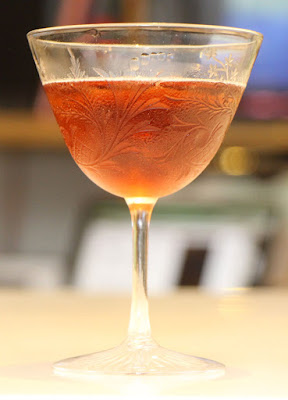
A Trilby cocktail
The Boudier’s citrus character blends easily enough with the gin and does poke its head up now and then with notes of sweetness and stemminess too. The Cartron has a similar effect, though it gets a bit lost. The Bols version is certainly more distinctive: while the juniper/Parfait interface is not horrible, it will come as a bit of a shock to Martini drinkers. Overall it is more cloying and doesn’t seem to sit comfortably with the seriousness of the Dry Martini ingredients. Might go better with Babycham.

However, noting that Ted Haigh, in Forgotten Spirits and Vintage Cocktails (2009), champions the Jupiter but is very particular about measures—in his recipe the gin is at 45ml and the vermouth at 20ml—I have another go the next night, using his exact quantities (and Bols liqueur) and the result is indeed more elegant. I must have overdone the Parfait Amour previously, as this version is actually quite dry. This probably does make the best of the liqueur; its nougat character takes on a hint of (white?) chocolate in this subtle incarnation.

Trilby
1 shot Scotch whisky
1 shot red vermouth
1 shot Parfait Amour
2 dashes absinthe
2 dashes orange bitters

Again, the Carton and Boudier versions produced only a fairly subtle influence. The Bols Parfait Amour made its presence felt more, sitting in the mix with the malty rasp of the Scotch, the herbal sweetness of the vermouth and the pungence of the absinthe (I used just a rinse), though whether the end result is complex or conflicting is debatable.

A Blonde Bombshell
I have a feeling that Parfait Amour can be quite a busy blend of flavours in itself, and so might actually work better in simpler combinations. Experimenting, I found that just adding a dash or two to a glass of Champagne or sparkling wine was one of the most satisfying serves, enabling the flavours of the liqueur to open up but not overwhelm (and in fact Bols claim on their website that this combination is drunk at weddings all over the world). There are a number of cocktails that are basically this, plus another ingredient as well. The Blonde Bombshell, for example, recommended on Bols’s website, adds elderflower liqueur:

Blonde Bombshell
15ml Parfait Amour
15ml elderflower liqueur
Top with Champagne or sparkling wine

The two liqueurs do complement each other, with the prickly high notes of the elderflower slotting in with the Bols’s warm nutty and vanilla layers. But I find myself boosting the elderflower (I’m using St Germain) to get a good balance, and frankly the whole thing is a bit too sweet for me anyway. Adding more sparkling wine helps, as does squeezing a bit of lemon juice into the blend.

A Double Perfect
The Double Perfect does the same thing but uses triple sec instead of elderflower liqueur. Again they specify 15ml for each liqueur but, warned by the Blonde Bombshell, I start with just 10ml and frankly this is all you need (unless you’re using a very large glass).

Double Perfect
10ml Parfait Amour
10ml Cointreau
Top with Champagne or sparkling wine

The Cointreau cranks up the orange aspects already present in the Parfait Amour and controls the confectionary nougat elements, making for a relatively elegant, poised use of the liqueur, especially in these reduced quantities. (I’m using Bols, which has a broader flavour than the other two brands, which are more citrus to start off with, so I’m not sure how much point there would be to this blend using Cartron or Boudier.)

And as a final test, my eye was caught by this combo on diffordsguide.com, to which he gives a higher score than most other Parfait cocktails:

The Brazen Martini
Brazen Martini
2½ shots bisongrass vodka
¼ shot Parfait Amour

Once again it really only takes a teaspoon of the liqueur to do the job, though I’m not convinced that it is a job worth doing. The pungent herbal element of the vodka, with its bitter aftertaste, interfaces interestingly with the plump, sweet vanilla of the Parfait Amour in the same way as the absinthe does in the Trilby, but it is more thought-provoking than actually pleasant, and is really not a cocktail I would be keen to have again.

As you can probably tell, I can’t get terribly excited about Parfait Amour—and I’m in good company, as the great David Embury, author of The Fine Art of Mixing Drinks (1948), ranked it with Forbidden Fruit as his two least favourite liqueurs. The best delivery methods for it are the Jupiter, the Double Perfect or just a small 5–10ml dose in sparkling wine—but as you can see, the key here is to use it sparingly.

* The play, an adaption of the Georges du Maurier novel, played first at the Boston Museum in 1895 before Herbert Beerbohm Tree brought it to the UK, where it ran with great success at the Haymarket Theatre in London. Trilby O’Ferrall is the female lead. The Trilby hat gets its name from the play as well.

Monday, 10 November 2014

Big Gin makes a big impression

While helping to judge the recent Craft Distilling Expo Gin of the Year, it was my great pleasure to meet Ben Capdevielle and Holly Robinson of Captive Spirits Distilling, part of the wave of “craft”, “boutique” or “artisan” distilling that is sweeping the US at the moment. Based in Ballard, near Seattle, they make Big Gin, both in its standard form and in a version that has been aged in ex-bourbon barrels.

Theirs is not a happy-go-lucky tale of casting around for something to do and hitting on the idea of making a gin on a whim.* Ben is actually a third-generation distiller—his grandfather was a distiller for Templeton Rye** during Prohibition—and the pair spent four years visiting distilleries and experimenting with botanicals and distillation variables before finally launching their product in 2012. “We are using the traditional method of making gin,” Holly explains, “and creating a small scale, boutique brand just using two 100-gallon pot stills. We are exclusively a gin company, instead of making a variety of spirits like most of the budding brands. We have a few other gin-centric products that will trickle out in the next few years…”

Holly and Ben (second and third from the left) at the Craft Distilling Expo Gin
of the Year judging
As the name suggests the idea was to make a bold, unashamedly gin-flavoured gin. “We took this away from all the big players in the gin game,” Holly says. “Consumers are used to drinking Beefeater, Bombay, etc—we wanted something that ginners could identify with, instead of trying to reinvent the wheel.” The botanicals are indeed mostly conventional—juniper, coriander, bitter orange peel, angelica, cassia, cardamom, orris—plus grains of paradise (not unusual either, being present in Bombay Sapphire) and Tasmanian pepper berries. The spirit base is made from corn. “This was the most neutral base we found to impart the botanicals,” Holly says.

Uncork a bottle of Big Gin and it is certainly big, with a strong waft of juniper. But it is more complex than that, with orange peel, dried fruit and a pronounced floral note like crystallised violets, perhaps from the angelica. There is also a herbal stemmy quality and a hint of ginger. It is big, bright and rich.

A Last Word made with Big Gin
On the palate it is powerful but remarkably smooth and sweetish, given that it is a hefty 47% ABV. Perhaps the corn-spirit base lends this sweetness. The flavour follows on from the nose, with that floral note to the fore and a slight peppery-bitter finish. It easily works in a Martini or gin and tonic, basically making its own rules. It is well-suited to a Negroni, clearly making its presence felt, whereas more delicate gins can sometimes get lost in the present of the Campari and vermouth.

Another muscular cocktail to test a gin is the Last Word, traditionally equal parts gin, Green Chartreuse, lime juice and maraschino: it has a balance between the sweetness of the liqueurs and the tartness of the lime, but these elements and the herbal blast from the Charteuse can drown the gin. I have to say that even Big Gin struggled here. But I noticed that on Simon Difford’s website he is now advocating a 3:1:1:1 ratio (the 3 being the gin). With Tarquin’s Cornish Gin I find that it does really need these proportions before you can really taste the gin in the mix, but Big Gin reaches that point at only 2:1:1:1.***

An Aviation made with Big Gin
I felt that Big Gin was less successful, however, in an Aviation, being perhaps too powerful for the subtle flavours of the maraschino and crème de violette (of which there is only about a teaspoon, otherwise the colour of the cocktail veers from the pale lilac-blue meant to represent the sky, from which the drink gets its name: try something like 50ml gin, 12.5ml lemon juice, 12.5ml maraschino, 5ml crème de violette).

You can get a sense of the big, savoury qualities of Big Gin from the recommended cocktails on the Captive Spirits website. The Out-of-Towner involves making a fennel syrup (plus gin, lemon juice and triple sec), and two of the recipes use elderflower liqueur (such as St Germain). The Morning Paper tops gin and elderflower with sparkling wine and a splash of grapefruit juice, and there is definitely a continuum between the gin botanicals and the sweetly pungent qualities of elderflower.

Although Captive are determinedly not planning to make a whiskey, they are interested in pushing their gin in different directions, such as the bourbon barrel aged example now on the market. “All the worlds best spirits are aged in bourbon barrels,” Holly explains. “With Big Gin being so flavorful, we thought it could stand up well and one could still actually taste the gin. Thankfully, we were correct.”

A Martinez made with Bourbon Barreled Big Gin
Ageing gin is all the rage it seems, but at a tasting of several of them earlier this year I did feel that none of the examples seemed particularly successful, with the wood notes somehow quarrelling with the essential gin flavour. But there is certainly a tradition: Seagrams have always rested their gin in charred new oak barrels to smooth off the rough edges of the spirit.

The barrel-aged version of Big Gin came as a revelation to me, however. Perhaps there is something about the prominent orange notes in the gin which marries well with the wood flavours, or maybe there is something about these particular barrels (which presumably have had bourbon in them for a long time, damping down the sawmill quality of fresh wood). On the nose the sharp juniper of the base gin is softened but still present, while a warmth and sherried sweetness are added, plus an enhancement of the dried fruit flavours I noticed before and a pleasant woody, almost mossy, mustiness. On the palate there is excellent integration of the aromatic gin elements and the tannic, vanilla wood flavours, plus clear notes of bourbon, emphasising the orange peel.

On a whim I try to make a sort of sweet Martini using Regal Rogue Bianco and the result shows remarkable balance and harmony from two strongly-flavoured ingredients, a little like a Martinez with orange and herbal notes all blending well. I try making a Martinez, using 2 shots gin, ½ a shot each of dry and sweet vermouth and a dash of maraschino, the result is sublime. Likewise in a Negroni it works as well as the normal Big Gin but with an extra dimension that fits naturally, as in a Manhattan or Boulvardier**** (which it virtually is). It really is a revelation.

A Spring Fling made with Bourbon Barreled Big Gin
There is a recommended cocktail, the Spring Fling, that once again uses elderflower liqueur, this time with the barrel-aged gin plus dry vermouth and some celery bitters. It’s an extraordinary tour de force, with the elderflower merging with the big herbal flavours of the gin, followed by a sweetness emerging and woody notes, then a fiery warmth. You also get a sense of sun-kissed Mediterranean aromatic herbs, like thyme or oregano. The prescribed garnish is grapefruit zest, but I only had lemon to hand and its aroma floats over the other flavours, balancing without muddying.

If you like gin then you should try Big Gin. It’s nice to come across a product that is not trying to make a “gin” for people who really want vodka, nor is it trying push the flavour in outré directions for reasons of gimmickry alone. But at the same time Big Gin is distinct. And it is big.

In the UK you can buy Big Gin through Master of Malt for £39.96 and the bourbon barrel aged version for £44.85.

* Talking to Holly you realise that the process of starting up a distillery is more of a bureaucratic slog than most of us realise, especially in the US. “There is a lot of red tape, but mostly several different levels of permitting, each of which cannot commence without the previous—it's a domino game. First Federal, than State, then City, then Fire, etc… Every state/city has different ideas of what/how things should be done. That’s the confusing part. Once that is all waded through, it’s a slow start to getting product out the door.” To help with all of this the couple got a third partner, old friend Todd Leabman, to help with the paperwork and accounting.

** The good folk of Templeton, Iowa, apparently carried on distilling whiskey throughout Prohibition and Al Capone is said to have like it so much he would send a driver all the way there from New York to stock up. 

*** It an interesting experiment, because if you start with the punchy sweet-and-sour traditional recipe and just add more gin, it’s easy to think, “Oh, no, this is getting too dry.” But if you come back to it later and try it you do realise it as a good, subtler cocktail. All the lime and Charteuse are very much there, but now you can taste the details of the gin too. Hurrah.

**** 1½ shots bourbon or rye whiskey, 1 shot Campari, 1 shot sweet vermouth, so a sort of mash-up between a Negroni and a Manhattan. It was invented by New Yorker Harry McElhone after he emigrated to Paris, fleeing Prohibition, and set up Harry’s New York Bar. He created it for ex-pat Erskine Gwynne in honour of his Parisian magazine The Boulvardier.