Showing posts with label Luxardo. Show all posts

Tuesday, 23 May 2023

Luxardo Espresso Liqueur


Luxardo kindly sent me a sample of their new Espresso liqueur. They describe it as “a traditional Italian liqueur obtained from a thirty-days infusion of a selected variety of fine coffees (Brazil, Columbia, Kenya), with the Arabica type predominating”. It certainly tastes very coffee-ish: I’m assuming it contains water, neutral spirit (it’s bottled at 27% ABV), sugar and coffee.

The obvious thing to compare it with is
Kahlúa. The first thing to note is that the Luxardo product is quite a bit less sweet, which would certainly make it more flexible—after all, you can always add more sugar, but you can’t really take it out. Secondly, while the Kahlúa does taste convincingly of coffee, the Luxardo liqueur tastes specifically of espresso coffee, that earthy, bitter, high-roast flavour, with hint of berry fruit (and a touch of rubber). In fact there is more to it than that: Kahlúa is made from a rum base, and the nose has rum and vanilla notes as well as coffee, whereas the Luxardo liqueur has a simpler nose, really just of coffee and sugar. The Kahlúa’s palate has distinct rum elements, whereas the Luxardo does not have any noticeable contribution from the spirit base; and Kahlúa’s coffee note is less profound, whereas the coffee flavour of the Luxardo has considerable depth to it (more than most cups of coffee I’ve had). 

Espresso Martini
Luxardo suggest drinking the espresso liqueur neat, chilled or on the rocks, though I don’t know how many people will do that. I get the impression that it’s all about the Espresso Martini, a cocktail created by Dick Bradsell in the early 1980s, originally served on the rocks, but converted to straight-up in a cocktail glass in the 1990s—a decade when every cocktail seemed to be served this way and named a “[Something] Martini”, even if its ingredients bore no resemblance to a Martini. This is typically made from vodka, freshly made espresso, coffee liqueur and sugar syrup. (Perversely, Simon Difford, on his website, omits the syrup but adds a couple of drops of saline solution, and adds that he likes to squeeze a lemon peel over the top. However, in my copy of Difford’s Cocktails #8, from 2009, the recipe just has vodka, espresso and sugar, so he’s obviously changed his mind since then. On the website he gives Bradsell’s recipe from the 1990s and it includes a blend of Kahlúa and Tia Maria.)

On this occasion I use the recipe from m’colleague David Smith’s new book Martini (Ryland Peters & Small):

Espresso Martini
45ml vodka (he suggests Beluga, but I’m using my new favourite, J.J. Whitley Artisanal Vodka)
15ml coffee liqueur (he uses Conker, but obviously I’m using Luxardo)
30ml espresso coffee
10ml simple syrup
Shake hard with ice and serve in a cocktail glass: it should have an appealing layer of foam on the top (what I believe coffee nerds call a crema). Garnish with coffee beans.

Reflecting on Difford’s original recipe, is this cocktail essentially vodka and coffee with a bit of sugar? (Apparently Bradsell’s original was just this, created at the request of a model who asked for something that would wake her up, then f**k her up.) Given that the liqueur has sugar in it anyway, you could just mix vodka and the liqueur—interestingly, another of the three cocktail recipes on Luxardo’s webpage for the liqueur is a Black Russian, which is precisely this, vodka and coffee liqueur. It’s a viable drink, particularly if you don’t want anything too sweet. Compared to the Martini, it’s obviously more about the alcohol, whereas the Martini is quite different, from having actual espresso in it. Which is interesting, given that the liqueur is made from coffee beans. But there is something earthy about the flavour and also the texture, which I guess comes from the suspension of coffee particles. To be honest the Espresso Martini from this recipe is too sweet for me, though Mrs H. is drinking it happily.
Coffee Old Fashioned
The Luxardo webpage gives only one other cocktail suggestion, a blend of 45ml coffee liqueur with 5ml sambuca, which they call an “Espresso, What Else!” I don’t have any sambuca to hand, though I’m guessing this is a riff on the tradition of serving sambuca on fire with a few coffee beans floating on the top.

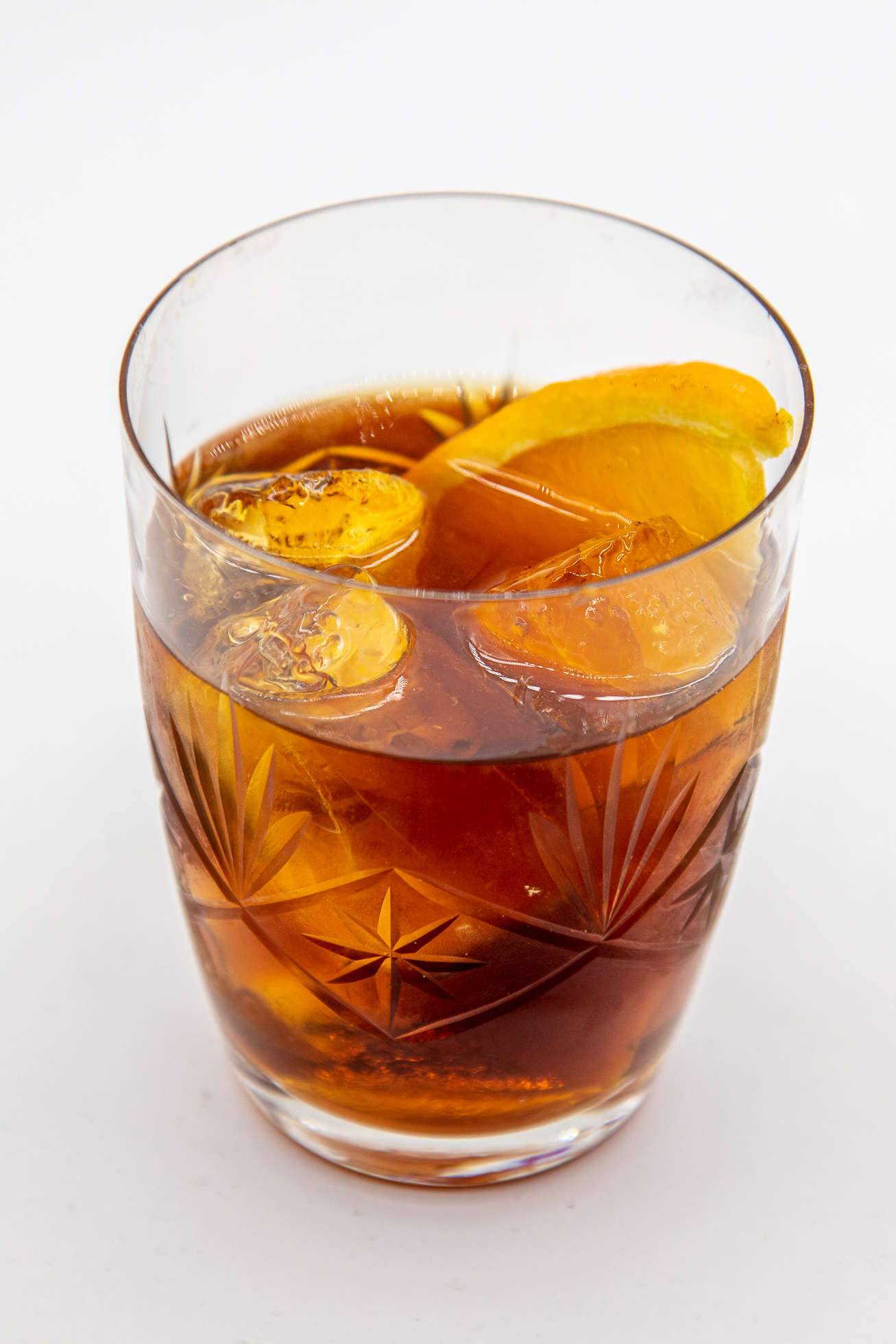
Instead, it occurs to me that the coffee flavour should pair well with bourbon, and indeed it does. I offer it to Mrs H. and she said it needed chocolate. I do actually have some chocolate bitters from Mozart, and I can confirm that 3 or 4 dashes of this does go very well, making a sort of Coffee Old Fashioned. Needless to say, I’m not the first person to have this idea, and if you Google “Coffee Old Fashioned” you’ll find a few iterations, several of which use orange bitters. In fact I find it works well with chocolate bitters, orange bitters or regular Angostura bitters.

Coffee Old Fashioned
50–60ml bourbon (rye would doubtless work too)
15ml coffee liqueur
3-4 dashes of Angostura, orange or chocolate bitters (or a perhaps a combination)
Build in a tumbler with ice.


Saturday, 24 July 2021

Happy birthday, Luxardo!

It was nice to be invited out on "Freedom Day"—last Monday, the day that Covid-related social restrictions were lifted here in the UK (though for how long, who knows?). In this case it was to a celebration of 200 years of Luxardo, most famous for their maraschino liqueur—see my previous analysis of the singular way they make it. It was a small gathering of only a dozen or so: previous plans for a big party had had to be abandoned, what with the plague and everything. Incidentally, the event falling on Freedom Day was a coincidence: the real reason they chose 19th July was that this is the 200th day of the year.

The venue was a "secret piazza" created for the summer at Hush Mayfair in London. Turn off Brook Street down Lancashire Court and you'll find an open courtyard with outdoor tables and a cocktail menu featuring Luxardo products. I'm not sure how Italian it really feels but being outside is a boon during Covid times. Here we sampled the new Antico vermouth-style aperitivo—not technically a vermouth because it is made from fermented cherry juice rather than grape wine, but it tastes very similar to red vermouth, with a hint of cherry at the end. I liked what I tasted and would be keen to try Manhattans and Negronis made with it.

We tasted the Antico neat, in a Spritz and also in a sgroppino, a traditional Venetian combination of lemon sorbet, vodka and Prosecco, in this case with added Antico. It's kind of a cross between a drink and a dessert and was probably the highlight of what we sampled on the day. The red powder sprinkled on the base of the glass was apparently dried raspberry, though I couldn't find a practical way of verifying this…

We were also honoured to get a taste of the Perla Dry Riserva Bicentenario, made from 50-year-old cherry distillate. It has less sugar than regular Luxardo maraschino; in fact it has a nose a bit like fino sherry and tastes a lot like grappa with notes of almond and chocolate. But don't expect to spend the summer swigging the stuff, as only 12 bottles are destined for this country (one of which I assume is the one I photographed here), at a price of £120 each. 

"G" Franklin, Luxardo's Global Brand Ambassador introduces the Perla Dry


Thanks to David T. Smith of Summer Fruit Cup for swinging me the invitation. The Luxardo Secret Piazza will be at Hush Mayfair until 30th September.

Luxardo Antico aperitivo, 16.5% ABV is £20 for 70cl. Luxardo Perla Dry Riserva Bicentario, 40% ABV, is £120 for 70cl.


Left to right: the Antico, the Antico with soda, the sgroppino and Luxardo's luminous orange regular Aperitivo, which is a bit sweet for me


Sunday, 6 May 2018

Pale fire: the perfect aperitif for a summer's day

During my investigations into Luxardo’s famous maraschino I came across Luxardo Bitter—I’d not heard of it before but it is an amaro made from an infusion of various herbs, spices and fruits. The basic bitter is bright red, so clearly in the same ballpark as Campari. (The colour of Campari is a gimmick, originally made with cochineal, i.e. crushed beetles, but nowadays synthetic, so I would assume the only reason Luxardo’s product would be the same colour is to try and encroach on the same market—but there are actually quite a few red amari out there so perhaps it is traditional.)

But they also make a Bianco version, which Luxardo describe only as an “infusion of bitter herbs, aromatic plants and citrus fruits in water and alcohol”. It is sweet and plump in the mouth, with a delicate complexity, floral notes and a pronounced rooty bitterness. I have some Campari to hand, and by comparison it is less sweet with stronger fruit notes, a distinct note of orange peel and a black pepper finish. I have read that Luxardo Bitter Bianco has some wormwood infused towards the end of the process to give it a lingering bitterness.

What really caught my eye was a reference to the Bitter Bianco in the context of a “White Negroni”. I’m a big fan of the Negroni cocktail, a drink with a colourful history, allegedly created when one Count Negroni asked for the soda in his Americano be replaced with gin (though there is bitter rivalry between different origin stories). It’s a powerful beverage—all the ingredients are alcoholic—that enjoyed a revival a few years ago. A mix of equal parts gin, Campari and red vermouth, it has a bitter-sweet flavour bursting with all the herbs and roots that have gone into the component infusions, with juniper rising over the top and strong orange notes (it is usually garnished with orange). And of course it is a deep red colour from the vermouth and Campari.

If you actively search for White Negoni cocktails the recipe that comes up most often actually has Lillet Blanc standing in for the vermouth and Suze standing in for the Campari. But there is a version that uses Luxardo Bitter in place of the Campari and bianco vermouth in place of the red vermouth. It is a fairly new drink, as Bitter Bianco was only released in 2016.

I guess the main schtick with this cocktail is its colourlessness compared to a regular Negroni, but it certainly works on its own terms, with a good sweet-bitter balance and a pronounced vanilla flavour from the vermouth (I used Cinzano Bianco). It’s less aggressive that a normal Negroni, subtle and thought-provoking. I can imagine pondering its delicate intricacies on a gentle summer’s afternoon. I get the impression that most people garnish a White Negroni with orange as normal, but I felt it was more chromatically harmonious to use lemon.

For more Negroni variants see this post from 2015.

Sunday, 29 April 2018

Maraschino: is wood good?

Luxardo's maraschino and Sangue Morlacco cherry brandy. The blossom is
from Greenwich park here in London and I doubt it is marasca cherry
Maraschino is an ancient cocktail ingredient, a liqueur made from marasca cherries. I used to wonder if it was often used mainly to add sweetness, as the flavour is quite delicate, but I recently had a revelation that changed my thinking.

Maraschino has been made in Dalmatia for hundreds of years but in this country the brand with the highest profile has to be Luxardo. Having said that, it’s not a hugely high-profile product at all—I recently ran out and discovered that no supermarket seems to sell maraschino. They have crème de cassis, crème de pêche, sambuca, etc, but not maraschino. In fact I’m sure the only other brand I’ve ever seen is Briottet, though a Google search shows that there are others available in this country, including examples by the other general liqueur manufacturers such as Giffard and Boudier.

Up to now I’ve mostly used Briottet, because it is cheaper than Luxardo (I think the whole Briottet range are extremely good value). It has a light fruit flavour plus a bitter-almond element that comes from the cherry stones that are included in the fermented pulp. But I recently acquired a bottle of the Luxardo version and I was struck by the difference in flavour. Moreover, as Luxardo had early worldwide success, it made me wonder whether this was the flavour that was intended in all those classic cocktail recipes.

The Luxardo brand goes back almost 200 years, when Girolamo Luxardo was sent as a diplomat from the Kingdom of Sardinia to Zara in Dalmatia, which was then part of the Austrian empire. There was a local tradition of making “rosolio maraschino” from the native marasca cherries, which Girolamo’s wife Maria took an interest in. The couple began to experiment with distilling their own from the cherries in their orchard, apparently after spending some years tinkering with the recipe. They founded a distillery in 1821 and things took off for them when the Austrian emperor gave their brand his stamp of approval and it was soon being exported all over the world. (The distinctive wicker wrapping on the bottle was originally to protect it during sea crossings.)

I must admit that I always thought maraschino was an Italian liqueur and, depending on how you look at it, you could say that it is. Prior to 1797 Dalamatia had been part of the Republic of Venice, and after the First World War part of it (including Zara) joined the Kingdom of Italy. The Second World War led to a change of fortunes for the Luxardo company, which by then was being run by the fourth generation of the family. Heavy bombing destroyed the factory and the orchard was burned. In 1947 the area became part of Yugoslavia and many Italian citizens fled; they were persecuted by Tito’s partisans and many were killed, including Piero and Nicolò Luxardo, and Nicolò’s wife Bianca, who were forcibly drowned.

But Giorgio Luxardo founded a new distillery in Torreglia, in the Veneto region of Italy, and started to rebuild the business. Apparently just one cherry sapling had been saved from the orchard in Zara (now Zadar in modern Croatia), and all the trees in today’s Luxardo orchard are descended from that one. The firm is still being run by the same family, now into its sixth generation.

An Aviation made with Luxardo maraschino.
Apologies for the lack of fine-straining
I’m not sure how other maraschinos are made (there is only talk of “maceration” of cherries) but Luxardo make theirs in a singular way. Cherries are crushed along with their stones (and, I gather, leaves and stalks too) and fermented. The resulting alcoholic soup is distilled to produce an eau de vie that is blended with sugar and water to make a liqueur. But the liqueur is aged for two years in Finnish ashwood vats. (The pulp left over from distillation is infused into alcohol and sugar to make their excellent “Sangue Morlacco” cherry brandy.)

The first thing that hits you on the nose with Luxardo maraschino is actually earthy, dry aromatic wood notes, with a hint of Angostura Bitters. The light cherry fruit comes after that. It is not cloying at all, and has a sweet/dry balance (presumably from wood tannins) and a spiritous heat.

I have a habit of adding a splash of maraschino to Manhattan cocktails, but the specific character of the Luxardo product is lost against the woody power of the whiskey. However, in an Aviation cocktail (roughly two measures of gin, half of maraschino, half of lemon juice and a teaspoon or so of crème de violette) that dry wood flavour is quite noticeable.

I can’t find a reference to any other commercial maraschino wood-ageing its product in the Luxardo way, including the Maraska brand made in Croatia, which claims its recipe dates back to the 16th century. Before Luxardo the Drioli brand was a major player (and a previous holder of the Austrian emperor’s warrant)—it was laid to rest in 1980 but I don’t know how widespread it still was in the late 19th and early 20th centuries, when the cocktail tradition was being developed.*

So it is hard to say if, for example, Hugo Ennslin was using a barrel-aged maraschino when he developed the Aviation (first published in 1918). But it is something to be aware of: if you find many classic cocktails too sweet you should try using Luxardo. And if you have been using it and find your drinks too dry and woody, consider using a different brand.**

* Mind you I did discover this website which says the Drioli brand was obtained by Luxardo and it seems to be in production again, though I don't know how widely distributed it is.

** Apologies for reusing a headline from 2014 but the matter here is essentially the same question: with certain spirits, is wood-ageing actually a Good Thing?

Thursday, 1 May 2014

With a cherry on the top: Luxardo Sangue Morlacco

Cherry brandy is one of those ancient cocktail ingredients and, like “apricot brandy”, isn’t really a brandy at all but a liqueur. Typically neutral spirit is infused with crushed cherries, although some posher examples use grape brandy as a starting point. (None of which is to be confused with a spirit made from fermented and distilled cherry juice, such as kirschwasser; maraschino, another cocktail staple, is also a liqueur, made by diluting and sweetening a spirit made from fermented and distilled marasca cherries, and is consequently colourless and tends to be drier and more delicately flavoured than cherry brandy.)

At a recent Candlelight Club event, our mixologist David Hamilton-Boyd included a recipe that specified Luxardo Sangue Morlacco Cherry Liqueur. I’d not heard of this and was interested to find that it is a cherry brandy that is oak-aged for two years. Luxardo are better known for their maraschino, and I gather that this is a by-product: cherries are fermented and then the alcohol is distilled off to make the maraschino. The left-over post-fermentation pulp is what is used to make the Sangue Morlacco, infused into neutral spirit with added sugar. There is a long history to this, and the name Sangue Morlacco—“blood of the Morlaccos”—was given to the drink by the poet Gabriel d’Annunzio in 1919 in respect of its colour, after the fiercely proud Dalmatian warriors who fought for the Republic of Venice and defended their homeland against invading Turks.

Pretty much all cherry boozes seem to include the stone, often grinding it up with the flesh, with the result that the dominant flavour is actually of almond. (It’s hard to conjure the flavour of cherries as distinct from their stones: I happen to have a jar of dark cherries in Luxardo kirsch in the fridge, so I eat one. But mostly you get the texture of the cherry flesh and that almond flavour of the kirsch. In fact while working on this post I open a bottle of red wine that has more of a distinct cherry fruit aroma than any of these spirits.)

I’ve got two other cherry brandies to hand, one by De Kuyper and some Cherry Marnier, by the same folk who make Grand Marnier. These two are quite tawny in colour, whereas the Morlacco is a vibrant purple-red, which is quite impressive after two years in a barrel.

The De Kuyper has a nose of marzipan and much the same on the palate. It is cloyingly sweet and pretty one-dimensional, with a very short finish. The Cherry Marnier is warmer, with darker, more complex flavours. To me it still essentially tastes of almonds, but there are elements of fresh fruit on the nose and palate too. The Sangue Morlacco immediately strikes me as more vinous on the nose, almost as if there were red wine in it—I suppose it does contain fermented cherry juice as well as spirit, and it has spent two years in a barrel. That familiar marzipan note still dominates the aroma and taste, but in the mouth it is less cloying that the others, with pronounced tartness and dry tannins (presumably from the wood) to balance the sugar. There is also a pepperiness on the finish.

There’s no doubt that, out of these three, the Sangue Morlacco is the most interesting, having more balance and depth. But I don’t think I would choose to drink any of them on its own.

The Blood and Sand* is a classic cherry brandy cocktail, so I rustle up a couple, one with De Kuyper and one with Sangue Morlacco. The traditional recipe is equal parts Scotch, cherry brandy, red vermouth and orange juice. I follow Simon Difford’s lead and double the quantity of Scotch (in this case Famous Grouse, with Martini Rosso as the vermouth).

First off, the Morlacco version is quite a different colour, a tawny red, as opposed to the sludge hue of the De Kuyper concoction. On the nose and palate, this latter is dominated by the confectionary almond element, giving it a slight cough-mixture quality. The same cocktail made with Sangue Morlacco is drier, with dark flavours, seemingly more emphasis on the vermouth and something reminiscent of port. It is altogether more of a grown-up drink, methinks. For me, this is where the superior qualities of Luxardo’s Sangue Morlacco come into their own—making cocktails with cherry brandy in them much more palatable.

* This cocktail was created in 1922 to celebrate the new Valentino movie of the same name. It was quite common in those days for movies and plays to be saluted in this way. It doesn’t seem to happen much today, but then would you want to drink a Fast and Furious 3? Or, for that matter, an Assassins Creed IV: Black Flag?