Showing posts with label Beefeater 24. Show all posts

Monday, 25 September 2017

Adnams Rising Sun gin

Back in 2011, when Suffolk brewery Adnams entered the distilling game with two gins and three vodkas, I was much taken with all of them. The basic Copper House gin, which is cheaper and more widely available, is based on Adnams’ entry-level barley vodka and features hibiscus in the botanicals, giving it a smooth, floral character; the more expensive First Rate gin is based on the more complex three-grain Longshore vodka and has a drier, more juniper-forward character.

Adnams is based in the seaside town of Southwold, with their brewery and distillery a stone’s throw from the seafront. I was in the town last week and found myself in their dedicated store (in fact they have two). Their range has expanded further, with a young single malt whisky, a triple-malt (wheat, barley and oats) blended whisky with a bourbon character, their Spirit of Broadside, distilled from their Broadside ale, an apple brandy, a triple sec, a limoncello, a rye vodka and also a third gin—Rising Sun.

The defining characteristics of Rising Sun are the use of two key botanicals—lemongrass and Japanese matcha tea—and the base spirit made from rye. (In fact the name apparently comes from the fact that the rising sun’s rays hit Jonathan Adnams’ field where the rye grows before any other. They don't say whether this spirit is the rye vodka that is now sold as a product in itself.) It seems to be quite divisive: a friend of mine who had already tried it was quite sure that he did not like it, saying that it was too savoury for him; and the woman in the smaller of the two Adnams shops declared that it was sharp and peppery, thanks to the use of grains of paradise, and she said it in a way that made it clear she wasn’t that keen herself.

In uncork the bottle and Rising Sun greets me with a reassuring waft of juniper,  some sweet orange peel and something floral like violets; concentrate the fumes and this becomes slightly overripe. There is a distinct sweetness, a hint of ginger and something biscuity, perhaps with a sharpness like varnish fumes, which may come from the rye base.

On the palate I’m half expecting a pronounced rye-whisky sharpness, but it is actually quite smooth. In fact it is complex, as if the spirit base is lean and dry but the botanicals are smoothing things out. For me the most striking element is the matcha tea which is quite noticeable (more so, for me, than in Beefeater 24, which prominently includes Japanese sencha and Chinese green teas among the botanicals). Not so sure I’m getting the lemongrass, but overall it is comfortably within the territory of modern smooth/sweet/floral crowd-pleasers. I’m not really seeing why it would wrinkle noses in the way that it has done. In fact to me it seems to have a faint aftertaste that is sugary like a boiled sweet (without actually being sweet as such).

I make a Dry Martini using Rising Sun and Belsazar Dry vermouth and the character persists, except that there is now a toffee-mint note emerging.

I try mixing the gin with Franklin’s tonic water and it brings a fruitiness—a concentrated kind of fruit like dates or dried figs, plus a note of chocolate. (Although I am quite new to Franklin’s, these flavours don’t come from the tonic itself—I checked.) And still the matcha tea note cuts through.

So far I like this gin. To me the green tea element makes perfect sense, but others may feel differently. It does not seem sharp to me as it did to the woman in the shop, but perhaps it is the rye that puts some people off: in the user comments on Adnams’ website one reviewer describes it as “propanone and sourdough starter gone bad”, which definitely sounds like a reaction to the spirit. (I suspect his “propanone” is what I refer to as reminding me of varnish.)

And I wouldn’t really call it savoury. But then I myself tend to prefer gins that are savoury in the sense of being herbal, so perhaps it just seems normal to me.

Comparing Rising Sun alongside Copper House, the latter seems cloyingly floral and fruity; I much prefer Rising Sun. But certainly I feel there is a house style to Adnams’ gins that is quite bold, citrusy, smooth and floral. (I have the remains of a bottle of Beefeater 24 for comparison and it is quite different, restrained with a stern, lean mouthfeel.)

I notice that on the webpage for Copper House gin they say that they first had the idea of using hibiscus when they encountered it in tea, so you get a sense of the overarching family of flavours that make up the Adnams approach to gin.

Thursday, 23 October 2014

Hoist the gin pennant for Cornwall's finest

Walking along the cliff path on St Anthony Head in Cornwall, with views out over the mouth of the Fal, the ancient fortifications of Pendennis and St Mawes Castles, the boats slicing in and out of Carrick Roads, I got to wondering what a self-consciously Cornish gin might taste of—what local botanicals could you use that would evoke the flavour of the place? Seaweed or something briny? Or the blackberry bushes that line all the paths, from which I idly picked as I walked along?

So I was interested to notice, while sitting in a fairly minimalist restaurant in St Mawes, that one of the few spirits on offer was Tarquin’s Cornish Gin. I tracked it down and discovered that it is, indeed, made by a chap called Tarquin Leadbetter at Southwestern Distillery in Wadebridge. They make just two products, the gin and Cornish Pastis (see what they did there?), using a small flame-fired copper pot still. They use fairly traditional botanicals from around the world (though mostly sourced through a bloke called David, apparently)—juniper from Kosovo and coriander from Bulgaria (which they describe as lemon-sherbety rather than hot and spicy like Moroccan coriander), angelica root from Poland, orris root from Morocco, green cardamom seeds from Guatemala, bitter almond from Morocco, cinnamon from Madagascar and liquorice root from Uzbekistan. They also use fresh (rather than dried) citrus peel, orange, lemon and grapefruit, from wherever they are in season in the world. And the final, magic ingredient—and the one that makes it distinctly Cornish—is Cornish violets, grown in Tarquin’s garden. It is diluted down to 42% ABV using springwater from near Boscastle (which is also bottled and sold as mineral water, called MeadowSweet). Each bottle of the small, 300-bottle batches is signed and numbered by hand by Tarquin himself, and dipped in striking blue wax for good measure.

I notice that, in addition to Tarquin’s signature and the bottle number, the label also includes a box labelled “Character”, again filled in by hand on each bottle. You might think the character of the gin would be fixed by the recipe, but Tarquin deliberately includes these tasting notes to emphasise the variations you get with gin made in this way. “We're celebrating the nuances between batches, highlighting the fact that our spirits are not mass-produced,” he tells me. “We could have blended batches, or implemented a sherry-style solera bottling system. But I think it's quite fun to do our crafty sort of way.” My sample was “Earthy orange”, while another bottle I had a taste from was “Eastern spices” and one in a photo on the website is “Fresh orange blossom”.

“In the months up to Christmas we're doing something special with some filming, to make these tasting notes more interactive,” Tarquin adds. “…So stay tuned!”

Tarquin's hand-written tasting note on my bottle from batch 91
If I expected the gin to smell of violets I was in for a surprise. Chilled you mostly get fresh, stern juniper and lemony coriander to the fore. On the palate you also notice a softness, perhaps from the water, or the liquorice or the orange peel. At room temperature the orange notes are more prominent on the nose too, along with an interesting herbaceous quality that emerges as quite a characteristic. Interestingly Tarquin says, “One unusual ingredient is the Devon violet. From these I take the delicate leaves, which add a vibrant green freshness to the gin and create something deliciously unique.” So it is not the violet flowers involved but the leaves, and this is presumably the stemmy, herbal element that I am getting.

I instantly warm to this gin, not least because it is a gin that knows it’s a gin. So many modern gins shy away from juniper in favour of sweet or floral elements which are, let’s face it, aimed at attracting people who don’t really like gin. But Tarquin puts juniper up front. As such the gin works well in a G&T and especially in a Negroni, where the juniper pokes through but the mid-range elements and the underlying softness round the drink out too. Then you have that interesting herbal layer combined with the orange aroma, and at the bottom a relatively soft, sweet finish so as not to scare the horses. This also makes it good for a Martini as it is relatively approachable neat.

To get a clearer picture I put the gin head-to-head with some others. Bombay Dry emerges as drier, with a lemon-sherbet sharpness, with Tarquin’s gin softer and sweeter. SW4 has a similar fullness, but Tarquin’s gin comes across as more savoury, leafy and herbal, while SW4 is plumper, sweeter and more about spice. Tanqueray is quite similar on the nose but Tarquin’s is fatter and more complex, with more herbal punch and again a softer, sweeter finish. Beefeater 24 does have a tea element which stands out and it is lighter and drier. Finally, G’vine Nouaison matches up in the aromatic stakes, smelling quite minty and suggesting sweet roots. In fact it seems positively cloying, again emphasising the savoury herbal cut of Tarquin’s jib.

Overall I think Tarquin’s Cornish Gin is a remarkable achievement, managing somehow to combine the steely, upright juniper cutting edge of classic London Dry Gin, with a sophisticated modern soft finish, and a distinctive mid-range of orange zest and sappy herbaceous punch, like fresh leaves crunching under foot. It is complex and versatile, but not so outré as to fall down in classic gin cocktails.

Does it remind me of Cornwall? The bottle has images of fishing boats, basking sharks and what looks like the lighthouse not fifty yards from where I was staying, but there is nothing of the sea about the liquid (though I suppose a dash of Islay whisky might remedy that). But Cornwall does have a warm, humid microclimate, so perhaps the waft of verdant undergrowth in this gin is apt.

Tarquin’s Cornish Gin can be had online from Master of Malt for £35.57 or if you’re in Falmouth you can pop into the Bottle Bank and get it for about £29. For more stockists see www.southwesterndistillery.com.

Monday, 3 December 2012

Beefeater 24 global cocktail competition


The 14 hopefuls set up their stations as guests sample the cocktails and make their choices
I was invited to help judge the Beefeater 24 Global Competition last Wednesday evening at the Shoreditch Studios in London. Beefeater had flown in hopeful bartenders from all over the world, vying for the prize of a trip to Japan, and earlier in the day they had encountered challenges measuring all aspects of modern bartending, including food matching. The organisers are looking for more than just the finished drink, judging overall ability to be a host and, unsurprisingly, an understanding of Beefeater 24 and its history and place in the cocktail pantheon. But our role was simply to taste 14 cocktails and choose our favourite.

It’s always interesting to go into a bar, study the menu, try a few drinks and get a clear sense of how this particularly mixologist’s thoughts and palate work. But it’s not often you’ll find yourself confronted with 14 different sensibilities in the same room. Having said that, it was noticeable how much similarity there was in the ingredients. Tim Stones, a B24 ambassador, explained that the contestants were told they had to include tea (Japanese sencha tea and Chinese green tea are ingredients in Beefeater 24). But grapefruit was also common (grapefruit peel is in the botanical mix of the gin too, along with more conventional orange and lemon peel) as was honey and elderflower. Tim mentioned that in the past you would get clear national styles emerging when judging competitions like this, but nowadays bartending is a much more global community and the styles are more homogenised and the standard higher. (Though he did mention that in an early heat one chap presented a simple gin and tonic as his entry—Tim couldn’t decide if he had misunderstood the idea of the competition or if he just had enormous front…)

These were the cocktails on offer:

Mr Burroughs’ Reviver
Nathan O’Neil, United Kingdom
The Mr Burroughs in question turns out to be Beefeater founder James Burroughs and not, as I had hoped, elegant beatnik hallucinatory wordsmith William Burroughs. The cocktail is a variant of the Corpse Reviver No.2, featuring absinthe (but, mercifully, no heroin, peyote, yage, bug powder, the True Black Meat of the Giant Centipede, or any of the other intoxicants that feature in Mr Burroughs’ oeuvre). The absinthe is infused with lapsang souchong tea, and there is also a green tea and sencha tea syrup, aquavit, orgeat and lemon juice. The nose is dominated by lemon, but the palate is more complex, with notes of honey, warming anise and something floral. I liked these elements but I think overall it doesn’t have the righteous balance of a normal Corpse Reviver.

The Trading Company Martini—not much
like a Martini, really
Trading Company Martini
Marko Radičev, Serbia
Named after the East India Trading Company, this drink takes its inspiration from ingredients that were shipped to this country by that goliath of a corporation (James Burroughs’ father was a tea merchant himself, which is where today’s master distiller Desmond Payne got the idea for B24). It has a nose of weak lemon and a palate that is surprisingly light and thin with a citrus peel/tea bitterness. Probably too bitter for many, and not really much like a Martini.

Ginjamboa
Diogo Quinaz, Portugal
The name comes from the main ingredients, gin, fresh ginger and grapefruit (jamboa in Portuguese). The nose is of honey and ginger plus a medicinal note and the palate is very bold but very balanced—sweetness from honey, tartness from citrus, tannin dryness from tea and a fiery finish from ginger. This was one of my favourites, robust and to-the-point but also multi-faceted, with all the ingredients playing their part. Which is what a good cocktail is all about.

The So British
Aurélie Pezet, France
Aurélie uses a special blend of Earl Grey (which she considers quintessentially English) flavoured with lime and grapefruit peel and some sort of purple flower for which she could not think of the English name. There is also elderflower and grapefruit juice in the mix. The drink has a surprising pungence from the elderflower and waxy honey, combined with a refreshing citrus tang. The notes of Earl Grey and elderflower do somehow seen redolent of an English summer, so I can forgive the cheesy name.

Diogo Quinaz with his Ginjamboa
Desert Punch
Alexander Frezza, Italy
Alexander takes his inspiration from the Moroccan tea ceremony, and in particular the punch-style idea of a drink as an evolving group experience rather than a single serving. Moroccan tea is poured from a height into small glasses and the drinker is expected to have several of these. The fresh mint in the pot gradually infuses a bitterness into the tea as is steeps, and the saying goes (if I remember it correctly) that the first glass is as fresh as life, the second as sweet as love and the third as bitter as death. Not sure that third glass is really selling itself to me. This simple cocktail—just gin, tea, citrus and mint—is light and does have a refreshing mint flavour with a bitter finish, though I’m not sure it could hold my interest long enough to make it to that deathly third glass.

Mr Oolong’s Fixer Upper
Hasse Bank Johansen, Nordic
Hasse runs a bar in Aarhus, Denmark’s second city, on the Jutland peninsula, where he is pretty much inventing the market. He takes great delight in introducing mixology to people who may never had tasted a cocktail before. He studied bartending in Japan for a while, where his teacher was actually called Mr Oolong and served them all oolong tea each morning to wake them up from the previous night’s indulgence, so this drink was named in his honour. As Hasse says, it is a Martini-style cocktail, with the gin strongly to the fore, plus a homemade oolong cordial, citric acid and some grapefruit bitters. I admired the restraint, giving the podium to the gin rather than trying to show off, while the other ingredients did a good job of adding just the right amounts of sweetness, sourness and tannic dryness. It’s the sort of drink I would actually order in a bar.

Elletaria
Raphaël Trémérie, Belgium
The name is the Latin for cardamom, and the cocktail also has a green tea syrup, apple and lime. Raphaël had a picnic hamper on display with little phials of the ingredients and his suggestion was that it was something anyone could make, though I doubt most people would want to take this chemistry set with them on a picnic. The drink has a vivid green colour which Raphaël said came from the tea, though it looked rather artificial to me (like Monin’s Green Apple Syrup, which may have been involved). The green tea is pronounced and I liked the appley aromatics, though it’s a bit sweet for me with a confectionary note that would probably put me off from drinking very much of it.
Belgium's entry, Raphaël Trémérie's chemistry-set picnic concept of the Elletaria cocktail


La Bella Donna
Sarah Parniak, Canada
Sarah is proud of her Italian roots, hence the name of this drink, though I’m not entirely clear on what’s particularly Italian about the recipe: sencha tea, liquorice, honey, Lillet Rose, orange blossom water, grapefruit oil and a homemade lemon cordial. It has a light, delicate, evasive flavour, with beeswax headiness of the honey and liquorice coming through and, oddly, a hint of rose (and apparently I’m not the only person to get that), even though there is no rose in it. Perhaps it is the blossom combining with something else. I think Sarah said she created the recipe with flavours that reminded her of time spent with her Italian grandmother, and this light, fresh, aromatic drink, does have teasing ghosts of scent that seem reminiscent of a half-remembered past.

As the judges deliberate, in the background Jamil, with his Japanese teapot,
rustles up a coconut-flavoured Coco Verde
Coco Verde
Jamil El Azem, Austria
Jamil described this as a “gin-based fancy Japanese cocktail”, serving it from an elegant Japanese tea pot, and its ingredients include green tea and sake, but also a syrup made from dried coconut. This is very important to him and he kept emphasising how unusual it was to have coconut in a cocktail these days and how he wanted to rehabilitate it as an ingredient. (I think he had consumed quite a few of his own cocktails by the time I spoke to him…) The coconut is actually quite subtle in the finished drink, with tangy lime juice to the fore and the tea clearly present, plus a mysterious earthy element that might come from the sake, with its distinctive dry, savoury flavour. Jamil seemed rather affronted when I suggested an earthy note, but, as I say, he was three sheets to the wind by this stage. Actually quite a poised drink in some ways but perhaps more “interesting” than moreish.

The 24/7 Cocktail
Gregory Ian Sanderson, Australia
When I asked Greg what his cocktail was all about he began a spiel about how the name comes from the fact that as a barman he likes to entertain 24 hours a day, 7 days a week, and my heart began to sink. But he’s a likeable chap who had an unusual twist to his offering. The basic recipe is fairly simple, combining the gin with grapefruit juice, elderflower liqueur and his own tea blend that includes sencha and lapsang souchong (he admits the tea on its own is too strong and bitter to be very nice but is designed to work in the cocktail). But just before he serves it he invites you to roll a die on to a wooden backgammon board on which he has laid out little bowls of six of the dried botanicals from the gin. Next to each bowl is an atomiser containing an extract of that botanical. Depending on which number comes up when you roll, Greg sprays that essence into the air over your drink before handing it to you. It’s an interesting idea to build in an element of randomness like this, and also just the idea that each iteration of a cocktail is designed to vary. For me, liquorice root came up, and the nose of grapefruit and elderflower was joined by a woody note. As if that wasn’t enough, Greg serves his cocktail from a teapot, and encourages you to taste a grapefruit-dipped morsel of duck rillette with your cocktail (which goes remarkably well). On its own, though, the cocktail was nice enough, with an interesting bitter-sweet finish, but perhaps a tad disappointing after all the build-up.

Greg dispenses his B24/7, complete with Dice Man spritz and duck rillette
B.P. Ruby @ 24
Eduard Ondracek, Czech Republic
This raspberry-dominated drink has evolved since its inception, its creator told me. An early version that got him through the heats had mint and crushed ice in it, but then the seasons changed so he removed those elements. The version I tasted had an Earl Grey syrup and, oddly, Maldon sea salt in the gin. On the nose, to me, it seemed to smell of tomato, making me expect a Bloody Mary: whether it is the salt doing this (can you smell salt?), I don’t know. On the palate it is mostly fresh raspberry with a rich texture from egg white. The salt is pronounced and it isn’t revolting, but I’m not sure it’s helping much. I think it would make it hard to drink very much of this cocktail.

B24 Martinez
Alex Chatte, Hong Kong
I think in this cocktail the tea was infused directly into the gin, and the other ingredients include Italian and French dry vermouths, grapefruit bitters and a late-harvest Sauvignon Blanc reduction with honeycomb. (Although representing Hong Kong, Alex comes originally from France, so it’s not surprising that wine should feature in his recipe.) Unusually, Alex invites to you try the drink with a nibble of 74%-cocoa-solid chocolate with Szechuan pepper. On the nose the cocktail is dry and aromatic with notes of honey and lavender, while the palate is sweeter and has that now familiar wax note from honey. With sour and tea-tannin bitter elements, the cocktail avoids being cloying, and in fact is relatively light to match with a heavyweight like chocolate, but it does work in an unexpected way. But if you’re going to spend an evening pummelling your liver with cocktails, it doesn’t seem fair to be encouraged to scoff chocs at the same time!

The Watchman’s Wife
Katrin Reitz, Germany
The watchman in the name is the Beefeater himself, guarding the Tower of London, and the reference to his wife is a nod to what Katrin sees as the floral, more feminine elements in this drink. Apples and pears are muddled with a cardamom syrup, oolong tea, rosewater and lime, but this cocktail is most noticeable for being the only one here that uses tonic water (in this case Thomas Henry, a German brand that is very good but hard to come by in the UK). Given that G&T is doubtless the default way of consuming gin for most people in this country (and probably the world), it is surprising that there aren’t more cocktails based on this combo. Katrin’s drink was masterfully balanced, with apple, pear, tea and rose all slotting into place, but you could also just enjoy it as a G&T, and for that reason I ultimately decided it was my pick of the bunch.

Pandora’s Box
Panagiotis Kanavetas, Greece
In addition to curaçao, lemon juice, agave syrup, peach bitters and citrus tea, this cocktail, unusually, featured milk—which I assume is a reference to the milk that is often added to tea. Its creator told me that the tea is usually served as a tea bag, infusing in the cocktail glass, which must further enhance the reference. I’m sure the name came from a desire to highlight his nation’s mythological tradition, though by the time he served it to me Panagiotis had actually changed it: he said he had realised that most of the things that came out of Pandora’s Box were actually unpleasant, so maybe it wasn’t such a great name… The end result is quite simple, with a big citrus jolt, followed by a sort of lactic mouthfeel, then the drying tannins. But to be honest I think I’d sooner just have a cup of tea.

Canada's Sarah Parniak talks a customer through her La Bella Donna cocktail
In the end I gave my top three as 1) the Watchman’s Wife for combining balanced complexity with straightforward drinkability, 2) the Ginjamboa for much the same reason, being multifaceted but bold enough that you didn’t have to concentrate too hard to get interest out of it, and 3) the So British, again a punchy drink with a subtle aura of English-summer grace notes. I’m pleased to say that the Watchman’s Wife won the public vote, so clearly we were all thinking along similar lines.* And it supports the notion that a good cocktail has to be more than just tricksy, playful or complex—it has to satisfy, the sort of drink you want when you just fancy a drink, a drink you don’t have to think about too hard to enjoy.

* The overall winner of the competition, judged by the organisers, was the UK's Nathan O’Neill.

Wednesday, 2 March 2011

Lemon Distillate

The Juniper Society & Lemon Distillate

Last Monday, Mrs. B, Hartley and I attended The Beefeater Gin Juniper Society at Graphic Bar in Golden Square, Soho. For the first half of the evening we enjoyed tutored tasting of three Beefeater Gins, led Master Distiller Desmond Payne. After a brief break to pick up refreshment (Gin & Tonic) we took part in a cocktail competition using a variety of tea syrups and infusions to make cocktails; this picked up on the tea elements of Beefeater 24.

In addition to the events of the evening I was also given a wax-sealed bottle from the industrious Gin Blog. I was told, in a whisper, that it was a sample bottle of Lemon Distillate. I'm not sure what high jinx the folks at The Gin Blog are planning but I have a shrewd idea they want to/are making a gin.

How exactly is it made? Carterhead or Pot still—it's all mysterious. Even the exact ABV was a matter of intrigue.

But how does it taste?

Own: nose of lemon rind and almond. Silky initially with some warmth; lemon, with touch of pear. Quite dry amaretti and lemon on the finish.When I added some water I noticed the gin began to louche (see picture) this is not unlike one of the distillates of Hendricks Gin.

From Freezer: becomes more like vodka, there is still some lemon but subtle almond has gone.

With Ginger Ale: (2:1 ratio) turns ginger ale slightly cloudy, looks like ginger beer. A nice burst of lemon and the nutty elements of the distillate go nicely with the ginger. An alternative to a gin buck and a good one at that.

HOT!: (Hot water and a teaspoon of honey added) and interesting warmer, without the sharpness of a normal hot toddy,the lemon flavours that are there go well with the honey and on a cold day like today it's perfect.

Thank you to The Gin Blog for providing me with a sample and I'll looking forward to future developments.

Juniper Society March:
14th Gin Mare
28th Bols


Wednesday, 17 November 2010

G & Tea?

Beefeater 24's bottle looks like it belongs
among the Crown Jewels
Can booze and tea sit happily in the same glass? Oh yes.

You have to feel sorry for Desmond Payne. He’s a master distiller (formerly at Plymouth, now at Beefeater) who’s been at it for 43 years—but always charged with distilling to other people’s recipes. He lives with a portrait of James Burroughs, the Beefeater founder who developed the formula 150 years ago, glaring down at him from the wall.

Finally he was asked to make his own gin, a special edition that would end up dubbed Beefeater 24, and DBS and I were present at 69 Colebrooke Row for a celebration of it a few weeks ago. (Mind you, I notice that it isn’t so much his own gin as his own “expression” of the Beefeater house style. Always the bridesmaid…)

I’d heard a story that the “24” in the name referred to there being 24 different botanicals, but this turned out to be codswallop: the gin has 12. “But it is not about how many botanicals you have or how exotic they are,” says Desmond. “It is about how they work together. Getting the right balance is crucial.” In fact the “24”  refers to the 24 hours for which the botanicals are left to soak in the base spirit before the whole soup is redistilled into glorious gin. Mind you, the 24-hour maceration is common to all Beefeater gin*—so what makes Beefeater 24 different?

Desmond explained that he at first tried a host of likely botanicals, but without success. While he was in Japan he craved a G&T—but quinine was not allowed, apparently, so no tonic water. Seeking a similar dry, sharp hit, he tried iced lemon tea—and was inspired to try using tea as the direction for Beefeater 24. What could be more English, as English as gin? He found that green tea worked best as it imparted the aromatic elements he wanted but without an overwhelming amount of tannin. But the presence of the tea also changed the relationships of the other botanicals—back to the importance of balance again—so a lot of tweaking was required.

The raven lurking on the inside of the label
Finally he had an end result ready for testing by a panel of esteemed mixologists: people liked it—but didn’t really pick up on the tea. So he went back to the lab and added Japanese Sencha tea with a fresh, green, slightly seaweed quality, that brought out the top notes. He was afraid that his tea dose would oxidise during the regulation 24 hour steeping, but was relieved to find that the alcohol preserved it. (Round about this time he discovered that James Burroughs’ father had actually been a tea merchant with a Royal Warrant—would Burroughs have approved of Payne’s new direction all along?)

When a batch of gin—or the mixture of spirit and steeping botanicals that will become gin—is distilled, different elements of the flavour emerge in a certain order: the distillery will actually smell different at different times of the day. In practice the citrus notes come out first, then juniper, then coriander. With Desmond’s tea injection he found that the high aromatic notes emerged at the very beginning while the tannic elements arose after the juniper. It’s normal for distillers to discard the very first and last distillate from a batch, but Desmond ended up making a “cut” that was particularly picky—in fact he discards some 30% of the juice that comes out of the still.

So what does it taste like? You can immediately tell how careful Desmond was to stay within the Beefeater house style, which I always think of as rather ethereal in its construction, with a delicacy that makes me think of quiet civil servants in wood-panelled rooms, as opposed to some of the two-fisted gins strutting on to the market now. Yet there is a subtle tea perfume here too joining the orange notes in the midrange, and a smoky element, but much more delicate that simply adding a peaty whisky rinse to your glass as in some “Smoky Martini” cocktails.

The Earl Grey Martini knocked up for us at Purl
The bottle in which Beefeater 24 is clad has had just as much thought and attention lavished on it. The patterns in the glass are taken from Royal Doulton ceramic designs: back in the day the distillery, like most, also produced a range of liqueurs and these were bottled in just such ceramic containers. The distinctive red punt is a nod to the Crown Jewels (this is Beefeater gin, remember) and if you look through the “window” in the bottom left corner on the back you can see a raven printed on the inside of the front label. The legend goes that if the Tower of London’s resident ravens ever leave, the kingdom will fall. “So if you finish the bottle,” Desmond adds, “put the cap back on so the raven can’t escape.”

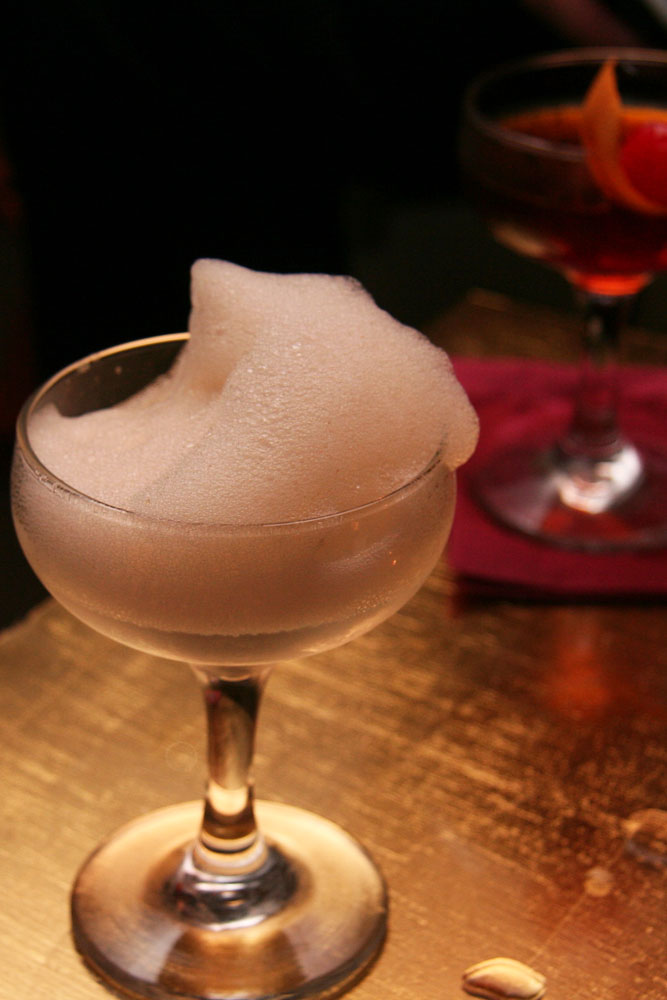
By interesting synchronicity, the idea of tea in booze seems to have cropped up quite a bit of late. At Purl a few weeks ago I came across their dry Martini served with an Earl Grey “air” (foam to you and me, though I gather there is a technical difference). This sits on the surface of the drink—looking rather as if the glass has just been washed up and not rinsed properly—and is actually one of the more convincing examples, in my opinion, of how molecular mixology can work. The tea flavour is all encapsulated in the foam: you hit it as you go in, but then strike crystalline Martini underneath, and the two elements are not just mixed all together. On a plate of food this separation of flavour elements is normal enough but it’s quite an achievement in a drink.

Two of David's homemade tea liqueurs
And of course how can we ignore Mr Bridgman-Smith’s recent experiments making his own tea liqueurs? I’ve tasted his lapsang souchong and his English Breakfast and I was mightily impressed. Homemade infusions have a tendency to fall into the “interesting, but…” category but I think he could convincingly bottle these and sell them at a farmer’s market somewhere. But the most interesting potential must be as a cocktail ingredient; at Graphic recently barman Adam took up the challenge and invented a smoky brew we dubbed the Fag Hag:

A Fag Hag cocktail
Fag Hag
30ml gin

20ml lemon juice

15ml lapsang souchong liqueur

10ml sugar syrup

20ml egg white

Dry shake the ingredients first to bind, then add ice, shake and strain into a glass.

You could probably achieve a similar effect using strong, cold tea and a little extra syrup.

Beefeater 24 is about £23 (or £29 if you buy it over the counter at Harrods)


* Beefeater claim that this 24-hour maceration is unique to them, but Hayman’s say their gin steeps for 24 hours, so do Berry Bros. and Rudd of their No.3 gin, Park Place about their SW4, and I have a feeling I’ve heard it about others too.