|
| Some of the Old Tom gins we tasted, including a couple of homemade recreations |
But what did it taste like? In his cocktail book of 1930 “Jimmy” (“late of Ciro’s”) explains “the difference between Dry and Old Tom Gin is the same as between Dry and Sweet Ginger Ale, that is to say one is bitter and one is sweet. Plymouth Gin is half way between the two.” Mind you, Jimmy also says that grenadine is made from raspberries. (Who knows, perhaps it was then…)
A number of manufacturers are increasingly releasing Old Tom style gins, but there is plenty of dispute over what these should taste like. Some are simply sweetened with sugar, while Christian Jensen insists that this would have been too expensive at the time and that any perceived sweetness would have come from the botanical mix. (Others have argued that landlords may have sweetened gin on the premises, perhaps to ameliorate poor quality gin, and that it was therefore unlikely that the gin would have been sweetened by the manufacturer.) David Wondrich is of the opinion that Old Tom is a general term for something that would have evolved and diverged, fundamentally driven by the fact that before the introduction of the column still, capable of producing very pure “neutral” spirit, the base alcohol for early gins would have been crude and distinctly flavoured—indeed much of the botanical flavouring might have been there simply to try and make the spirit more palatable, as might any sweetening or deliberate ageing in wood (something which lies at the heart of whisky making). But the column still signalled a paradigm shift: masking of the base spirit flavour became unnecessary, botanicals could be used simply to add a desired flavour profile and gins became leaner. Genever, meanwhile, remained popular in the Netherlands, revelling in the malty taste of the “impurities” of the pot still alcohol itself.
 |
| Kamil looking pale after ten Old Toms |
1. Both’s Old Tom Gin (47% ABV) Made in Germany, this spirit is intended as a reproduction of nineteenth-century Old Tom and sports a rather disturbing “flock” label featuring a cat. (One explanation for the name “Old Tom” comes from the story of Dudley Bradstreet, an exciseman who actually sold gin on the sly. On the outside wall of his house was a cat figure; the customer would put money in the cat’s mouth, at which gin was dispensed through a tube between the cat’s paws.) The nose is strongly of caraway and orange. That’s pretty much it, with the palate basically the same, with a middling sweetness. I rather like it, but then I like Akvavit. 8/10.
2. The Wondrich Method Wondrich’s own solution for recreating the taste of Old Tom is to blend modern gin with sugar and whisky. DBS made this sample using the roughest gin he could find, Richmond Gin. I can see the logic, but you’re unlikely to make a very nice concoction this way! This sample has a nose of orange and a bit of red berry; it’s a slightly dusty smell and rather synthetic like a perfumed hand-wipe. The taste is overwhelmingly sweet, again a bit berryish, and reminiscent of barley sugars. Not as noticeably malty as I would have expected, but I guess it depends on the proportions you use—DBS didn’t reveal his precise recipe. 3/10
3. Ransom Old Tom Gin (44% ABV) Made in Oregon—in consultation with Wondrich—this recreation goes down a very woody route, ageing the gin for 3–6 months in pinot noir barrels. Malted barley is used to give a whiskyish hint, combined with botanicals (juniper, orange peel, lemon peel, coriander seed, angelica root and cardamom) infused in corn spirit. The finished gin is a startling colour, looking more like whisky. The nose is strong and astringent, with heavy juniper grappling with orange and an underlying resinous hint like coal tar. Compared to the other samples this one was surprising also in that it was quite dry and austere, driven by pencil-lead juniper. 5/10
4. Secret Treasures Old Tom Style Gin, 2007 (40% ABV) Another German offering, part of Haromex’s Secret Treasures Collection, this sample was made in 2007. The nose is quite balanced between juniper, citrus, fennel and something slightly soapy, then finishing on vanilla and darker notes. There are interesting hints of cucumber skin and mushroom too. The palate is, like Ransom, surprisingly dry and, to me, disappointingly simplistic after that promising nose. Predominantly juniper/pine notes. 4/10
5. Wondrich Method (Oaked) Another batch cooked up by DBS following David Wondrich’s suggestion of adding whisky and sugar to London gin, but this time “oak aged” using whisky barrel wood chips in the bottle for 24 hours. As before this offering probably suffers from the poor quality of the base gin but the wood has smoothed it a bit. The nose is predominantly orange with a distinct butter undertow. The palate is still mostly about barley sugar; the oaking is subtle after only 24 hours but certainly not out of place, and adds a piney, resinous note. 3/10
6. Jensen’s Old Tom Gin (43% ABV) The nose has a soft, vegetal complexity, like ratatouille—sweet pepper and fennel, with darker, toasty wood notes, plus orange, lime and a sugary smell. This carries on to the palate but here there is also an odd character like the glue on envelopes, a sort of cellulose sweetness (if you’ve ever made the mistake of trying to use a kitchen paper towel as a makeshift filter for food or coffee you’ll know what I mean). There is a “thickness” to this gin, as if it were heavily sugared, even though Jensen’s principle is that it is the botanical mix that creates the sweetness rather than sugar. Having said that, it does not come across as particularly sweet. This gin is apparently based on a recipe from the 1840s. 6/10
7. Gin Xorigeur (38% ABV) An antediluvian curio, made on Menorca in the town of Mahon, where it was introduced by the British in the eighteenth century, and allegedly little changed since then. It is made from grape spirit, vapour-infused with the botanicals in a flavour box rather than macerating in the spirit, and aged in American oak barrels before bottling. Oddly, instead of producing a high ABV distillate which is then diluted for bottling, the liquid added to the still is actually a blend of spirit, wine and water, and what emerges is at bottling strength of 38%. In addition to juniper, citrus and fennel, it has a similar sawmill nose to Ransom, plus celery, something toasty, a sour spicy note and something akin to the inside of a rubber glove. The palate is dry, vinous and juniper-led, with celery and sweet pepper. It is perfumed and spiritous, rather than full-bodied (possibly because the botanicals are not macerated), finishing on juniper again. Desmond was clearly quite struck by this one and felt it probably came closest to historical Old Tom. 6/10
8. The Dorchester Old Tom, 2007 (40% ABV) Only available at the Dorchester Hotel, for whom it is made by William Grant (who also make Hendrick’s) so their barmen can make classic cocktails that call for Old Tom. The nose is big: lots of orange and (perhaps unsurprisingly, given the Hendrick’s connection) masses of rose, plus woody spice—cinnamon, or perhaps sandalwood or even camphor wood. The palate is heavy and seductive with any perceived sweetness coming from rose. Add water and an aroma of tonic water emerges, presumably from citrus notes coming out. 8.5/10
9. Hayman’s Old Tom Gin (40% ABV) Made allegedly to an ancestral recipe of James Borough, ancestor of Christopher Hayman, the current Master Distiller. The nose is strongly of orange, almost like curaçao, plus juniper and a little chocolate. The palate, to me, is rather middle-of-the road, with the usual juniper and citrus, plus a lot of added sugar. Doesn’t do much for me. 5/10
10. Artesian Bar Old Tom, The Langham Hotel This is made specially at the hotel by blending two gins, adding some nuts and then wood ageing it. It does indeed smell of hazelnuts but also something sour, suggesting the dryness of walnuts too. Plus a bit of wood and bran—like opening a packet of bran flakes. It tastes a little of tea and hazelnuts. And a bit like bran flakes. 5/10
As a group we all agreed the Dorchester Old Tom was the nicest. For me the other stand-out gin was the Both’s; it came third in our overall rankings as a group, with the Xorigeur in second place. Hayman’s came fourth and the Langham gin fifth.
 |
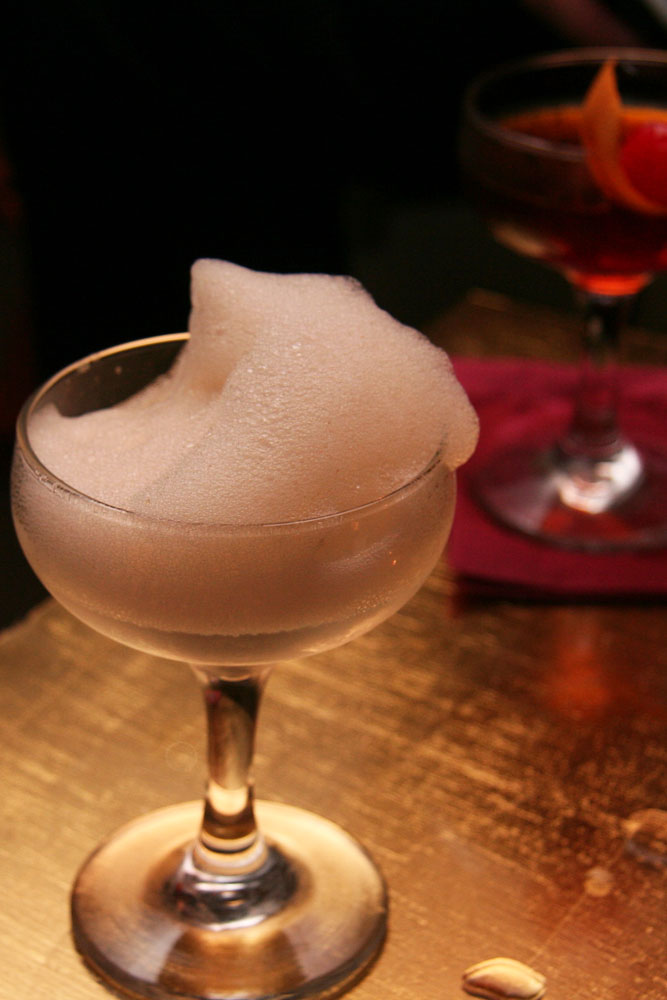
| Martinez Cocktails made with (left to right) Xoriguer, Dorchester and Both's |
We then tried the top three in three classic Old Tom cocktails:
Collins (gin, lemon juice, sugar and soda water) With the Both’s elements of fennel and violets come out; with the Dorchester it’s lemon and lime. Made with Xoriguer that pine flavour comes through, reminiscent of Retsina.
Martinez (gin, red vermouth, maraschino, Angostura bitters) The sweetness level of Both’s balances well for me and brings out the complex flavours, whereas the Dorchester here seems too sweet and fruity. The Retsina quality of the Xoriguer works surprisingly harmoniously with the aromatic elements of the vermouth and the bitters.
Old Tom Cocktail (gin, sugar, orange bitters) Here again I think the Xoriguer actually works best, with the astringent, woody, aromatic character balancing with the sweetness of the recipe. Both’s is pretty good, with the drink again bringing out a floral, violet character that I didn’t really notice neat. But overall this cocktail is too sweet for me, I suspect.
While satisfyingly thorough, I admit that this experiment doesn’t really get you very far: my two favourites are both largely unobtainable! I wasn’t so taken with the Xoriguer as some, but I know David later experimented with sweetening it and ageing it with wood chips to try and approach what he feels historical Old Tom would have been like. Of course there are clearly as many approaches to creating an Old Tom as there are products, and doubtless more besides. Personally I feel a product that is simply a sweeter gin is a bit pointless when you can simply sweeten an ordinary gin. I’m more interested in recipes that offer a different and more intense botanical mix. As I mentioned before, my curiosity was piqued when I heard that Prohibition gin is based on a nineteenth-century recipe: yet its maker thinks of it more as a New Western rather than an Old Tom. New Western gins in classic London gin cocktails often taste rather peculiar to me, but this got me thinking that experimenting with New Westerns in place of Old Toms in classic cocktail recipes might prove fruitful. I shall report back…