Showing posts with label SW4 gin. Show all posts

Friday, 24 July 2015

The purity test: is your water and ice letting your drinks down?

I received a press release recently for a bottled water called Isbre. It is sourced in Norway from an aquifer under a 5,000-year-old glacier at the end of the Hardanger Flord in Ulvik, where it is bottled on site. The Big Thing about Isbre is its purity, showing no more than four parts per million (ppm) of total dissolved solids, which is apparently the lowest figure ever for an unprocessed water.

Purity is an interesting concept in drinks. There is a natural tendency to associate it with safety and health, and producers of spirits, especially vodka (about which there is not much else to say) frequently use the p-word, either talking about the purity of the spring water they use to dilute their alcohol, or bragging about innovative filtration methods, often involving precious metals or stones. In fact if you look at the website of Technofilter, a leading manufacturer of filtration systems for the vodka industry, they make the point that, while filtration (traditionally through birch charcoal) was once necessary to remove impurities that imparted bad flavours or odours or even made the vodka unsafe, nowadays any producer can buy in incredibly pure alcohol and all distilleries will have the means to make distilled water on site. Modern vodka filtration is more about altering the flavour and perhaps fishing out unsightly particles that may have been introduced from machinery or from additives like sugar or honey that are sometimes introduced to create a perceived smoothness.

Naturally sparkling, Apollinaris pitched itself as having medicinal benefits, "the sworn enemy of gout,
rheumatism and indigestion", in this detail from an 1876 advert. Despite the high mineral content it also
speaks of "purity" and "softness". Note also that they recommend it as a mixer for brandy, gin and wine
(click to enlarge)


This 1903 ad is pushing Apollinaris (by now threatened
by mechanically aerated waters) as a mixer for Scotch
Once upon a time drinking water that came in bottles was generally referred to as “mineral water”—the point being that you drank it precisely because of the dissolved minerals in it, either for the taste or for imagined health benefits. (According to a table on the Isbre website Evian has 300 ppm total dissolved solids, Vittel 400, San Pellegrino 990 and Apollinaris, a German spring water with a long history, which I’ve not seen for sale in the UK, a whopping 1800.) Our modern interest in bottled water may have been prompted simply by fashion and marketing, so that we want to be seen clutching the hippest water brand, or perhaps by a rise in health-consciousness and a belief that tap water is not safe. (There have been scares in recent years about the levels of oestrogen in mains water, for example, or worries about fluoridation, although in fact UK tap water has to pass more stringent tests than bottled water does.)

I live in south-east London and my tap water is pretty tasty (not true of some parts of the UK I have visited). It is a hard water with, on average, 261 ppm of calcium carbonate, which comes from the chalky composition of local aquifers. (This can tend to leave lime scale deposits in your kettle or on the showerhead, but it makes the water quick to wash away soap and apparently forms a film on the inside of old lead pipes which prevents the metal from leaching into the water supply.) The UK Drinking Water Inspectorate regularly tests tap water and apparently London’s is the best in the country (mind you we are talking about a 99.98% pass rate compared to 99.94% in the worst-performing area, so there is not much in it). You can see a full chemical analysis here.) No fluoride is added but the total dissolved solids are about 350–400, compared to Isbre’s 4.

SW4 gin diluted half and half with tap water, Isbre and distilled water
All of which got me wondering about water in booze—not the water that is used to dilute spirits to bottling strength (over which I have no control), but water that we might add at the point of preparing a drink. Many people believe, for example, that adding a small amount of water to malt whisky helps unlock flavours and aromas. And even if you don’t add water, any drink that you serve on the rocks will be diluted as the ice melts.

I gather that in Japanese whisky bars it is de rigeur that if you add water to your whisky you use only water from the same spring where the whisky is made. Camper English of Alcademics has done some interesting experiments diluting different Scotch whiskies with spring water from different parts of Scotland. The general result was that water from a particular region brings out flavour characteristics associated with whisky made in that region.

But the test here today is about the benefits of purity in water. I decided to put Isbre* up alongside London tap water. And to push things to the other extreme, I also got hold of some commercially produced distilled water.**

The same test using Nikka Taketsuru Pure Malt whisky
Tasted neat, the three waters seem remarkably similar to me, though the purity of Isbre does give it a softer feel and a perceived sweetness to the finish. The hard tap water, particularly after it has been in the glass for a while, has a flatness, a hint of something sour or metallic. (I expected the distilled water to taste much the same as the Isbre, but to me it actually tasted less pleasant, with a slight bitterness to the finish.)***

I try diluting some SW4 gin (the high-strength 47% version), half and half with water. I don’t normally drink gin this way, though my father-in-law likes his gin half and with water and a dash of bitters. It’s quite a revelation, actually, because the botanicals in the gin are loud and proud, with the high, resinous juniper joined by orange sweetness and floral, woody notes, and a bitterness towards the end. To my surprise there was quite a noticeable difference between tap water and Isbre, with the former seeming to have a heaviness or roughness. Gin and Isbre, on the other hand, felt lighter and more ethereal on the tongue and, moreover, you had a sense of perceiving the botanicals more clearly and vividly. The distilled water gave the same effect, and I honestly couldn’t detect a difference between that and Isbre.

Ice cubes made from (left to right) tap water, Isbre and distilled water. As you
see, the purity of the water does not have an effect on the clarity of the ice
I try the same thing with Nikka Taketsuru Pure Malt Japanese whisky, again half water, half whisky, and get the same result. The tap water gives a hard, flat quality, compared to the sweet smoothness of Isbre. Distilled water is likewise smooth and light.

What about ice? If you pour yourself a whisky on the rocks and sip it slowly enough for the ice to melt, then you have diluted your drink quite a lot by the end. I always regret doing this, because ice made from my tap water leaves a gritty deposit in your drink when it melts. I make some ice from Isbre and try the same thing and, hey presto, no grit.

Nothing to see here: vodka with cubes of the three ices. They look identical until…
But if you think that ice made from pure water will be crystal clear, think again. The clarity of ice is affected far more by how fast it freezes and at what temperature (see this explanation). I make up trays of ice cubes using Isbre and distilled water and they look the same as ice cubes made from tap water.

I start off with vodka on the rocks, taking 25ml of Ketel One and adding two cubes each of the three types of ice. As you might expect the results are essentially the same as when we simply added water: at first the samples seem alike but as the ice melts the sample with tap water ice takes on a flatness, something a bit like soggy cardboard, with a slight sour note, compared to the other two, which seem to maintain the original flavour of the vodka better.

Once the ice has melted, the vodka with the tap water ice now has white mineral
deposits at the bottom of the glass. This was from just two cubes of ice. No such
deposits appeared with ice cubes from Isbre or distilled water
But in my household I suspect more ice gets used in the shaker (then discarded) than added directly to drinks. Would water purity still make a difference in this context? I rustle up three Martinis, using SW4 47% and Noilly Prat. I follow James Bond’s example and shake, rather than stir, on the grounds that this will presumably result in more dilution and an enhanced effect.

Three Martinis, shaken with ice made from (left to right) tap water, Isbre and distilled
I use a measure of gin and a teaspoon of vermouth for each sample, add six ice cubes and shake exactly 40 times. I eschew a garnish to help focus on the matter in hand. Not unexpectedly, the differences are less noticeable this time, though I still think that the Isbre has a softer, sweeter mouthfeel and a sense of greater depth and transparency in the flavours of the ingredients. The tap water ice seems to give a slight masking harshness and again even the distilled water seems less appealing, which I cannot explain. But these are subtle distinctions.

This whole process has been a revelation to me. There are many bottled waters out there, with their own flavour profiles that may or may not blend harmoniously with other ingredients, but as a simple starting point it is an eye-opener to use water that is much more neutral than what I am used to. While the contribution in ice used to shake cocktails is subtle to say the least, when it comes to ice over which drinks are served, and certainly where water is directly added, using purer water makes a noticeable difference. When Isbre comes to market in the UK (I can’t find it for sale anywhere yet) it will be about £1.50 a litre: for ice to serve in drinks (as opposed, perhaps, to shaking) I think this is certainly worth paying.

One thing I am keen to try now is absinthe—which is typically served with two to five times as much water as spirit…

* Of course Isbre isn’t the only bottled water one could try—in fact while searching my inbox I stumble across a press release sent to me a few years ago for a brand called Sno, made in Iceland from a glacier, this time 20,000 years old. They also bang on about purity, but Sno contains 68ppm of dissolved solids according to the press release (though on their current website this has dropped to 52), so for the purposes of our experiment Isbre is more useful.

** Curiously, almost all suppliers had a footnote that their product was not suitable for human consumption. Considering that the whole point of distilled water is that it contains nothing but water, this is odd. It could be that if you habitually drink nothing but distilled water you would miss out on vital minerals, but I suspect it is simply that any product that is intended for human consumption has to undergo various tests that the water distillers don’t want to pay for—their products are actually designed for laboratory use or cleaning delicate equipment.

*** Although Isbre’s website only talks about total dissolved solids, I did find another site which gave more of a breakdown. This suggests the only detectable minerals are nitrates (0.05 ppm) and silica (2 ppm) from the rocky aquifer. My distilled water, for the record, has <0.2 ppm nitrates, <0.1 ppm lead, <0.2 ppm ammonium and <10 parts per billion silicon and chloride. So the distilled water actually has more of all these contaminants than Isbre, with the exception of silicon—and I gather that 5–25 ppm silica is typical for natural water, so Isbre is still fairly low. This site also gives Isbre’s pH as 5.7, which is slightly acidic. I can only assume that the silica (silicon dioxide) is in solution in the form of silicic acid. Which, in case you were wondering, is considered to be good for you. However, I later got hold of the latest lab report from Isbre themselves: it doesn't give a figure for silica but I see that the pH is 6.6, which is pretty close to pH neutral. Nitrates in this sample are down to 0.015 ppm and there are around 0.5 ppm traces of calcium, sodium, sulphate and chloride and 0.1 ppm magnesium and potassium. Total dissolved solids are given as just 3.9 ppm.

Thursday, 23 October 2014

Hoist the gin pennant for Cornwall's finest

Walking along the cliff path on St Anthony Head in Cornwall, with views out over the mouth of the Fal, the ancient fortifications of Pendennis and St Mawes Castles, the boats slicing in and out of Carrick Roads, I got to wondering what a self-consciously Cornish gin might taste of—what local botanicals could you use that would evoke the flavour of the place? Seaweed or something briny? Or the blackberry bushes that line all the paths, from which I idly picked as I walked along?

So I was interested to notice, while sitting in a fairly minimalist restaurant in St Mawes, that one of the few spirits on offer was Tarquin’s Cornish Gin. I tracked it down and discovered that it is, indeed, made by a chap called Tarquin Leadbetter at Southwestern Distillery in Wadebridge. They make just two products, the gin and Cornish Pastis (see what they did there?), using a small flame-fired copper pot still. They use fairly traditional botanicals from around the world (though mostly sourced through a bloke called David, apparently)—juniper from Kosovo and coriander from Bulgaria (which they describe as lemon-sherbety rather than hot and spicy like Moroccan coriander), angelica root from Poland, orris root from Morocco, green cardamom seeds from Guatemala, bitter almond from Morocco, cinnamon from Madagascar and liquorice root from Uzbekistan. They also use fresh (rather than dried) citrus peel, orange, lemon and grapefruit, from wherever they are in season in the world. And the final, magic ingredient—and the one that makes it distinctly Cornish—is Cornish violets, grown in Tarquin’s garden. It is diluted down to 42% ABV using springwater from near Boscastle (which is also bottled and sold as mineral water, called MeadowSweet). Each bottle of the small, 300-bottle batches is signed and numbered by hand by Tarquin himself, and dipped in striking blue wax for good measure.

I notice that, in addition to Tarquin’s signature and the bottle number, the label also includes a box labelled “Character”, again filled in by hand on each bottle. You might think the character of the gin would be fixed by the recipe, but Tarquin deliberately includes these tasting notes to emphasise the variations you get with gin made in this way. “We're celebrating the nuances between batches, highlighting the fact that our spirits are not mass-produced,” he tells me. “We could have blended batches, or implemented a sherry-style solera bottling system. But I think it's quite fun to do our crafty sort of way.” My sample was “Earthy orange”, while another bottle I had a taste from was “Eastern spices” and one in a photo on the website is “Fresh orange blossom”.

“In the months up to Christmas we're doing something special with some filming, to make these tasting notes more interactive,” Tarquin adds. “…So stay tuned!”

Tarquin's hand-written tasting note on my bottle from batch 91
If I expected the gin to smell of violets I was in for a surprise. Chilled you mostly get fresh, stern juniper and lemony coriander to the fore. On the palate you also notice a softness, perhaps from the water, or the liquorice or the orange peel. At room temperature the orange notes are more prominent on the nose too, along with an interesting herbaceous quality that emerges as quite a characteristic. Interestingly Tarquin says, “One unusual ingredient is the Devon violet. From these I take the delicate leaves, which add a vibrant green freshness to the gin and create something deliciously unique.” So it is not the violet flowers involved but the leaves, and this is presumably the stemmy, herbal element that I am getting.

I instantly warm to this gin, not least because it is a gin that knows it’s a gin. So many modern gins shy away from juniper in favour of sweet or floral elements which are, let’s face it, aimed at attracting people who don’t really like gin. But Tarquin puts juniper up front. As such the gin works well in a G&T and especially in a Negroni, where the juniper pokes through but the mid-range elements and the underlying softness round the drink out too. Then you have that interesting herbal layer combined with the orange aroma, and at the bottom a relatively soft, sweet finish so as not to scare the horses. This also makes it good for a Martini as it is relatively approachable neat.

To get a clearer picture I put the gin head-to-head with some others. Bombay Dry emerges as drier, with a lemon-sherbet sharpness, with Tarquin’s gin softer and sweeter. SW4 has a similar fullness, but Tarquin’s gin comes across as more savoury, leafy and herbal, while SW4 is plumper, sweeter and more about spice. Tanqueray is quite similar on the nose but Tarquin’s is fatter and more complex, with more herbal punch and again a softer, sweeter finish. Beefeater 24 does have a tea element which stands out and it is lighter and drier. Finally, G’vine Nouaison matches up in the aromatic stakes, smelling quite minty and suggesting sweet roots. In fact it seems positively cloying, again emphasising the savoury herbal cut of Tarquin’s jib.

Overall I think Tarquin’s Cornish Gin is a remarkable achievement, managing somehow to combine the steely, upright juniper cutting edge of classic London Dry Gin, with a sophisticated modern soft finish, and a distinctive mid-range of orange zest and sappy herbaceous punch, like fresh leaves crunching under foot. It is complex and versatile, but not so outrĂ© as to fall down in classic gin cocktails.

Does it remind me of Cornwall? The bottle has images of fishing boats, basking sharks and what looks like the lighthouse not fifty yards from where I was staying, but there is nothing of the sea about the liquid (though I suppose a dash of Islay whisky might remedy that). But Cornwall does have a warm, humid microclimate, so perhaps the waft of verdant undergrowth in this gin is apt.

Tarquin’s Cornish Gin can be had online from Master of Malt for £35.57 or if you’re in Falmouth you can pop into the Bottle Bank and get it for about £29. For more stockists see www.southwesterndistillery.com.

Friday, 25 February 2011

Not only here for the beer: spirits from Adnams

Anyone with a still seems to be chucking out a gin at the moment, but I was surprised to hear recently that Adnams, brewers of fine Suffolk ales since 1872, had also now produced a range of vodkas and gins. I shouldn’t have been, really—their premium spirits are made from exactly the same grains as their beer, a mixture of locally sourced barley, wheat and oats. Even though they’ve had to have a still installed—a copper one, for they too subscribe to the cult of copper—it’s all part of the process. So are they bandwagon-jumping or do they have something to bring to the party?

Let’s start with Adnams Copper House Barley Vodka (40% ABV). It’s made from East Anglian malted barley, brewed into a wash at 6% ABV without hops, then distilled. They describe it as “beautifully smooth…with a natural sweetness”, but to me it has a keen nose with a hint of dry sherry. The palate does have cream, by comparison with mass-produced vodkas, but compared to other premium vodkas I’ve had recently it tends more towards fruit and minerals—this is a characterful drink. Indeed Adnams describe it as having “plenty of character from our handmade copper pot still”. I couldn’t say if that is where the flavours come from but if I line it up with some others I have to hand—SW4*, Sipsmith, Chase and Indiana—it seems to have oranges, grapes and even cherries going on. Sipsmith and SW4 are also made from barley but their styles are quite different. If you’re after a vodka that is all about creamy smoothness and nectar sweetness, then this probably isn’t the one for you, but my curiosity has been well and truly piqued.

Next up is Longshore, a vodka bottled at 48% ABV, made from the more complicated three-grain blend and a finer “cut”—taking just the choice middle section of the distillation batch. And what a difference it is. If the Copper House barley vodka has an edgy, fruity character, this vodka smells like a meringue, rich and sweet. But on the palate it still has a family resemblance to the first one—rather than the unctuous smoothness of Sipsmith it has a distinctly citrus-cream fruity flavour with hints of wood. It tastes like a wooden crate that was used to store oranges.

As a relative vodka novice I’ve been astonished by the variety of flavours you can get from this basic recipe. The Chase potato vodka, for instance is vinous on the nose with a smooth palate and a hint of pears. So what will we make of the third Adnams offering—North Cove Oak-Aged Vodka, a version of their Longshore that is bottled at 50% ABV after sitting in oak barrels? (The sample that I have spent a month in a mix of French and American oak though I’m told the production version will use just European barrels.) As soon as you stick your nose in the glass you really can smell the wood, and not just a general “woodiness” but actual sawn planks. Then comes the buttery, vanilla richness, familiar from oak-aged wine. Adnams suggest coconut too, and it is there, in a coconut-matting kind of way. On the palate again a strong wood character—probably too much for some—giving it an edge almost like red wine. You can imagine this vodka pairing well with food, such as smoked salmon; this, or perhaps the lighter vodkas, might be a good match with sushi.

To me this whole range has a striking fruit character. The oak-aged one has elements of prunes and marmalade, but even the basic barley vodka has it too. The next morning I smell all the empty tasting glasses and, while Indiana, SW4, Sipsmith and Chase have no residual aroma to speak of, all of the Adnams range do, especially the oak-aged, though less so the Longshore. When we tried them all together I got the impression that DBS was most keen on SW4, followed by Indiana and Sipsmith. I think they’re excellent too, but I have to say I’m taken by the forthright character of the Adnams range.

The family also includes two gins, the Distilled Gin made from the barley vodka and First Rate gin made from the Longshore vodka. The Distilled Gin has six botanicals, featuring sweet orange peel and hibiscus flower, plus juniper, cardamom, coriander seed and orris. This sweet, floral approach is very much of the moment. Berry Bros. No.3 gin is specifically intended for Martinis and also includes sweet orange peel in its spartan botanical list: I assume the sweetness is there to make it more palatable served more or less neat.

Certainly there is juniper and citrus straightaway and a pronounced floral aroma. I don’t really know what hibiscus tastes/smells of but here there is a sweetness and a hint of blackcurrants too. This perfumed character reminds me slightly of soap, though I guess that is more a comment on how we choose to fragrance our toiletries than on the gin. On the palate overall it’s again about sweet orange, flowers and also gingerbread. Plus a smidgen of geranium. Diluted by half with water, it maintains this character, though I get a whiff of strawberries too.

First Rate gin immediately contrasts by having more juniper on the nose. It has the same botanicals, minus the hibiscus, and adds caraway and fennel seeds, cassia, angelica, lemon peel, liquorice, thyme and vanilla. You do get a clear family resemblance: flowers, gingernut (interesting that there are no flowers in this one, and no ginger in either) and that stemmy geranium note. On the palate this persists, though it also has more alcohol, plus the smooth, creamy character of the underlying vodka. Watered by half, I also get a dry aromatic perfume like lavender, which must come from the thyme and perhaps the seeds.

Comparing these two with SW4 gin, you realise how much more the latter is characterised by mid-range spice notes of coriander, cinnamon, cassia and maybe nutmeg, compared to the floral characters on display here. Oddly I am reminded of the G’Vine range, which is also all about flowers (vine flowers in their case), sweetness and with a strong ginger note. They too have a lower ABV version and a higher ABV one with a sterner, more junipery mix: I assume the basic idea here is to have a sweet, floral, approachable version marketed at people who basically are put off by traditional gin’s austerity, plus a more juniper-driven one for people who do actually like gin.

Both the Adnams gins are comfortable with tonic at 2:1. Again the Distilled is sweet and floral while the First Rate brings in a steely note of juniper and the sharp aromatics of the spices and resinous thyme. Adnams themselves feel both gins work well with tonic or as Martinis, and benefit from lime garnishes, adding that First Rate is also “stunning with a strip of cucumber”.

Personally I prefer the First Rate, because I like a drier, more pokey spirit, but I think both are well made, intriguingly complex products. They’re not cheap, mind—and with both First Rate and Longshore the more pernickety distillation method cranks up the price further. Adnams Copper House Barley Vodka is £22.99 for 70cl; the Longshore Vodka is £23.99 for 50cl; the North Cove Oak Aged Vodka is £25.99 for 50cl; the Distilled Gin is £23.99 for 70cl and the First Rate Gin is £24.99 for 50cl. All may be purchased directly from Adnams’ website.

* This vodka doesn't really have a name yet. On the Park Place Drinks site it is called Radost but it hasn't actually been brought to market yet. Perhaps you can email Martin your suggestions for a name?

Wednesday, 16 February 2011

Indiana vodka: bringing it all back home

Given that, on paper, vodka is just alcohol and water, the continuing release of new brands—each claiming to be the vodka you’ve always wanted—could reasonably strike you as little more than marketing exercises. They tend to focus on authenticity, honesty, heritage and “purity” rather than coming out and saying “Hey, this tastes really good.” Perhaps they’re just afraid that to the typical punter they all just taste like, you know, vodka.

I’ve not spent much time tasting vodkas (unlike DBS who, I discovered recently, used to be quite a connoisseur before he got into gin) so I was actually quite struck by the differences when we lined up half a dozen vodkas recently (more of which anon). One of those was Indiana vodka from Heartland Distillers in Indianapolis, Indiana. It is not yet commercially available in the UK but I was lucky enough to get a sample from Bar Spirits who will be distributing it.

Heartland is actually the first new distillery in Indiana since Prohibition, and founder Stuart Hobson believes that Prohibition pretty much killed off the state’s distilling tradition. He seems to be driven by local pride as much as anything, making a point of sourcing his raw materials locally, as well as a desire to make something artisanal and old-school. All the bottling and labelling are done by hand, he says—each bottleneck is even hand-dipped in wax.

Many vodkas boast that their spirits are “tripled distilled” or “four times distilled”, but Heartland ups the ante by distilling Indiana six times. It is distilled and redistilled in batches, and each time they discard the “head” (the first distillate to emerge, which contains impurities you don’t want) and the low-alcohol “tail” (at the end of the distillation) keeping only the “heart”, thus gradually filtering the less desirable bits of the spectrum.

Like Sipsmith, they believe copper stills are best (in fact their still was made by the same Bavarian company as Sipsmith’s, Christian Carl), and that the copper reacts with the spirit to remove certain impurities such as sulphites.

Indiana is made from corn and maize, which Hobson believes produces a smoother and lighter flavour, with a sweeter finish, than vodkas made from wheat or potato. Just think, he says, how much tastier corn on the cob is compared to bread or mashed potato. Hmm. I don’t know that this argument holds much water, but there’s no doubting that Indiana is cracking vodka. It’s a lot like Sipsmith, in fact, in that it is smooth, sweet and creamy (a characteristic that Sipsmith attribute to their vodka’s being made from barley—not corn). It’s also remarkably fruity.

I have some Sipsmith to hand, so how do they compare? The Sipsmith has a much softer nose, with less of the fruitiness of Indiana, and its palate is dominated by a smooth unctuousness. I’ve also got a mini of Chase potato vodka: this is fruitier again on the nose, almost vinous, but the palate is quite buttery, hinting at ice cream. Chase somehow tickles the sour-receptors of the tongue without actually tasting sour, whereas Sipsmith bats its eyelids at your sweetness-receptors*. Compared to both, Indiana actually seems quite dry.

The only vodka I have to hand that I think may be made from wheat** is Smirnoff Red. It’s probably an unfair comparison, but I try the Smirnoff alongside. It seems to have no nose at all—and no taste***, only a little burning at the back of the throat to let you know it was there.

Clearly vodkas are not created equal. But I’m not convinced that any particular grain is the bee’s knees. I wouldn’t say that Indiana, the only corn/maize vodka I have knowingly tried, is superior to Chase potato vodka or Sipsmith barley vodka****. But it’s certainly good.

Matt Ford from Bar Spirits tells me the retail price of Indiana will be £23–26 when it gets here around 28th March. From their vodka Heartland make a range of seven infused versions as well as a gin they call Prohibition, which I will tell you about very shortly.


* Apparently we were lied to in school and the tongue does not have specific zones for different tastes. Which must be a bit embarrassing for high-end drinks glass merchant Reidel who used the “tongue map” as justification for their vast range of specific vessels for every conceivable alcoholic drink. Well, I don’t suppose they do one for Thunderbird or WKD, but they do an awful lot and they tend to be very expensive.
** Actually it's hard to know what it is made from. I heard a rumour that it was made from molasses spirit, as a lot of European volume vodka apparently is, but the Diageo PR I spoke to insisted it is "grain"-based. This website aimed at those with food allergies offers a list that gives Smirnoff as corn-based, something I've seen elsewhere. Yet another site suggests that in its original form it was made from wheat and rye, which I think is quite traditional, but that under Diageo it can be made from all manner of grain and non-grain spirits. Neither Smirnoff's nor Diageo's sites tell you anything.
*** Amusing, in 1938 Smirnoff was (quite successfully) marketed by one distributor in Kentucky as "White whiskey—no taste, no smell".
**** Martin Price, the man behind SW4, also has a vodka up his sleeve, as it were. It has not been brought to market yet, so I don’t even know what it will be called, but it is also made from barley. It’s jolly good, but it is different from Sipsmith, with saltier, edgier style.

Thursday, 10 February 2011

Gin Bombe—with a Liquid Gin Centre


The Institute for Alcoholic Experimentation proudly presents....

The SW4 Bombe


The Gin Bombe is essentially a tonic ice ball with a liquid gin centre. So how do you make such a... drink?

First you need some ice ball moulds (we got ours from G'Vine). You then carefully fill these with tonic water. When I did this I noticed that the fizz of the tonic meant that, when it froze, the inside of the ice ball was hollow. This got me thinking...

I bored a hole in the ice ball with a cork screw and then covered the rest of the ball in a thin layer of water. I returned it to the freezer to let it ice up (so that it could hold gin).

After a little while I then poured some SW4 from the refrigerator (gin at room temperature the ball would melt too quickly, from the freezer too slowly) into the bore-hole.

This is best drunk with a straw but it is interesting that as the drink warms up the flavours change and your straight gin becomes more and more like a gin & tonic. Presenting someone with a glass of the below should create some confusion and amusement.


Thursday, 27 January 2011

Gin safari!

The precious map that led us to our prize
Of course we’d all heard the rumours. But it wasn’t until an old wino staggered into the IAE offices and inconveniently expired in the wingback in reception that we realised it might be true: clutched in his right hand (after we opened his fingers with a bolt-cutter) was a map—torn and charred but unmistakeable.

In our report on the recent exhibition about bitters we mentioned that the curator Ricardo Leizaola regarded Herb Afrik and Alomo Bitters as the tastiest examples of all the “world bitters” he encountered. I had noticed that the makers of Herb Afrik, the Ghanaian distillery GIHOC, also produced three gins: Castle Bridge, Lawyer (with a label that is surely a close reference to Gordon’s Export) and Betsuo. Curious, I’d tried contacting them but had failed to elicit a response.

Meanwhile DBS had become interested in a Ugandan gin called Uganda Waragi. So when our vagrant friend—who turned out to be a burnt-out ex-bartender famous for his trips into the Interior to source rare ingredients, and widely regarded as insane after the tragedy with his Puffer Fish and Durian Fruit Daquiri—snuffed it holding a map with a big “X” marking the fabled land of Forest Gate, we knew it was a sign. Saddling the club mule (startled at being asked to leave the stables for the first time in 15 years) we loaded up with iron rations of foie gras and Sauternes and headed up country.

Forest Gate turns out to be a hive of multicultural trading. David had actually established that one shop, Pascheal Exotics, did stock Uganda Waragi and had reserved a few bottles. But on the way there and back we ducked into various trading establishments looking for the bitters—when we eventually found some the store also sold Castle Bridge. “All the way from Ghana,” the shopkeeper said with a mixture of pride and wistfulness. “It’s lovely.” My curiosity was well and truly piqued: what could be so different about this gin that it was worth importing to a small shop in north-west London? Yet the retail price of £12 for Castle Bridge and £15 for Waragi was cheap enough to make you wonder just how rough this was going to be, when bottles of domestically-produced Gordon’s and Beefeater sell for £14–15.

Interestingly Uganda Waragi also comes in soft plastic sachets, each a couple of double measures. It has a strangely utilitarian feel, as if it had come from a UN aid parcel, and there is something sinister about a delivery method that of course must be drunk all in one go. I’m told a lot of drinks are sold this way in Africa, though some campaigners are trying to get the format banned.

Back at the Institute we dashed to the lab without even brushing the trail dust from our topees, eager to put the drinks through their paces. Castle Bridge is bottled at 40% ABV and has a very juniper-led nose, almost a bit ham-fisted in its unsubtlety. Neat the palate is light and astringent. I always think of Beefeater as rather ethereal and straight-backed but compared to Castle Bridge it seems fat, spicy and complex. SW4 is a juniper-led brand specifically intended to be quintessentially ginny but again, compared to Castle Bridge’s pencil-lead juniper fixation, SW4’s sweet orange notes are emphasised. Mind you Castle Bridge is a perfectly creditable gin. It’s more palatable than Hogarth and about the same price, while DBS assures me it’s considerably pleasanter than Richmond, his current benchmark for repulsiveness.

The name and the styling are clearly trying to evoke an Old World European sophistication and the year “1792” is emblazoned across the top label, though the significance of this date is never mentioned. It clearly calls itself a “London Dry Gin” though I wonder whether it really fulfils the EU requirements. Neither the bottle nor the website give anything away about the botanicals* but what originally roused my curiosity was the fact that it is made from molasses neutral spirit. This sounded rather exotic, but in fact sugar beet molasses turns out to be the base for quite a bit of mass-market gin and about a third of European vodka production.

I dig out some Gordon’s green and mix up a couple of G&Ts with Schweppes tonic, using Castle Bridge in one and Gordon’s in the other. I offer them blind to DBS and ask which he prefers. Without much deliberation he chooses the Ghanaian gin. In truth even the 37.5% Gordon’s green is more complex than Castle Bridge in my opinion, but the latter has an appealing freshness to it and, as I suspected, when mixed with tonic it performs its role in the partnership perfectly diligently. I suspect its simplicity might actually make it ideal with more elaborate tonics.

So there you have it, ladies and gentleman: at £2–3 cheaper per bottle Castle Bridge is better value than Gordon’s (and a higher ABV too).

Our booty for the day. Yes, that's a carton of Egg Nog
At £15 a bottle Uganda Waragi (40% ABV) is dearer. The term “waragi’ is actually a generic one for locally distilled spirit, made from all kinds if things including banana and cassava. The word apparently means “war gin” and was coined by European ex-pats, referring to the practice of drinking before battle for “Dutch courage”; the local word for such spirits was enguli. I suspect the actual “gin” style of flavouring was brought by the settlers themselves and adopted locally. Despite decades of legislation plenty of the stuff is distilled illegally—only last year 80 people died from drinking toxic banana moonshine.

The beverage that is branded as Uganda Waragi is made by East African Breweries Ltd, makers of Tusker beer and ultimately owned by Diageo. It is triple distilled from millet and its sales represent a third of the entire spirits market in Uganda. Interestingly, although this product clearly is what you would call gin, the label only uses the word in very small writing near the top, and I have seen pictures of some labelling which doesn’t mention gin at all. (Perhaps it is only labelled as gin for export.)

It’s quite sweet, floral and spicy compared to Castle Bridge, with a remarkable perfume to it, though I feel that it could possibly tend towards cloying, with something in the smell that reminds me of plasticine. Up against SW4 it actually has a similar overall profile though the latter is more complex as well as more juniper-driven.

DBS carted three bottles of the stuff away. I’m assuming this batch is harmless, though, now I think of it, I haven’t heard from him in a while…

* The label does helpfully explain that it is "blended from superior ingredients according to an old secret formula".

To find out how we got on with the bitters, plus various strange soft drinks, tune in for Gin Safari 2, coming soon…

Sunday, 7 November 2010

Tonic for the troops

The guinea pigs prepare for the blind tasting
Although I often find myself sampling gins neat, I seldom actually drink gin that way for pleasure. Part of gin’s recent surge in popularity is precisely its versatility as a cocktail ingredient, but let us not forget the humble gin and tonic, which is how I suspect a lot of people almost always drink their gin. (It was for just this “silent majority” that SW4 gin was created.)

Mr Bridgman-Smith tests gins exhaustively in about 16 different ways: I’m not sure my tastebuds or my liver have the stamina, but you certainly can’t get the measure of a gin without trying a G&T. Yet it has always niggled with me that if you’re really comparing different products this way then you surely can’t ignore what probably makes up at least two thirds of your drink—the tonic.

DBS explains his elaborate scoring system. He is roundly ignored
It’s not surprising that we’ve seen a rise in the range of tonics out there too, with recent arrivals Q and 6 O’Clock joining Fever Tree and Fentimans which have been around a few years, and venerable brands such as Schweppes and Britvic. A couple of months ago we had a spontaneous tasting at one of our regular ginthusiast nights at Graphic, but DBS was determined to formalise the process and so, last Monday, we returned to blind-taste eight tonic waters.

Just as gin started life as a way of both making crap spirit taste better with a juniper infusion and as a way of preserving the medicinal benefits of juniper, so tonic water began in the days of the Raj as a way of making the daily anti-malarial quinine dose more palatable by diluting it with water and adding sugar. Inevitably someone realised it was even more palatable with gin in it.

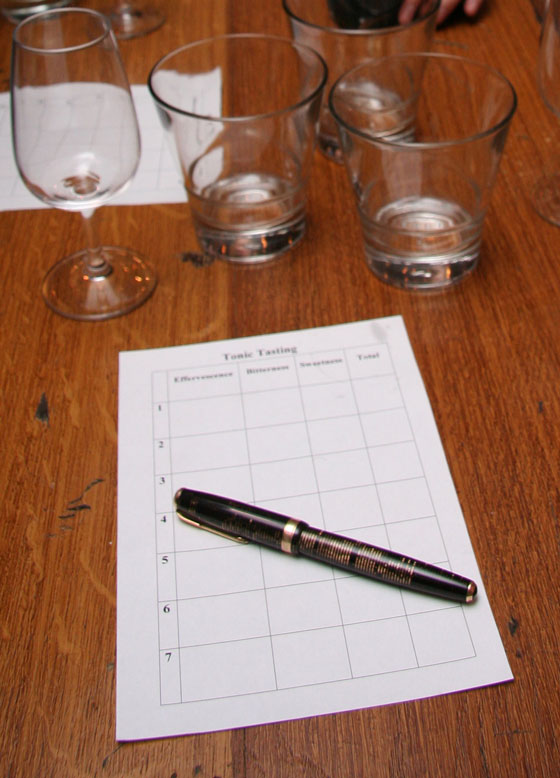
My scoring grid, before I cover it in tonic-spattered
tasting notes that ignore the categories of bitterness.
sweetness and effervescent DBS has carefully laid out
Quinine itself came originally from South America. In 1638 Countess Chinchona, wife of the Spanish Viceroy in Peru, was cured of a fever by a local healer using bark from the native quina tree; this popularised the substance across Europe, where it cured Charles II and Louis XIV, and the tree acquired the botanical name Cinchona Officinalis after the countess. However, the bark seems to have been in use in Rome (surrounded by malarial swamps in those days) at least as early as 1631, having been brought back by Jesuits (in fact it was known as “Jesuit’s bark”). The active ingredient quinine took its name from the native word for the tree, though “cinchona” turns up in the names of fortified wines like Kina Lillet and China Martini, which both contain extracts. Peru and the other countries where it grew outlawed the export of trees and seeds, and the bark became rare and precious, but eventually seeds were smuggled out to Indonesia and the tree became widely cultivated in Asia and the West Indies.

Mind you, modern tonic waters have much less quinine (but apparently still enough to make them fluoresce under UV lighting—there’s something you can try at home), although tonic is still recommended for treating nocturnal cramps. In fact anyone genuinely wanting to take therapeutic quinine might be interested in a concentrated tonic syrup that DBS and I were given to try by Louis Xavier Victor-Smith of Hendrick’s. It’s called Battersea Quinine Cordial though I don’t think it has actually had a commercial release yet. I thought it was yummy.

The quinine cordial they don't
want you to have
However, the Battersea Quinine Cordial was not among the tonics we tasted on Monday, although we had been sent a phial of John’s Tonic Syrup all the way from Arizona—it comes as a concentrate and you add soda water.

We initially tasted the tonics neat and DBS asked us to rank them in order of preference. Although the blindness of the tasting was laudable, owing to a shortage of glassware we had to taste the samples one at a time, which meant you somehow had to remember the flavours of all of them to make a comparison. DBS, ever the instinctive taxonomist, does like to know which of any group of samples is your “favourite”, but I often don’t have one—I’m just interested in the differences. Here are my tasting notes, in the order we tasted—bearing in mind that at the time I did not know what I was tasting in each case:

Tesco own brand Lime on the nose and palate. A bit one-dimensional. Quite sweet, lacking in bitterness. Not very effervescent.

Schweppes More fizz, more dominant bitterness, less citrus than the last one. Not much happening in the aroma department.

Britvic Very effervescent, giving an interesting mouthfeel. Balanced citrus notes. Nose is more complex than previous two.

John's Tonic Syrup, handmade at the Tuck Shop
restaurant in Phoenix, Arizona
John’s Tonic Syrup This one is frankly brown, which is a bit of a giveaway (although, as we didn’t even know which tonics were on test, I guessed it was David’s own homemade tonic syrup, which is pretty terrifying). This one was unexpectedly savoury and vegetal, with an extraordinary spicy, herbal nose and earthy root flavours. Plenty of bitterness—perhaps too much for drinking on its own. Leaves a disturbing tide mark of interesting scum around the glass. Overall, quite intriguing, but a bit outside the comfort zone if tonic water is what you're after.

Fever Tree Good mouthfeel from the balanced effervescence. Plenty of citrus on the nose, although unfortunately it reminds me of some cleaning product. Good level of bitterness, though a shade too much for drinking on its own. Good balance of lemon and lime, though the taste seems a bit crude.

Schweppes Slimline Big citrus nose—though not backed up on the palate, which is pretty empty. A slightly austere mouthfeel. Overall a bit watery, which at least makes it easy enough to drink on its own.

Fentimans Rather an overwhelming nose of citrus. Big exotic flavours, including lemongrass, are a giveaway: although we weren’t trying to identify the brands, Fentimans is pretty distinctive.

6 O’Clock Very bold! Nose does have a hint of varnish but on the palate it is rather tasty.

Obliged to rank them, I put Schweppes and Britvic joint first, 6 O’Clock third, Tesco fourth, Fever Tree fifth, Fentiman’s sixth, Schweppes Slimline seventh and poor John’s tonic last. In truth I was only certain about the last three, and even then I think Fentiman’s is actually quite nice but too overwhelming as a mixer. Likewise the brown syrup is fascinating but not what I look for in a tonic water. (Or perhaps it just takes a bit of getting used to?)

The winners, by popular vote
As a group, our overall rankings put Schweppes first, Britvic and Schweppes Slimline joint second, Fever Tree and Fentimans joint fourth, Tesco and 6 O’Clock joint sixth and John’s syrup limping in lasting place. Apparently these are pretty standard results for this sort of blind test, and in fact mirror a home tasting that DBS held, where Britvic came out a surprise winner.

I don’t drink tonic water on its own, so I had no real yardstick to compare against; but I do drink G&T, and we now had a chance to taste the top three (plus 6 O’Clock, for curiosity’s sake I guess) with gin (Bombay Sapphire in this case). I added Fever Tree too, because it is what I usually drink at home. The results were a bit different:

Britvic Dominated by citrus and sweetness—too sweet for my tastes.

Schweppes Less sweet than Britvic and more citric than Fever Tree. Has a sort of neutrality about it; arguably a benchmark taste for what a tonic “should” taste like.

Fever Tree Compared to the others this is all about mid-range notes for me, warm and almost spicy (Fever Tree don’t say what goes into it but do mention “botanical oils”), compared to the high citric notes that dominate some others. It’s probably worth experimenting with matching different gins and different tonic waters.

6 O’Clock Rather nice, though I kept getting an odd hint of mustard (I was alone in this observation). This tonic was actually created to match with 6 O’Clock gin, a combination I’d be keen to try.

Schweppes Slimline Doesn’t taste much of anything.

The lesson? Well, if you’ve always used the same tonic you might well be surprised by the differences if you shop around. Mind you, if your default tonic is Schweppes then this test at least shows that you can rest assured life is not passing you by.