Showing posts with label 69 Colebrooke Row. Show all posts

Tuesday, 25 January 2011

Update from the Lab #5 "Cask-Ageing Gin"


With the news that the Juniper Society's late-January session will feature the French Gin Citadelle, I got thinking about their two products—Citadelle Standard (1) and Citadelle Reserve. It is the latter that interests me most, as it is "refined" in oak casks. (2) This results in an altered taste and a liquid that is straw yellow. The flavour is quite mellow although there is some warmth after and there is some subtle flavour of vanilla, something which don't recall from the Standard Citadelle. (3) This is small batch gin and the bottle I was recently given (from 2008) suggested that only 21 "small" (4) casks of the gin will be released that year. The bottle is numbered. (5)

So that got me thinking about oak-aging (or refining) my own spirits. I know that there are folk experimenting with ageing cocktails. Mr Hartley and I had the pleasure of trying an aged Manhattan at 69 Colebrook Row—definitely worth trying.

Most folk who do this, though, use whole casks. The issue with this is the expense, (6) a space to store it in (with the right conditions) and the fact that even the "small" casks take several litres of alcohol to fill, quite an investment.

But how about using whisky barrel chippings? I managed to find some which were billed as "BBQ chips" (7) and I figured that these might well do the trick. In fact I did wonder whether they might even be better, or work faster, given that, when they are suspended in the liquid, they have a greater surface area for contact with the spirit. (8)

I filled a clean, empty jam jar with some chips and then added some gin. I used a good but inexpensive gin from Aldi. The picture here shows the results after just 12 hours in the jar. Sampling after 24 hours I found that some of the flavours were starting to change (easy to spot with a side-by-side analysis). After 36 hours the flavours are even more pronounced—very interesting. I've also got a vodka on the go for comparison and fancy trying even some Campari. (9) Cocktails would also be an interesting experiment—an "aged" Gimlet, or Old Fashioned, Martinez or Negroni (10), although I think I'll leave off the Alexanders and I fear a Gin & Tonic just wouldn't work. (11)

For those interested in coming along to the Juniper Society on January 31st there is a brief introduction to Gin starting at 19:00 and the show really kicks off at 19:30. For further details and to reserve your place (the event itself is free) call
Graphic Bar on: 020 7287 9241

I will keep you updated on the aged gin. (12)

Footnotes:
(1) Citadelle contains 19 botanicals, a huge number beaten only by The Botanist with 31.
(2) I imagine there is some technical reason why it can't be considered "aging".
(3) I wondered if anyone has ever used vanilla as a botanical—it appears that the answer is yes: Tru2
(4) You can get at least 45 bottles out of a cask so I wonder how "small" it actually is. I suppose it's all relative.
(5)  If you're interested mine was Cask 9 of 21 and Bottle No.45
(6)  Particularly when you consider shipping
(7)  For fancy chips the 'Trose (Waitrose for the uninitiated) sell Jack Daniels ones (£8)
(8)  "To increase the surface area" was a standard responses in my Biology exams and it's that phrase that got me my O Level.
(9)  This has just come to me and seems insane as I detest this bitter liquid of sadness.
(10)  Again with the Campari!
(11)  No reason not to try though!
(12)  Some readers may be wondering why their are so many footnotes in this post, well it a nod to Sir Richard Francis Burton, the explorer who's work is noted for (among other things) his frequent use of footnotes. On some occasions there is more text in the footnotes than books main body.

Sunday, 12 December 2010

Meddling with the forces of Nature

The humble medlar, a mystifying bullet of a fruit
This a medlar. I’d heard of them but never actually seen one until a man turned up selling punnets of them at the market the other day. He advised that I could either make a jelly from them now or wait until they were “bletted” and eat them raw.

It turns out that, while related to the apple, they are actually part of the rose family, native to Persia and cultivated by the Romans, whence they spread all over Europe. They fruit late and are hardy enough to grow in all manner of conditions, even Scandinavia.

But they’re pretty tough even when ripe, hence the idea of the bletting—which basically means leaving them to soften. The Victorians used to sit them in damp sawdust or bran to blet, bringing them to the table in their sawdust. But how do you know when a medlar is bletted? (Sounds like a question for Rambling Syd Rumpo.)

Note the darkened, wrinkled skin of the first fruit I tried
After a week or so I noticed that one side of one of them was dark, soft and slightly wrinkled, do I delved in. The flesh had browned, with a few cavities appearing: it looked frankly off and had that powdery texture of an apple that is past its best. Out of curiosity I tried a bit that was still pale green and firm. It does taste like an apple but tart and with an extraordinarily dry mouthfeel. Not inedible but it’s hard to see why you would eat one when you could eat an apple instead.

From Alan Davidson’s The Oxford Companion to Food I learn that bletting is an “internal fermentation” that “gives the fruit an acid, aromatic taste that appeals to some and not to others”. D. H. Lawrence referred to them as “wineskins of brown morbidity, autumnal excrement”, giving off an “exquisite odour of leave-taking”. Probably wouldn’t work on the poster.

So it seems that the soft brown “off” flesh I discarded may have been precisely the delicacy I was looking out for. The Victorians used to scoop this out and mix it with sugar and cream for a dessert.

I originally decided to include this post simply out of curiosity, even though it didn’t really have anything to do with booze. But that reference to “fermentation” makes me realise that, when correctly bletted, there is something boozy going on. Those crafty Victorians, getting blatted on bletted fruit.

Four days later I noticed that the remaining medlars were beginning to soften to the touch, though without the exterior darkening. I sliced one in half and was surprised to see that the flesh was brown again, though this time without the pitting of the last fruit I tried. All one’s senses and experience say, “Do not eat this—it is putrefying,” but I decided to give it a go all the same.

The flesh of what I guess is a properly bletted medlar, now with the consistence of chestnut purée
This time it was rather different. The texture is like that of chestnut purée and the taste is like apple—baked apple, just as the man in the market said it would be. There are large seeds inside too, hidden in the sticky brown pulp, which take up much of the body of the fruit. And I wouldn’t describe it as a “wineskin” exactly—but I can just imagine mixing this with cream.

Subsequent investigation showed that they eventually pass over and become less pleasant, like that first one I tried. But at their peak they taste and feel remarkably like luscious, slow barked apple, with strong hints of almond.

Is there a place for the medlar in mixology? I doubt it. It doesn’t produce juice, exactly, though perhaps the molecular crowd could try fashioning some of the paste-like pulp into a quenelle and using it as a garnish or allowing it to sink to the bottom of the glass like a shipwrecked cargo of ambergris or frankincense. Actually its most useful characteristic is probably that incredibly dry mouthfeel of the under-ripe ones: when we were last at 69 Colebrooke Row Tony was extracting a tannin essence from grapeseeds solely so that he could use it to make a drier-than-dry Martini. I think a medlar could give it a run for its money.

Wednesday, 17 November 2010

G & Tea?

Beefeater 24's bottle looks like it belongs
among the Crown Jewels
Can booze and tea sit happily in the same glass? Oh yes.

You have to feel sorry for Desmond Payne. He’s a master distiller (formerly at Plymouth, now at Beefeater) who’s been at it for 43 years—but always charged with distilling to other people’s recipes. He lives with a portrait of James Burroughs, the Beefeater founder who developed the formula 150 years ago, glaring down at him from the wall.

Finally he was asked to make his own gin, a special edition that would end up dubbed Beefeater 24, and DBS and I were present at 69 Colebrooke Row for a celebration of it a few weeks ago. (Mind you, I notice that it isn’t so much his own gin as his own “expression” of the Beefeater house style. Always the bridesmaid…)

I’d heard a story that the “24” in the name referred to there being 24 different botanicals, but this turned out to be codswallop: the gin has 12. “But it is not about how many botanicals you have or how exotic they are,” says Desmond. “It is about how they work together. Getting the right balance is crucial.” In fact the “24”  refers to the 24 hours for which the botanicals are left to soak in the base spirit before the whole soup is redistilled into glorious gin. Mind you, the 24-hour maceration is common to all Beefeater gin*—so what makes Beefeater 24 different?

Desmond explained that he at first tried a host of likely botanicals, but without success. While he was in Japan he craved a G&T—but quinine was not allowed, apparently, so no tonic water. Seeking a similar dry, sharp hit, he tried iced lemon tea—and was inspired to try using tea as the direction for Beefeater 24. What could be more English, as English as gin? He found that green tea worked best as it imparted the aromatic elements he wanted but without an overwhelming amount of tannin. But the presence of the tea also changed the relationships of the other botanicals—back to the importance of balance again—so a lot of tweaking was required.

The raven lurking on the inside of the label
Finally he had an end result ready for testing by a panel of esteemed mixologists: people liked it—but didn’t really pick up on the tea. So he went back to the lab and added Japanese Sencha tea with a fresh, green, slightly seaweed quality, that brought out the top notes. He was afraid that his tea dose would oxidise during the regulation 24 hour steeping, but was relieved to find that the alcohol preserved it. (Round about this time he discovered that James Burroughs’ father had actually been a tea merchant with a Royal Warrant—would Burroughs have approved of Payne’s new direction all along?)

When a batch of gin—or the mixture of spirit and steeping botanicals that will become gin—is distilled, different elements of the flavour emerge in a certain order: the distillery will actually smell different at different times of the day. In practice the citrus notes come out first, then juniper, then coriander. With Desmond’s tea injection he found that the high aromatic notes emerged at the very beginning while the tannic elements arose after the juniper. It’s normal for distillers to discard the very first and last distillate from a batch, but Desmond ended up making a “cut” that was particularly picky—in fact he discards some 30% of the juice that comes out of the still.

So what does it taste like? You can immediately tell how careful Desmond was to stay within the Beefeater house style, which I always think of as rather ethereal in its construction, with a delicacy that makes me think of quiet civil servants in wood-panelled rooms, as opposed to some of the two-fisted gins strutting on to the market now. Yet there is a subtle tea perfume here too joining the orange notes in the midrange, and a smoky element, but much more delicate that simply adding a peaty whisky rinse to your glass as in some “Smoky Martini” cocktails.

The Earl Grey Martini knocked up for us at Purl
The bottle in which Beefeater 24 is clad has had just as much thought and attention lavished on it. The patterns in the glass are taken from Royal Doulton ceramic designs: back in the day the distillery, like most, also produced a range of liqueurs and these were bottled in just such ceramic containers. The distinctive red punt is a nod to the Crown Jewels (this is Beefeater gin, remember) and if you look through the “window” in the bottom left corner on the back you can see a raven printed on the inside of the front label. The legend goes that if the Tower of London’s resident ravens ever leave, the kingdom will fall. “So if you finish the bottle,” Desmond adds, “put the cap back on so the raven can’t escape.”

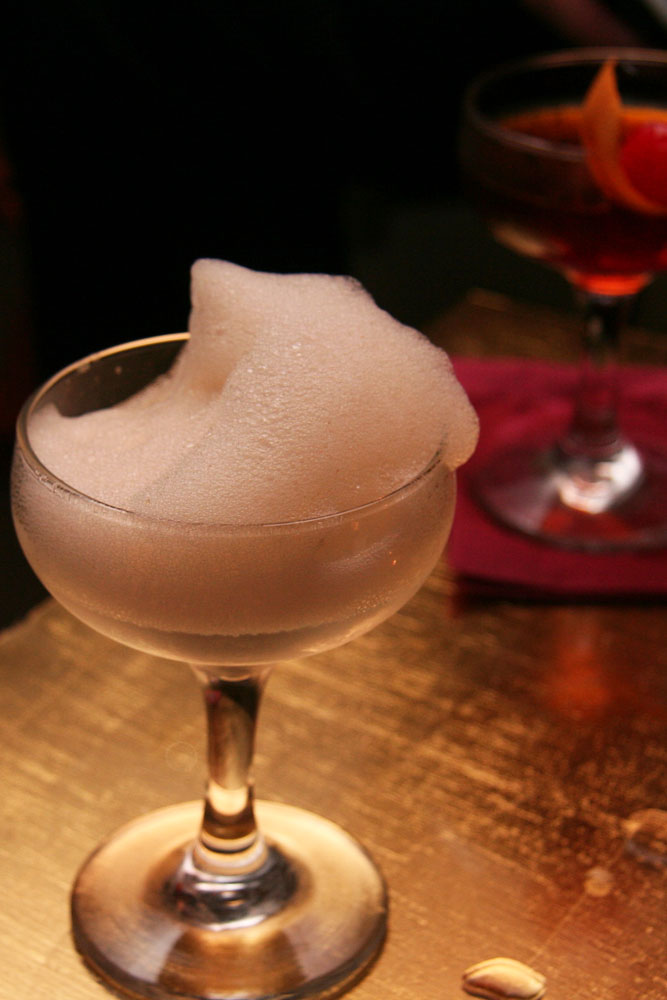
By interesting synchronicity, the idea of tea in booze seems to have cropped up quite a bit of late. At Purl a few weeks ago I came across their dry Martini served with an Earl Grey “air” (foam to you and me, though I gather there is a technical difference). This sits on the surface of the drink—looking rather as if the glass has just been washed up and not rinsed properly—and is actually one of the more convincing examples, in my opinion, of how molecular mixology can work. The tea flavour is all encapsulated in the foam: you hit it as you go in, but then strike crystalline Martini underneath, and the two elements are not just mixed all together. On a plate of food this separation of flavour elements is normal enough but it’s quite an achievement in a drink.

Two of David's homemade tea liqueurs
And of course how can we ignore Mr Bridgman-Smith’s recent experiments making his own tea liqueurs? I’ve tasted his lapsang souchong and his English Breakfast and I was mightily impressed. Homemade infusions have a tendency to fall into the “interesting, but…” category but I think he could convincingly bottle these and sell them at a farmer’s market somewhere. But the most interesting potential must be as a cocktail ingredient; at Graphic recently barman Adam took up the challenge and invented a smoky brew we dubbed the Fag Hag:

A Fag Hag cocktail
Fag Hag
30ml gin

20ml lemon juice

15ml lapsang souchong liqueur

10ml sugar syrup

20ml egg white

Dry shake the ingredients first to bind, then add ice, shake and strain into a glass.

You could probably achieve a similar effect using strong, cold tea and a little extra syrup.

Beefeater 24 is about £23 (or £29 if you buy it over the counter at Harrods)


* Beefeater claim that this 24-hour maceration is unique to them, but Hayman’s say their gin steeps for 24 hours, so do Berry Bros. and Rudd of their No.3 gin, Park Place about their SW4, and I have a feeling I’ve heard it about others too.

Friday, 12 November 2010

Update from the Lab #2

Update from the Lab #2 – Old Tom and Forbidden Fruit


As promised in the last lab update, I shall be looking at making Old Tom Gin. This is by no means the last word on the subject and I know my fellow drinksmiths at the Institute are keen to look at this in greater depth.

My idea stems from a conversation we had with Tony at 69 Colebrook Row who mentioned that drinks expert David Wondrich suggested creating Old Tom gin by rinsing a glass with Scotch whisky, adding gin and sugar syrup and then using that to make your drink; a cocktail within a cocktail, you might say.

I scaled this up to make half a bottle's worth; I have another experiment coming up where I will need large quantities of Old Tom so being able to produce a substitute will be useful.


I added a small amount of whisky to gin and cane sugar I then gently warmed this until the sugar had dissolved and then cooled, strained and bottled the result.

The Taste: the sugar gives the gin a silky smooth quality (as you may expect) making it much more sippable. The whisky seems to tweak the flavour a little bit and certainly colours the gin a light gold. The juniper still comes through in the middle and at the extreme finish is a flavour akin to violet. This is a sweet gin and does resemble some of the other sweetened Old Tom gins in a basic way. Another work in progress but the work will be fun.

Forbidden Fruit
Not content with telling our lab observers merely about Old Tom gin, I decided to recreate a drink known as the Forbidden Fruit which appears in Louis' mixed Drinks (1906) under "Miscellaneous Drinks" see recipe below:

My first issue was that I had misremembered that the recipe calls for a grapefruit and went out and bought a melon, still we had a nice breakfast and starter for our dinner. Having obtained the right fruit I followed the recipe.


The result was a drink with an interesting temperature range, hot at the top and warm at the bottom. Mrs. B described it as a "serious drink which was also sweet and fruity". It was surprisingly smooth and rather drinkable, even to a non-brandy drinker like Mrs B. The grapefruit oil from the skin of the fruit mixed well with the burnt sugar and brandy and reminded me of a similar effect made from flaming orange, particularly nice (I'm told) over a Negroni.

This drink does involve fire so please make sure you take full safety precautions before making this drink, I used glove and apron and as you can see did it over the sink.

Thursday, 28 October 2010

Campari Safari!

In my unabashed Campari apology a few posts ago I mentioned that they had stopped using cochineal to colour it. What I hadn't realised was that—as with so many things in modern life—they had also altered the recipe in other ways over the years.

I was very lucky that, while at 69 Colebrooke Row on Monday (surely the bar with the highest ratio of kudos to floorspace in western history) mixology meister Tony Conigliaro gave us a taste of a bottle of the stuff that dates from the 1950s.

The intervening 50 or 60 years has, astonishingly, not harmed it in any way. Tony's first point was you could see the colour was different, but it went far beyond that: much as I like Campari I found that the contemporary stuff (tasted neat) seemed almost crude and ham-fisted compared to the smooth subtlety of the the vintage batch, which had the mellow strength of a vintage port. I could have slid into it like a warm, comforting, luxurious bath, but I was called away to taste other things. So I leave you with this photograph of what is left of its label and the heart-warming period graphics offering an idiot's guide to making a Campari and soda.

Archivists among you might also like to see this snap of a bottle of rum from 1947, also from the back bar of 69 Colebrooke Row.