Showing posts with label Battersea Quinine Cordial. Show all posts

Monday, 11 January 2016

The world's first quinine gin?

Despite the plethora of gin-based cocktails out there, I’m sure that most of the world’s gin gets guzzled in combination with tonic water. This combination stems from the days of the Raj, when British Army officers and East India Company employees were issued with quinine to ward off malaria, and found its intense bitterness could be mollified by mixing it with gin, water, sugar and lime. They developed a taste for the drink, and modern tonic water contains the quinine, water, sugar and citrus elements.

Although various attempts have been made to produce quinine syrups or concentrates, it’s surprising that (given the bloom of exotic gins on the market) no has tried putting quinine in gin itself, until now: 1897 Quinine Gin from Maverick Drinks uses cinchona bark, the source of natural quinine, as a botanical.

The other botanicals are juniper, coriander, angelica, orange, lemon, nutmeg, cassia, cinnamon, orris and liquorice—which are macerated and traditionally distilled in a copper pot still—plus pink and white grapefruit peel and lemon peel which are cold-distilled separately with the cinchona. In this latter process, instead of using heat to boil off the alcohol, a vacuum pump is used to reduce the pressure inside the vessel to the point where the alcohol evaporates. Adherents feel that by not “cooking” your botanicals you extract a different, and more natural, flavour from them. Oxley gin uses vacuum distillation and has a similar emphasis on fresh citrus. When you reduce the pressure to the point of evaporation, the temperature naturally drops—in the case of Oxley it drops to -5 degrees Celsius. Sacred Gin also uses vacuum distillation, but distiller Ian Hart uses a warm water bath to keep it at room temperature. Whereas Oxley macerates all the botanicals together and distils in one shot, Sacred botanicals are all macerated and distilled separately then blended (Ian does this so that different botanicals can be macerated for different lengths of time). So 1897 Quinine Gin is a hybrid: clearly the producers felt that the benefits of cold distillation (in this case at room temperature) were felt with the citrus, but not with the other botanicals. (I gather that cold distilling juniper gives a much gentler, grassier flavour than the sharp pine resin character we are used to.) It is bottled at 45.8% ABV.

The number in the gin’s name is the year in which Sir Ronald Ross discovered the parasite in mosquitoes that causes malaria, paving the way to an effective treatment.* The day of his discovery, 20th August, is apparently World Mosquito Day. Of course the fever-fighting properties of quinine had been known for a long time before that,** but Ross’s discovery in theory meant that insecticides could be used to curb the spread of the disease. In fact mosquitoes have proved good an evolving resistance to these, and even today a child dies every minute from malaria. Consequently, half the profits from sales of this gin (at least £5 per bottle—enough to buy, deliver and install a mosquito net) are donated to the charity Malaria No More UK.

Note the intriguing embossed background pattern. No explanation is offered
The gin comes in a handsome rectangular bottle that combines weighty opulence with a rough-hewn, artisanal quality. The cap is dipped in black wax and the  labels are black and silver. The front label, which is elaborately embossed (including a background pattern that I at first took for the veins of a leaf but which turned out, on closer inspection, to be a geometric design that to me suggests African textiles or decorative woven baskets) features a stylised cinchona tree. The border features lines from Ross’s poem.*

So what does quinine in a gin taste like? Not so easy to say: we seldom encounter it on its own, and most of us just know it as being bitter. Yet, as Ian Hart once showed me, it is easy enough to distil out the bitter elements from a bitter ingredients (he gave me macerations of hops and gentian to taste—very bitter—and then distillations of the same macerations—not bitter at all). I’ve got a bottle of the Battersea Quinine Cordial, an experimental quinine syrup made by Hendrick’s a few years ago: it has a sort of heady, dusty, woody, aromatic smell to it, like some vermouths or cocktail bitters, and a rubbery floral element on the tongue—plus a pronounced bitter finish. (But I should point out that this product also contains orange flower, lavender and holy thistle as well as cinchona bark.) Maverick describe the bark as adding an “ethereal flavour and floral aroma” to their gin.

A GT Turbo made with 1897 Quinine Gin and Battersea Quinine Cordial
Sniffing the bottle of Quinine Gin I’m hit first by orange and grapefruit, then spices—cinnamon, cardamom, nutmeg—and sandalwood, plus something floral and a hint of chocolate. In a glass you get a delicate and distinctly sweet balance of juniper with juicy orange, something leafy and a parma-violet floral weight. You expect it to be sweet and heavy on the tongue but it fact it is dry with a slightly bitter finish. It has poise in the way it subtly balances juicy, fruity citrus, woody spice with a dry chocolate finish, and heavy floral elements. The sinus-clearing resinous character of juniper is definitely there, but this is not a juniper-led gin. Citrus is what dominates.

I try it in a few obvious cocktails. It makes a lush, perfumed Martini, and this is a great way to appreciate the gin. It also works well in an Aviation, with its citrus and floral elements sitting perfectly happily with the violet and lemon ingredients. I expected that it would get rather lost in a Negroni, but in fact the fruity/floral character shines through, balancing nicely with the bitterness of the Campari to produce a mellow, thoughtful version of the drink.

Ironically, one drink that I did not think worked so well was a gin and tonic. It will vary depending on what tonic you use (perhaps the clean, blank canvas of 1724 might be more forgiving), but with Schweppes I found that the lack of juniper thrust made the gin get a bit lost. Better to appreciate this gin in a Martini, and it would probably make a good Gin Old Fashioned too.

On the subject of which, since I’ve got the Battersea Quinine Cordial out, I can’t resist trying a GT Turbo. I think this may have been invented at Purl, but it combines gin with tonic syrup and some lime juice to make a short drink that is meant to be a sort of compressed G&T. The end result will depend on the syrup you use (and there is no standard here), but with 50ml of Quinine Gin, 20ml Battersea Cordial and 20ml lime juice you get something that is indeed oddly like a condensed G&T, with a sharp, cleansing bitterness that fans of Campari will appreciate. The fruitiness of the gin is a good foil to the woody dryness of the tonic syrup. On paper we’re in the same ballpark as the Corpse Reviver No.2—short, sweet and sour, citrus and a bit herbal (particularly if you use a quinated amaro like Cocchi Americano or China Martini)—but this is altogether leaner and with a nettle-y asceticism, more about the bitter high notes.

1897 Quinine Gin is available online from Mast of Malt and Amazon at about £40 for 70cl.


*He was so chuffed that it prompted him to write a poem: 

This day relenting God
Hath placed within my hand
A wondrous thing; and God
Be praised. At His command,

Seeking his secret deeds
With tears and toiling breath,
I find thy cunning seeds,
O million-murdering Death.

I know this little thing
A myriad men will save.
O Death, where is thy sting?
Thy victory, O grave?

The last two lines are from Corinthians 15:55. I suspect few boffins write poetry when they have a major breakthrough these days; they probably tweet about it instead. Not sure which is better.

** It was in use to fight malaria in Rome in 1631. The South American nations where cinchona grew naturally tried to band the export of seeds but eventually they were smuggled out. By the time of Ross’s discovery quinine production was at its peak in the Dutch colony of Java, fuelling the colonialist tendencies of the West. The Second World War cut the British off from the supply, leading them to develop synthetic alternatives. Since 2006 quinine has no longer been recommended by the World Health Organisation as a first-line treatment for malaria.

Sunday, 7 November 2010

Tonic for the troops

The guinea pigs prepare for the blind tasting
Although I often find myself sampling gins neat, I seldom actually drink gin that way for pleasure. Part of gin’s recent surge in popularity is precisely its versatility as a cocktail ingredient, but let us not forget the humble gin and tonic, which is how I suspect a lot of people almost always drink their gin. (It was for just this “silent majority” that SW4 gin was created.)

Mr Bridgman-Smith tests gins exhaustively in about 16 different ways: I’m not sure my tastebuds or my liver have the stamina, but you certainly can’t get the measure of a gin without trying a G&T. Yet it has always niggled with me that if you’re really comparing different products this way then you surely can’t ignore what probably makes up at least two thirds of your drink—the tonic.

DBS explains his elaborate scoring system. He is roundly ignored
It’s not surprising that we’ve seen a rise in the range of tonics out there too, with recent arrivals Q and 6 O’Clock joining Fever Tree and Fentimans which have been around a few years, and venerable brands such as Schweppes and Britvic. A couple of months ago we had a spontaneous tasting at one of our regular ginthusiast nights at Graphic, but DBS was determined to formalise the process and so, last Monday, we returned to blind-taste eight tonic waters.

Just as gin started life as a way of both making crap spirit taste better with a juniper infusion and as a way of preserving the medicinal benefits of juniper, so tonic water began in the days of the Raj as a way of making the daily anti-malarial quinine dose more palatable by diluting it with water and adding sugar. Inevitably someone realised it was even more palatable with gin in it.

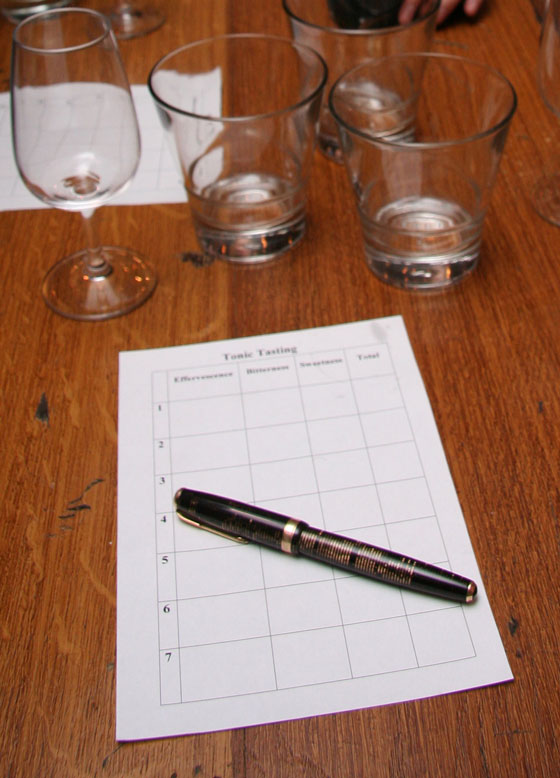
My scoring grid, before I cover it in tonic-spattered
tasting notes that ignore the categories of bitterness.
sweetness and effervescent DBS has carefully laid out
Quinine itself came originally from South America. In 1638 Countess Chinchona, wife of the Spanish Viceroy in Peru, was cured of a fever by a local healer using bark from the native quina tree; this popularised the substance across Europe, where it cured Charles II and Louis XIV, and the tree acquired the botanical name Cinchona Officinalis after the countess. However, the bark seems to have been in use in Rome (surrounded by malarial swamps in those days) at least as early as 1631, having been brought back by Jesuits (in fact it was known as “Jesuit’s bark”). The active ingredient quinine took its name from the native word for the tree, though “cinchona” turns up in the names of fortified wines like Kina Lillet and China Martini, which both contain extracts. Peru and the other countries where it grew outlawed the export of trees and seeds, and the bark became rare and precious, but eventually seeds were smuggled out to Indonesia and the tree became widely cultivated in Asia and the West Indies.

Mind you, modern tonic waters have much less quinine (but apparently still enough to make them fluoresce under UV lighting—there’s something you can try at home), although tonic is still recommended for treating nocturnal cramps. In fact anyone genuinely wanting to take therapeutic quinine might be interested in a concentrated tonic syrup that DBS and I were given to try by Louis Xavier Victor-Smith of Hendrick’s. It’s called Battersea Quinine Cordial though I don’t think it has actually had a commercial release yet. I thought it was yummy.

The quinine cordial they don't
want you to have
However, the Battersea Quinine Cordial was not among the tonics we tasted on Monday, although we had been sent a phial of John’s Tonic Syrup all the way from Arizona—it comes as a concentrate and you add soda water.

We initially tasted the tonics neat and DBS asked us to rank them in order of preference. Although the blindness of the tasting was laudable, owing to a shortage of glassware we had to taste the samples one at a time, which meant you somehow had to remember the flavours of all of them to make a comparison. DBS, ever the instinctive taxonomist, does like to know which of any group of samples is your “favourite”, but I often don’t have one—I’m just interested in the differences. Here are my tasting notes, in the order we tasted—bearing in mind that at the time I did not know what I was tasting in each case:

Tesco own brand Lime on the nose and palate. A bit one-dimensional. Quite sweet, lacking in bitterness. Not very effervescent.

Schweppes More fizz, more dominant bitterness, less citrus than the last one. Not much happening in the aroma department.

Britvic Very effervescent, giving an interesting mouthfeel. Balanced citrus notes. Nose is more complex than previous two.

John's Tonic Syrup, handmade at the Tuck Shop
restaurant in Phoenix, Arizona
John’s Tonic Syrup This one is frankly brown, which is a bit of a giveaway (although, as we didn’t even know which tonics were on test, I guessed it was David’s own homemade tonic syrup, which is pretty terrifying). This one was unexpectedly savoury and vegetal, with an extraordinary spicy, herbal nose and earthy root flavours. Plenty of bitterness—perhaps too much for drinking on its own. Leaves a disturbing tide mark of interesting scum around the glass. Overall, quite intriguing, but a bit outside the comfort zone if tonic water is what you're after.

Fever Tree Good mouthfeel from the balanced effervescence. Plenty of citrus on the nose, although unfortunately it reminds me of some cleaning product. Good level of bitterness, though a shade too much for drinking on its own. Good balance of lemon and lime, though the taste seems a bit crude.

Schweppes Slimline Big citrus nose—though not backed up on the palate, which is pretty empty. A slightly austere mouthfeel. Overall a bit watery, which at least makes it easy enough to drink on its own.

Fentimans Rather an overwhelming nose of citrus. Big exotic flavours, including lemongrass, are a giveaway: although we weren’t trying to identify the brands, Fentimans is pretty distinctive.

6 O’Clock Very bold! Nose does have a hint of varnish but on the palate it is rather tasty.

Obliged to rank them, I put Schweppes and Britvic joint first, 6 O’Clock third, Tesco fourth, Fever Tree fifth, Fentiman’s sixth, Schweppes Slimline seventh and poor John’s tonic last. In truth I was only certain about the last three, and even then I think Fentiman’s is actually quite nice but too overwhelming as a mixer. Likewise the brown syrup is fascinating but not what I look for in a tonic water. (Or perhaps it just takes a bit of getting used to?)

The winners, by popular vote
As a group, our overall rankings put Schweppes first, Britvic and Schweppes Slimline joint second, Fever Tree and Fentimans joint fourth, Tesco and 6 O’Clock joint sixth and John’s syrup limping in lasting place. Apparently these are pretty standard results for this sort of blind test, and in fact mirror a home tasting that DBS held, where Britvic came out a surprise winner.

I don’t drink tonic water on its own, so I had no real yardstick to compare against; but I do drink G&T, and we now had a chance to taste the top three (plus 6 O’Clock, for curiosity’s sake I guess) with gin (Bombay Sapphire in this case). I added Fever Tree too, because it is what I usually drink at home. The results were a bit different:

Britvic Dominated by citrus and sweetness—too sweet for my tastes.

Schweppes Less sweet than Britvic and more citric than Fever Tree. Has a sort of neutrality about it; arguably a benchmark taste for what a tonic “should” taste like.

Fever Tree Compared to the others this is all about mid-range notes for me, warm and almost spicy (Fever Tree don’t say what goes into it but do mention “botanical oils”), compared to the high citric notes that dominate some others. It’s probably worth experimenting with matching different gins and different tonic waters.

6 O’Clock Rather nice, though I kept getting an odd hint of mustard (I was alone in this observation). This tonic was actually created to match with 6 O’Clock gin, a combination I’d be keen to try.

Schweppes Slimline Doesn’t taste much of anything.

The lesson? Well, if you’ve always used the same tonic you might well be surprised by the differences if you shop around. Mind you, if your default tonic is Schweppes then this test at least shows that you can rest assured life is not passing you by.