Showing posts with label Pink Gin. Show all posts

Sunday, 28 May 2023

Is this the Martini-lover's bible?


Hot on the heels of his book Negroni (OK, a bit over two years later) m’colleague David Smith has published his new work, Martini, again written in conjunction with Keli Rivers. As its name suggests, it is an exploration of variations of this classic cocktail.

In its purest sense a Martini is a mixture of gin and vermouth. The iconic Dry Martini uses dry white vermouth in a ratio that greatly favours the gin. (In the early to mid-20th century there seemed to be a cult of minimising the vermouth presence, by delivering it with a pipette, atomiser or even a “Martini stone”—a stone that was kept in a vessel of vermouth. One added the stone to the glass, trusting that what vermouth clung to it would be sufficient.) The traditional garnish is either an olive or a twist of lemon peel. A Perfect Martini uses a half-and-half mix of dry white and sweet red vermouth. You don’t encounter Sweet Martinis much, though the Savoy Cocktail Book (1930) does have one that uses “Italian” (i.e. sweet red) vermouth, rather than bianco (sweet white) vermouth as you might expect.

There was as time in the 1990s and beyond when it was fashionable for any cocktail to be dubbed a “[Something] Martini”, even if its ingredients had nothing in common with those of a Martini, simply by virtue of serving it in a v-shaped “Martini glass”. To his credit, Mr Smith does tend to stick to recipes with some relation to the basic idea of a Martini, with a base spirit (usually gin or vodka, though occasionally straying into tequila or rum territory) augmented with a smaller amount of vermouth or something standing in for vermouth, such as sherry, amaro, liqueur, etc., and sometimes also small amounts of citrus juice and/or syrup. We do get a Dry Manhattan, which would seem to be a whole different ballpark, but whereas a Manhattan more often uses sweet red vermouth, here it uses dry white, so I guess it’s a sort of Martini/Manhattan hybrid. Perhaps inevitably we encounter the Espresso Martini (see my previous post) and the Porn Star Martini but, being vodka based, they are at least slightly related to a real Martini. (The Porn Star Martini features passion fruit purée and/or liqueur, lime juice and an element of vanilla, either from vanilla syrup, vanilla vodka or vanilla liqueur, such as Galliano.)

We encounter classics such as the Dirty Martini, which includes brine from the olive jar, or the Gibson, which is a Dry Martini garnished with a cocktail onion. (No mention of the Murphy, however, where the garnish is a radish. Though, as I discovered, there is a good reason for this—it adds nothing.) We get the related classic the Gimlet, gin and lime cordial, along with its modern version made with fresh lime juice and syrup. Another classic is the Pink Gin, just gin and Angostura bitters, sometimes with water, but here we instead get the Pink Gin Up, with added dry vermouth, so a cross between the Pink Gin and the Martini. We get the modern classic the Vesper, created by Ian Fleming for his 1953 James Bond novel Casino Royale, which blends gin and vodka and uses Kina Lillet instead of vermouth. (Kina Lillet hasn’t been made since the 1980s; Cocchi Americano is a useful alternative, though here David suggests a 50:50 mix of Lillet Blanc and China Martini.) 

An Improved Appletini, a 2:1 mix of gin and Calvados with a little curaçao


Red vermouth is also represented, in the form of the classic Gin and It, where the “It” is short for Italian (sweet red) vermouth, as well as the Martinez: here it is also gin and red vermouth, though using Old Tom gin (usually sweeter than London Dry) and splashes of maraschino and bitters. (It’s an old recipe, possibly even older than the Martini, and other recipes feature curaçao or both dry and red vermouths.)

We get two versions of the Cosmopolitan, the original 1930s recipe of gin, curaçao, lemon juice and raspberry syrup, and the 1980s reinvention of vodka, curaçao, lime juice and cranberry juice. We’re also treated to some modern twists, such as the Leggero Martini, essentially a Martini spliced with a G&T, or the GT Turbo, which is in a way the opposite—a GT concentrated into a Martini glass, using a “tonic syrup”. There have been commercially available tonic syrups, but David suggests making one by heating tonic water in a saucepan until reduced to a syrup.

We get the historical curiosity which is The Saint, inspired by an incident from the 1930s when the bar on the airship the Hindenburg ran out of gin, so Pauline Charteris, wife of the novelist Leslie Charteris, suggested using kirschwasser instead. And the book finishes with some seasonal ideas, such as a Halloween-appropriate version of tequila, sherry and blood orange, garnished with “fangs” of grapefruit peel, or, for New Year’s Eve, the Millionaire’s Martini, with a splash of Champagne.

Martini is a slim volume of just 64 pages, but it contains much useful, well-curated material, offering both a grounding in the essence of the Martini, as well some variations, from the traditional to the exotic (fancy a Breakfast Martini, made with a spoonful of marmalade?). There is no jokey filler here:* the recipes are actually things you might want to drink. In each case specific gins and vermouths are suggested, but the recipes are not dependent on having those to hand, and hints are offered as to what kind of flavour profile would make a suitable gin for that recipe.

Martini was published by Ryland Peters & Small on 9th May, priced at £8.99

* Even the Mr Blue Sky, which has blue curaçao for colour and is garnished by a “cloud” of white candy floss

Saturday, 30 May 2020

Hernö Pink BTL gin

Just as the lockdown was taking effect I had an email from Jon Hillgren of Hernö. I’m a big fan of their gin, which is classic in its profile but somehow manages to be more vivid and 3D than most. Jon announced he had “a bottle” he wanted to send me. When it arrived it turned out to be the new Pink BTL gin.

Pink BTL comes across as a gin with issues. You’ll notice that it is emphatically the bottle (or more specifically the label) that is pink, not the gin. Jon would have no truck with giving gin a silly colour. In fact the accompanying letter begins with the sentence “This is a no-bullshit gin” in large type, a phrase that is repeated on the label. I’m not sure if having the word “bullshit” on you label might offend some potential stockists or customers, but you have to admire Jon’s conviction. The label also states: “This is not a cocktail. Pink Gin is a cocktail. This is a pink bottle of gin.”

The letter goes on to bemoan that many producers are jumping on the gin bandwagon but offering products that aren’t really gin. So Pink BTL is an attempt to be creative with gin, offering the fruity, floral profile “that so many are asking for”, while emphatically staying true to the juniper-driven essence of what makes gin gin. In fact we are told that Pink BTL actually uses more juniper than the regular Hernö gin.

The letter explains that neutral grain spirit is infused with juniper, coriander and strawberries, heated to 60 degrees C and left for 18 hours. Then rose petals, cassia, black pepper, lemon peel and vanilla are added and the liquid resdistilled, one-shot, then diluted to bottling strength (42%) using water from Hernö’s own well.

On the nose resinous pine and lemon peel are up front, but lurking behind is a sweet strawberry fruit. It really is quite subtle—as if Jon was terrified of its becoming cloying. You almost feel as if Jon has approached this whole project against his will. But it’s a point worth making that if you buy this gin because you want a sweet, fruity drink—and perhaps you don’t really like gin—then you will be disappointed. In fact, to you, it will simply taste of gin.

On the palate it has a smooth, polished mouthfeel. The juniper is strong but not fierce, and behind there is gentle strawberry and black pepper on the finish.

I try a fairly Dry Martini, made with Belsazar Dry, in what looked like 10:1 proportions, though it could have been wetter. Juniper is still up front, but the vermouth adds an exotic saline finish, joining that black pepper again. The nose has a definitely creamy note—we’re looking at strawberries and cream! It’s a clever balancing act between the stern juniper rod of classic gin and a soft, flighty summer fruit angle from the strawberry and rose.

An Aviation made with Hernö Pink BTL
I wondered how the light florality would work in an Aviation (50ml gin, 12.5ml lemon juice, 12.5ml maraschino and about a teaspoon of crème de violette). As it turned out there was no risk of it becoming cloying in combination with the cherry and violet elements. In fact it makes a very grown-up cocktail, with a complex interplay of savoury and soft flavours. The dry steeliness of the juniper still underpins, with the black pepper helping to keep the drink’s feet on the ground, but the faint strawberry fruit floats behind that, interweaving with the rose and violet. This cocktail is a good one for assessing gins, not least because the sweet and sour elements (maraschino and lemon juice) are present in quite small quantities.

I’m interested to see what elements come out when served just with tonic water. It certainly makes a nice enough drink, though in fact the dilution is not especially transformative. It’s still reassuringly juniper-dominated, though you do sense the rose now.

I also try Pink BTL in a Corpse Reviver No.2 (gin, curaçao, lemon juice, Cocchi Americano and a dash of absinthe). It’s a tough gig for a gin, as it’s up against some powerful sweet, sour, bitter and pungent flavours. This one turns out to be a nice example of its kind, and the strong juniper backbone of the gin can be relied upon to keep any classic gin cocktail on the straight and narrow, but I wouldn’t say that Pink BTL shone in this combination.

Ultimately, although Pink BTL has a strong presence, the things that make it different are those fairly subtle notes of strawberry, rose and black pepper. As a final experiment I make a White Lady, skipping the egg white and reducing the quantities of curaçao and lemon juice by half—normally you’re looking at about 50ml gin and 25ml each of the other two, but I cut these to 12.5ml, along the same lines as the Aviation. Sure enough, this works. It’s not a classic White Lady but you can appreciate the character of the gin.

And it’s a character worth appreciating. In the right sort of cocktail, in the right proportions, it creates harmonies with thought-provoking subtleties. Out of the ones I tried, a straight Martini probably works best, but in the Aviation—or other cocktails constructed with similar proportions—it has a lot to give, and makes for an adult drink with summery echoes.

Tuesday, 10 January 2012

Price of Angostura Bitters set to skyrocket?


The oversized label apparently happened
by accident with a faulty batch. When
no one corrected the mistake in the next
 batch the bottling plant ended up using
the dodgy batch, and it quickly became
iconic.

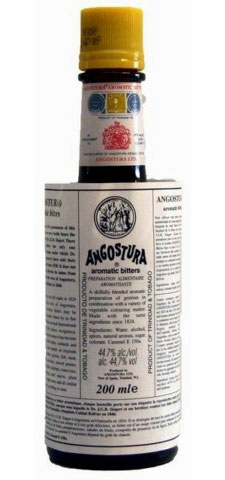
A lawyer friend of mine (yes, it is technically possible) asked my opinion back in August for a document he was preparing to challenge a proposal to lift the exemption from excise duty on Angosura Bitters. Angostura is actually 44.7% ABV, so it technically a booze, but since 1970 it has been exempt from UK duty—according to a press release from HM Revenue & Customs, this measure was introduced to help the economy of Trinidad, where it is made. HMRC now feel that that help is no longer needed.

My chum’s argument, however, was that the reason Angostura is not taxed in the UK “and most other countries” is that it is used to add flavour rather than as an alcoholic drink in its own right, and that the alcohol present is simply a preservative. Since it is used in such small quantities, he estimates that a 200ml bottle will contain over a 100 doses and, even in a domestic context, will be used in drinks for at least a dozen people—and obviously far more in bars. Since some 240,000 bottles of Angostura are imported into the UK each year, the tax change will affect an estimated 3 million people here.

HMRC estimates that the lifting of tax relief will raise the price of a 200ml bottle in the UK by £2–3, which is 35–50%, and as a result will cut UK sales by half. It’s worth noting that the turnover of the manufacturer, the House of Angostura (there’s an idea for a theme park ride), represents 3% of Trinidad and Tobago’s entire non-petrochemical manufacturing GDP.

Like many traditional bitters and liqueurs, Angostura started life as a medicine, invented by German ex-pat Johann Siegert in 1824. Siegert had gone to Venezuela to help Simon Bolivar fight the rule of the Spanish throne and Bolivar appointed him Surgeon-General to the military hospital in the town of Angostura. He created the bitters from herbs and roots* to treat fevers and stomach disorders afflicting the troops, and the tincture also became popular with seasick mariners. By 1850 demand outstripped supply and Siegert resigned his commission to focus on the bitters. After the doctor’s death the torch was carried on by his son, Carlos, a bon vivant and dandy who exhibited the product in London—where it was a hit with gin—Paris, Vienna, Philadelphia and Australia. Fearing the political instability of Venezuela, Carlos and his brothers moved the business to Trinidad, where it had remained, attracting various royal warrants and even a visit by the Queen in 1985.

Of course nowadays there is a huge number of new bitters on the market, many focusing on one particular flavour, such as orange, grapefruit, rhubarb, pepper or chocolate. It’s worth noting that none of these rivals gets the same tax relief—just Angostura. But when there was a shortage of Angostura in 2009 there was a panic among the bar community: clearly nothing else could quite take Angostura’s place. This may be, to one degree or another, a matter of history and culture—most normal people have heard of Angostura but are almost certainly unaware of any other bitters. Yet there is more to it than that: there really is something of the magic formula to Angostura. If I myself were on a desert island and, for some reason, were only allowed one type of bitters, it would undoubtedly by this one.

That iconic, if wordy, label. Click to enlarge

My friend’s argument was that a 50% loss in UK sales would actually mean a net loss to the Treasury, partly because the gain in excise duty would be offset by the lost VAT, reasoning that because of Angostura’s uniqueness there would be no alternative product purchased in its stead. I think that for most consumers this is probably true, given that, as mentioned above, they are probably not aware of any other bitters, and are unlikely to come across them in their normal shopping environment. Moreover (and here’s where the argument gets a little more speculative), he contends that the majority of Angostura goes into Pink Gins: he may have a point here, when you consider the hinterland of drinkers of a certain generation, compared to the relatively small community of cocktail-heads.

“It is important to remember that the Pink Gin occupies a unique position amongst alcoholic drinks,” he argues,” being the only way that the vast majority of drinkers will drink a very short, almost neat, gin.**  This is in contrast to other major spirits, such as whisky and vodka, where drinking neat, or with just ice or a small splash of mixer, is much more common.

A pink gin yesterday
“In addition, the drinking of Pink Gins is a particular social action, particularly amongst those who are its regular devotees, for which there is no direct substitute.” He estimates that 20% of Pink Gin sales will be entirely lost, rather than the drinker switching to something else.

So a slump in Angostura sales will lead directly to a slump in gin sales, he reasons, meaning more lost revenue for HMRC. Moreover he believes that those Pink Gin drinkers who do switch rather than abstain will most likely move to premium vodkas made outside the UK, rather than gin made here, leading to yet more lost tax. He also contends that 18 UK jobs will be lost on the manufacturing side and 79 in the bar sector. Overall he reckons the Treasury will be down by some £2.8 million.

His plan was to submit his proposal anonymously under the banner of the Pink Gin Alliance, which tells you something about the degree of tongue-in-cheekery going on here. In any case, the government have evidently not been swayed by his argument, and the lifting of tax relief on Angostura Bitters will come into force in April 2013. Better start stockpiling now.

* The story goes that only about five people in the world know the formula. Some years ago when the writing on the piece of paper locked in a New York vault began to fade, the only other copy was exhumed and the recipe copied on to another sheet, which was then cut into quarters, each quarter sealed and dispatched separately by plane to New York. Who knows if any of this is true but it’s a good story.
** In fact recipes vary. Some people shake gin and Angostura with ice and serve in a Martini glass. My father-in-law likes his half-and-half with water. But the Pink Gin is undoubtedly historically significant, being the signature drink of the Royal Navy, allegedly because the gin was drunk to make the bitters (taken medicinally) more palatable.