Showing posts with label Gin Mare. Show all posts

Wednesday, 28 June 2017

Northern light: Ungava Canadian gin

I was in ASDA yesterday, which is frankly not the most upmarket supermarket, and I was surprised by the range of gins they had on offer. My eye was caught by Ungava, not so much because of its lurid neon-yellow colour but because it comes from Canada. I was actually born in Canada, as my parents lived there for a few years, so I have a soft spot for all things connected with that country (though, as my wife points out, I am a fairly rubbish Canadian, never having been back there since I left at the age of three). So I decided to give Ungava a try.

The name comes from the vast wilderness region in the north-east of the country where six botanicals are foraged during the brief summer: Nordic juniper, wild rose hips, crowberry (looks a bit like a blueberry), cloudberry, Labrador tea, the white flowers and evergreen leaves of which are described as giving a herbal flavour to the gin, and Arctic blend, which is very similar to Labrador tea and its flowers, leaves and stems apparently contribute the “underlying botanical base” of the gin. It’s not clear if these are all the botanicals involved or whether some other conventional ones are included as well; if it’s just these six then the distillers have done an impressive job of covering all the bases of the basic gin flavour profile with the plants to hand.

The gin is bottled at 43.1% ABV and, although they don’t actually say, I have read elsewhere that the base spirit is made from corn. There is a conventional steeping and redistilling process as well as a post-distillation infusion, which accounts for the colour. (They don’t mention which of the botanicals is responsible for the colour; it looks suspiciously artificial to me, the colour of Galliano, but they insist that all the ingredients are 100% natural.) The colour is said to recall the aurora borealis, which can be seen in the region. The bottle itself is adorned with Inuit characters, which I assume spell out something relevant. (The word above the name does, according to Wikipedia, say “Ungava”.)

This colour is apparently natural
Uncork the bottle and stick your nose to the neck, and the first thing that hits you is, reassuring, juniper. There is also a prominent citrus note, plus something herbal and mentholly, like wintergreen, a dustiness and even something that reminds me of banana, which I suspect is a slightly over-mellow floral element. You can believe there is tea is there too. It’s a pretty appealing nose, with just a suggestion that it might become cloying.

On the palate the flavour carries on from the nose. It does not strike me as hugely smooth (other gins of the same ABV do manage a smoothness) and there is a slightly bitter aftertaste. It is subtly complex, but not very strongly flavoured compared to many, quickly fading to leave a stemmy, grassy finish and a ghost of Opal Fruit (Starburst to you younger people).

As you can see from the botanicals, there is quite an emphasis on berries, and the dominant character of Ungava is a fruitiness. Add a little water to ease the alcohol burn and a sweetness emerges on the tongue, giving the whole thing a candied tone to match the candy colour.

A Dry Martini made with Belsazar Dry (which is quite dark in itself)
I try making a Martini using Belsazar Dry, and the result is an approachable drink that brings out the fruitiness, making me think of an orange and lemon ice cream. With this in mind I make a Gimlet (gin and lime cordial) and, as you might imagine, the result is harmonious. But when I compare this to a Gimlet made with Gin Mare, a bottle of which happens to be nearby, the latter drink is frankly much more interesting: Gin Mare is pretty wild, but its powerful, pungent, rosemary-led blast certainly holds your attention.

A gin and tonic made with Ungava is the colour of Pinot Grigio and again shows an essentially ginny, but quite restrained, character. Citrus is to the fore, with a dusty herbal layer and a dry, slightly bitter aftertaste. Not unpleasant by any means, but a G&T made with Thomas Dakin gin with the same tonic (Fevertree) in the same proportions has much more punch: a lively but harmonious collection of essentially classic flavours that bursts on your tongue.

Maybe that is just distracting, with the botanical intensity of Gin Mare and Thomas Dakin giving them an unfair advantage in comparison; but as interesting as Ungava is on paper, it is fairly quiet in practice. You can play with the colour (I’ll have to try an Aviation, which logically should end up green), but that’s a bit of a gimmick and Ungava is quite restrained on the tongue.

Having said that, it did grow on me, and I suspect the best way to drink it might be simply on the rocks, puckering your brow over the delicate notes of tea on the nose that subtle grassy aftertaste.

Just nobody mention the deadly yellow snow

EDIT:

I wasn't entirely right about the Aviation—more dark yellow than green…

An Aviation cocktail made with Ungava: yellow sky in the morning, aviator's warning…

Tuesday, 11 March 2014

Boodles gin returns home

The modern bottle design
Drifting through the spirits aisle of Sainsbury’s I noticed that they were now stocking Boodles gin. This took me slightly by surprise—DBS has always proclaimed it to be his favourite gin (and this from a man who has tasted hundreds), but I had never hitherto been able to taste it, as it was no longer available in this country. Clearly that is no longer the case.

The gin was named after Boodle’s, the gentleman’s club at 28 St James’s Street that celebrated its 250th anniversary in 2012. (This club itself was founded by the Earl of Shelburne, later to become Prime Minister, but was named after its head waiter, Edward Boodle.) According to the brand owner’s website it was created in 1845 and was a favourite of Winston Churchill’s (although I’ve also heard that Plymouth was his top tipple.) It doesn’t seem as if it was the house gin at the club, however. Throughout the 20th century it was bottled by Seagram in the US, ownership later passing to Pernod Ricard.

The back label
Made by Greenalls in a Carter-Head still* as a botanical concentrate (i.e. distilled with a high quantity of botanicals, and therefore with a very concentrated flavour), it was, by the time I became aware if it, being shipped to Arkansas where it was diluted with alcohol and water to get its flavour down to a palatable intensity and its ABV to 47.2% (which later dropped to 45.2%). Since 2013, although still made by Greenalls in the same way, it has been owned by Proximo, of Kraken rum fame, and is bottled in Burlington. Although still sold in the US at 45.2%, the version distributed in the UK is only 40% ABV. (This is quite a common pattern.) David certainly feels that the 40% version is not a patch on the higher strength expression.

Boodles famously has an understated juniper component, and this is indeed how it strikes you, the nose offering candied floral notes and something like lemon sherbet. Orange seems to be present, although in fact there is, unusually, no citrus among the nine botanicals—juniper, coriander seed, angelica root and seed, cassia bark, caraway seed, nutmeg, rosemary and sage. I’m guessing the impression of citrus is coming from the coriander and nutmeg, both rather lemony in their way. On the palate it is smooth, with an immediate impression of sweetness on the tip of the tongue, which then dries out. There is black pepper on the finish and, for me, a slight bitter aftertaste. As you add water you get more of an orange/lemon suggestion, and something like violets (presumably from the angelica, the root of which is doubtless adding to the sense of sweetness).

An Aviation cocktail made with Boodles
Some of those botanicals are pretty rare groove. Can I taste rosemary and sage? Not really. I can believe there is rosemary there, though its resinous herbaceous character occupies similar territory to juniper.

I believe Churchill was fond of a Martini, and I can see that the sweet, softness of this gin makes for an approachable example of this drink. I make one up, and get the same floral character with hints of vanilla and ginger. In an Aviation** the gin blends in smoothly and harmonises with the cherry and violet fragrance. It shows warm, dry spice that almost reminds me of turmeric or cumin. I think this gin likes an Aviation, and it’s interesting to note that I thought the same of Gin Mare, the only other gin I have tasted with rosemary in it.

Finally I try a side-by-side comparison with Tanqueray and Plymouth. Tanqueray has an up-front juniper nose and is dry on the tongue, while Plymouth has a softer nose and a smooth palate with plenty of orange peel. Boodles by comparison leads with that lemon sherbet element, which is refreshing, though I’m not keen on that hint of bitterness on the aftertaste. I decided to try and combat the latter by mixing the three gins with sugar and lemon juice. Now the Boodles comes across as coyly sweet and smooth compared to the others (perhaps too much so: one needs to control the sugar), and floral complexities unfold, with refreshing suggestions of lime.

I don’t think that Boodles could become my favourite gin, but I can see how it, like Plymouth, might appeal as a Martini ingredient. Like Gin Mare, it sounds as if it should be savoury but in fact blends best when you consider its forward floral character. But as for gins with unusual herbs in them, I prefer Gin Mare.

* The defining characteristic of the Carter-Head is that, instead of macerating in the alcohol prior to redistillation, the botanicals are placed in a basket within the still so that the alcohol vapour passes through them. This process, without any actual steeping in the liquid alcohol, extracts different flavours.

** Gin, lemon juice, maraschino and crème de violette, although after the last ingredient became hard to find many got into the habit of leaving it out. Of course without the crème de violette, your cocktail does not have the pale blue colour from which its name derives. I use the modern version from The Bitter Truth. You only need a small amount, but the violet note is distinctive part of the cocktail.

Monday, 5 September 2011

Gin Mare: a gin you can't refuse


As the fad continues for producing “gins” that include all manner of bizarre flavours, Gin Mare, behind which a fair amount of marketing clout seems to have been put, looks like a bold move. In addition to juniper, coriander, cardamom and citrus peel (lemon plus both bitter and sweet oranges), we have thyme, basil, rosemary and olives. The idea is to create a self-consciously Mediterranean gin, something that denizens of that region will embrace as their own. (The name comes from the concept of Mare Nostra, “Our Sea”. Spain is a huge gin market so you can see the logic.)

Fortunately they allow us Brits to drink the stuff too. The bottle is striking, with an olive-leaf pattern prominent on the front along with the phrase “Colección de autor”. Some marketing bumf I’ve seen attempts to translate this, rather bafflingly, as “author’s collection”. I speak no Spanish, so I don’t know if they are getting at something artisanal here, a product created by craftsmen, or if it means the creation of an visionary auteur: it is, apparently, “the vision of a new generation of a family with a long tradition of distilling high quality spirits”. So, both traditional and innovative at the same time, conveniently.

The blue and white shades of the bottle represent the sky and the clouds, the sea and the surf.  The bold cap covers the whole neck and forms a handy 50ml measure. Its top is struck like a classical medallion and there are four vanes on the side that apparently represent the four Mediterranean botanicals (the basil is from Italy, the thyme from Turkey, the Rosemary from Greece and the Arbequina olives—the only olives to have their own DOC category—from Spain, though in fact the citrus also comes from Spain and the juniper is, they say, harvested on their own farms, so I assume that is Spanish too). But to me the bottle cap has a Futurist architectural quality and reminds me of Mussolini’s Fascist EuR development in Rome.*

The product was launched in February 2010 and the promotional literature shows that it was born as a titanic marketing exercise, attempting to encapsulate a relaxed Mediterranean lifestyle, a warm climate, a native love of gastronomy and a sense of escape. (This last one seems at odds—if you’re a native of the Med, surely you’re not escaping there? It’s only us pasty Brits who try that.) There are photos of beautiful people dressed in minimalist white and scenes of what Mount Olympus would look like if it were a club on Ibiza.

Typical Gin Mare consumers: these people are so relaxed they have forgotten
to build the rest of their house
But a lot of thought and effort have gone into the product too. All the botanicals are distilled separately (something I used to think only Ian Hart of Sacred did, but one hears of it more and more). Whereas most gins macerate their botanicals all together for about 24 hours, Gin Mare botanicals are steeped for varying times—from 36 hours for the olives up to a year for the citrus peel. At a tasting at Graphic in March we were told that the reason for the separate distillations is that the olive distillate varies a lot in heaviness and flavour, so this way they can keep the balance consistent. The distillates are hand blended and the finished product is bottled at 42.7% ABV.
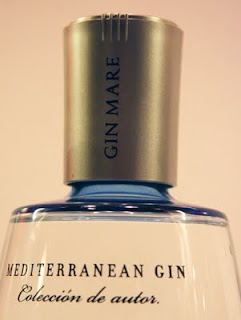
That Futurist bottle cap
As if terroir, tradition and technique weren’t enough, the manufacturers have hedged their bets even further by erecting the still in an 18th-century chapel that was dismantled brick by brick and reassembled in its current location in an old fishing village between the Costa Brava and the Costa Dorada, presumably to make sure that God is also on their side.

So many New Gins seem to play down the juniper aspect and add sweet, floral notes, apparently to woo punters who perhaps are ripe to like the idea of gin, but fundamentally don’t like the taste (especially women, at whom some brands are specifically aimed). Gin Mare is, when you unscrew the cap, clearly gin—the juniper hits you first. But then there is obviously something floral, smooth and sweet going on too. On the palate I get something like cinnamon, warm and rich, and then there is the olive, quite noticeably, plus the woody, aromatic thyme and rosemary elements. This is the fascinating thing about Gin Mare, the way it manages to present sweet, smooth, floral qualities yet avoids ending up cloying like many modern gins, and somehow successfully marrying this with a distinct saltiness from the olives and the dry, savoury, resinous elements of the herbs too.

In a G&T this character remains pronounced, with both a distinctive herbaceous quality and a silky smooth mouthfeel. At the Graphic tasting we had our wrists slapped over the idea of garnishing the drink with lemon or lime (despite the fact that citrus is an ingredient) on the ground that they would overpower the flavours: instead we should use rosemary, thyme, basil or mint. In a Martini one should use an olive.**

I tried the gin in a few other classic cocktails:

Martinez (2 parts Gin Mare, 1 part Carpano Antica Formula red vermouth, 1–2 tsp maraschino, dash of Angostura bitters) Cracking. The herbaceous flavours of the gin marry well with the vermouth and balance nicely with the fruity sweetness of the maraschino.

Negroni (equal parts Gin Mare, Carpano Antica Formula red vermouth, Campari)
With Antica Formula this makes a warm, chocolately Negroni, with the sweet fragrance of the gin and the prominent vanilla of the vermouth creating a smooth feather-pillow for your tongue; but then there is that bitterness at the end, from both the vermouth and the Campari. Not sure it’s the very best Negroni I’ve had—perhaps it wants the steely juniper note in more conventional gins.

Dirty Martini (4 parts Gin Mare to 1 part dry vermouth, plus about ½ tsp of olive brine) It seemed an obvious thing to try and, as you might imagine, it works very well—although you are really just adding more of the salty olive character that is already there. Nevertheless it does emphasise the effectiveness of the botanical combination in the gin.

Graphic bar manager Sarah Mitchell with Duncan Hayter
from Gin Mare at the event in March
Gimlet (2½ parts Gin Mare and ¾ part lime cordial) Balances in a surprising manner—it brings out the floral character in the gin, though the savoury, salty qualities are still in there too. The warm, spicy elements poke through clearly. In fact in an interesting way this cocktail spotlights the complex balancing act that Gin Mare attempts—and for my money by and large achieves—though I sense it might be a love-it-or-hate-it thing for most people.

Gibson (A dry Martini with one or two cocktail onions as garnish) Having quite a savoury tooth I do like this cocktail and I figured that a gin with so many savoury elements as Gin Mare would work well. But I’m not sure I was right: in context Gin Mare came up with some surprising sweet elements that seemed to jar with the sulphurous allium flavour of the onion (reminding me a bit of sweet-pickled herring). It makes you realise that the dominant herbaceous notes aren’t as savoury as they seem.

Red Snapper (2 parts Gin Mare, 4 parts tomato juice, ½ part lemon or lime juice, Tabasco, Worcestershire sauce, black pepper, celery salt) Likewise an obviously savoury cocktail (and one of the few classic cocktails that sits easily with the extraordinarily savoury Aviation gin). And it was pretty good, yet again it didn’t work as neatly as I would have assumed. In this savoury, almost meaty context, Gin Mare showed itself to be more floral and sweet than I had thought. And I am reminded just how powerfully flavoured it is: this is a muscular cocktail context, with the acids of the tomato and lemon and the chilli and pepper heat, yet the Gin Mare immediately pushed its flavour profile through.

Aviation (2 parts Gin Mare, ½ part maraschino, ½ part lemon juice, ¼ part crème de violette) As gin shorts go this is relatively fruity/floral, so I didn’t expect it to work but I was wrong. This sort of cocktail, perhaps like the Gimlet, showed that Gin Mare actually has a strong floral perfume, that in this case sits quite happily with the violet and cherry flavours.

I’ve now nearly finished my bottle of Gin Mare in my experimentations, which is in itself a sign. The strong thyme, rosemary, basil and olive elements are impossible to ignore, yet this would make the gin sound like food, and as it turns out it is not that savoury as a mixer. It works well in combinations with a floral/fruity character. Forcefully characterful, it may well divide and perplex drinkers, but I still find myself fascinated by it.

Gin Mare can be had for about £34 a bottle (or £42 if you buy it from Harvey Nicks).

* See m’colleague’s recent review of Adler gin from Munich: adler means “eagle”, but it is reminiscent of the Adlerhorst, Hitler’s “Eagle’s Nest” mountain hideaway. So if Adler is “Hitler’s gin” then perhaps Gin Mare can be “Mussolini’s gin”. I believe that Churchill was partial to Plymouth in his Martinis. So, what would be Roosevelt’s and Stalin’s gins, I wonder..?
** This whole business of garnishes sometimes seems a bit pointless to me. Granted that nothing you can do to the constituent liquids will create the same effect as squeezing the oil from a strip of lemon rind on to the surface of your Martini, but many prescribed garnishes leave me thinking, If you believe your gin needs that extra element of grapefruit/basil/raw beef or whatever, why not just add that flavour when you distil it and serve it without a garnish? Much of it is just gimmickry, methinks.